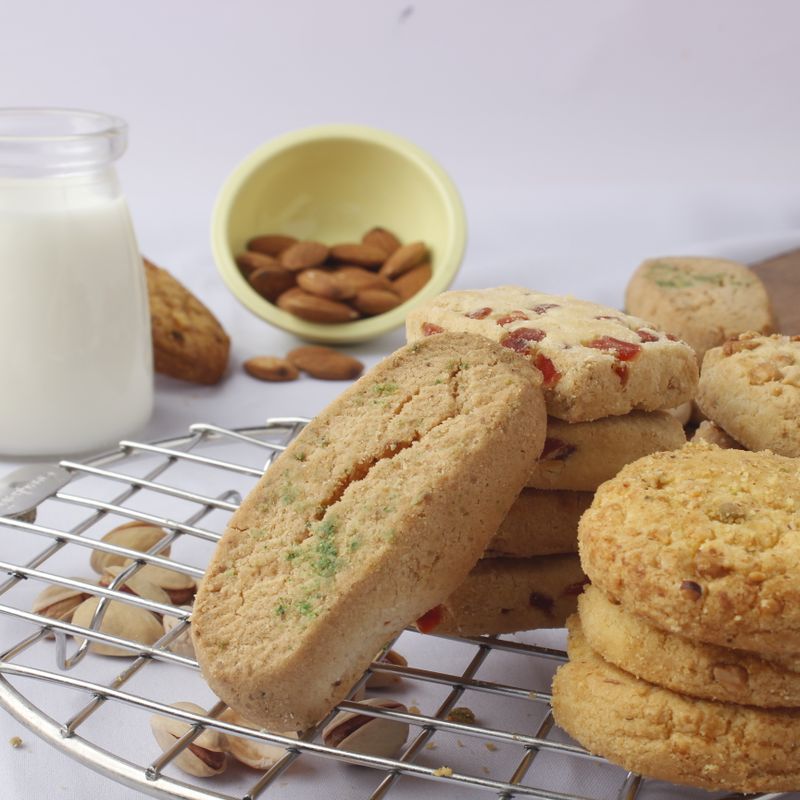
Simple Semolina Almond Cookies
These buttery, nutty semolina cookies are studded with toasted almonds and bound with creamy yogurt. Golden and tender with a delicate crumb, they're brushed with warm honey after baking for a gentle sweetness. A Middle Eastern classic that's easier to make than it looks—no electric mixer required.
Steps
Before you start
- Preheat your oven to 350°F (175°C)
- Toast the almonds first so they develop flavor
- Have all ingredients at room temperature for easier mixing
- Line two baking sheets with parchment paper
Toast the almonds
- Heat a small skillet over medium heat.
- Add the sliced almonds and stir frequently for 3–4 minutes until fragrant and light golden.
- Watch them closely—they brown quickly.
- Pour onto a plate to cool completely.
+ Show details− Hide details
Ready when: Almonds are light golden and fragrant
Tip: Don't walk away—almonds can burn in seconds once they start browning
Cream butter and sugar
- In a medium mixing bowl, combine the softened butter pieces and granulated sugar.
- Stir and beat with a wooden spoon for 2–3 minutes until the mixture looks pale, fluffy, and creamy.
- The butter should break down enough to incorporate the sugar without an electric mixer.
+ Show details− Hide details
Ready when: Mixture is pale, fluffy, and light in texture
Tip: Soft butter at room temperature makes this much easier by hand—don't use cold butter straight from the refrigerator
Add yogurt and vanilla
- Add the room-temperature yogurt and vanilla extract to the butter-sugar mixture.
- Stir gently but thoroughly until completely combined and smooth, about 1 minute.
- The mixture will look curdled at first, but keep stirring—it comes together.
+ Show details− Hide details
Ready when: Mixture is smooth and fully combined with no streaks of yogurt
Tip: Room-temperature yogurt is key—cold yogurt can cause the mixture to seize
Mix dry ingredients
- In a small bowl, whisk together the semolina, all-purpose flour, baking powder, and salt.
- If using orange zest, add it to the dry mixture now.
- Whisk for about 1 minute until evenly distributed.
+ Show details− Hide details
Ready when: Dry ingredients are evenly combined with no lumps
Tip: Whisking distributes the baking powder evenly so your cookies rise uniformly
Fold in dry ingredients
- Pour the dry ingredient mixture into the wet ingredients.
- Using a spatula or wooden spoon, fold gently but thoroughly until just combined.
- The dough will be thick but spreadable.
- Do not overmix—stop as soon as you don't see any white flour streaks, about 1 minute.
+ Show details− Hide details
Ready when: No white streaks of flour visible; dough is uniform
Tip: Overmixing develops gluten and makes cookies tough—fold gently just until combined
Fold in toasted almonds
- Gently fold the cooled toasted almonds into the dough with a spatula, being careful to fold them in evenly throughout, about 1 minute.
- The dough is now ready to portion.
+ Show details− Hide details
Ready when: Almonds are evenly distributed throughout the dough
Tip: Fold gently to avoid crushing the toasted almonds
Shape and place cookiesOven 350°F / 175°C
- Preheat your oven to 350°F (175°C) if not already preheated.
- Line two baking sheets with parchment paper.
- Using a spoon or small ice cream scoop (about 1 tablespoon), drop balls of dough onto the baking sheets, spacing them about 1 inch apart.
- You should get about 24 cookies.
- Gently flatten each ball slightly with the back of a spoon or your fingertips so they are about ½ inch thick.
+ Show details− Hide details
Ready when: Cookies are portioned and lightly flattened
Tip: Don't press too hard or the cookies will spread too much and lose their tender crumb
Bake the cookiesOven 350°F / 175°C
- Place the baking sheets in the preheated 350°F (175°C) oven.
- Bake for 16–18 minutes until the cookies are light golden around the edges and set in the center but still very pale on top.
- They will firm up significantly as they cool, so don't overbake.
+ Show details− Hide details
Ready when: Cookies are light golden at the edges; centers are set but still pale
Tip: Underbake slightly if you prefer softer, chewier cookies—they firm up as they cool
Cool on sheet
- Remove the baking sheets from the oven and let the cookies cool on the sheets for 5 minutes.
- They will continue to set during this time and be easy to move without breaking.
+ Show details− Hide details
Ready when: Cookies are firm enough to transfer without breaking
Tip: Don't move them too soon—they break easily when hot
Warm the honey glaze
- While the cookies are cooling, pour the honey into a small saucepan and warm over low heat for 1–2 minutes until it's thin and pourable but not hot.
- You can also microwave it for 15–20 seconds.
- Set aside to cool slightly so it's warm but comfortable to handle.
+ Show details− Hide details
Ready when: Honey is thin, pourable, and warm to the touch
Tip: Don't overheat the honey or it will be too thin—you want it just warm enough to flow
Brush cookies with honey
- Transfer the cooled cookies to a serving platter or wire rack.
- Using a pastry brush or clean kitchen brush, generously brush each cookie with the warm honey.
- Let the honey soak in for a minute, then brush again if desired for extra sweetness.
- The cookies will glisten and soften slightly as the honey absorbs.
+ Show details− Hide details
Ready when: Cookies are evenly brushed with honey and glistening
Tip: A double brush of honey gives more traditional Middle Eastern flavor and texture
Rest and serve
- Allow the honey-brushed cookies to rest at room temperature for 15–30 minutes before serving.
- This lets the honey fully absorb and the cookies reach their final texture—tender with a slight honey glaze.
+ Show details− Hide details
Ready when: Honey has soaked in; cookies have a tender, final texture
Tip: These are best eaten within a few hours of glazing while the honey is still soft
Good to know
Tips
- Room-temperature ingredients are essential—soft butter, warm yogurt, and cool almonds fold together smoothly without lumps or separated texture.
- Toast your own almonds right before making the dough to maximize flavor and freshness; store-bought toasted almonds lose intensity over time.
- This dough is thick by design and doesn't need refrigeration—the semolina and yogurt keep it stable and easy to portion right away.
- Semolina gives these cookies a distinctive tender, slightly grainy crumb different from all-flour versions; don't skip it or substitute completely.
Make ahead
Unbaked dough can be covered and refrigerated for up to 24 hours. Bring to room temperature for 15 minutes before portioning and baking. Baked cookies (before glazing) can be frozen for up to 2 months; thaw at room temperature, then glaze with warm honey before serving.
Storage & reheating
Store glazed cookies in an airtight container at room temperature for up to 5 days. The honey keeps them soft and moist. After 24 hours they will become slightly chewier. Do not refrigerate. To refresh, warm gently in a 300°F (150°C) oven for 5 minutes.
Substitutions
- plain whole-milk yogurt → Greek yogurt thinned with 1–2 tablespoons milk, or sour cream mixed with 1 tablespoon milk. Thinner yogurt prevents the dough from being too thick. Adjust if necessary.
- sliced or slivered almonds, toasted → Toasted sliced pistachios, walnuts, or hazelnuts. Use the same weight. Toast nuts the same way. Pistachios add a beautiful color and subtle flavor.
- honey → Warm agave nectar, maple syrup, or simple syrup (equal parts sugar and water boiled, cooled slightly). These have different flavors; honey is most traditional but any liquid sweetener works.
- orange zest → Rose water (1 teaspoon), ground cardamom (¼ teaspoon), or 1 teaspoon finely chopped fresh mint stirred into the honey glaze. Optional but adds authentic Middle Eastern character. Add to the wet dough or the warm honey.
More cookies
See all →


Find more like this
- Meal
- Dessert
- Cuisine
- Middle Eastern
- Diet
- VegetarianHalal
- Method
- Oven
- Quick & Easy
- Easy