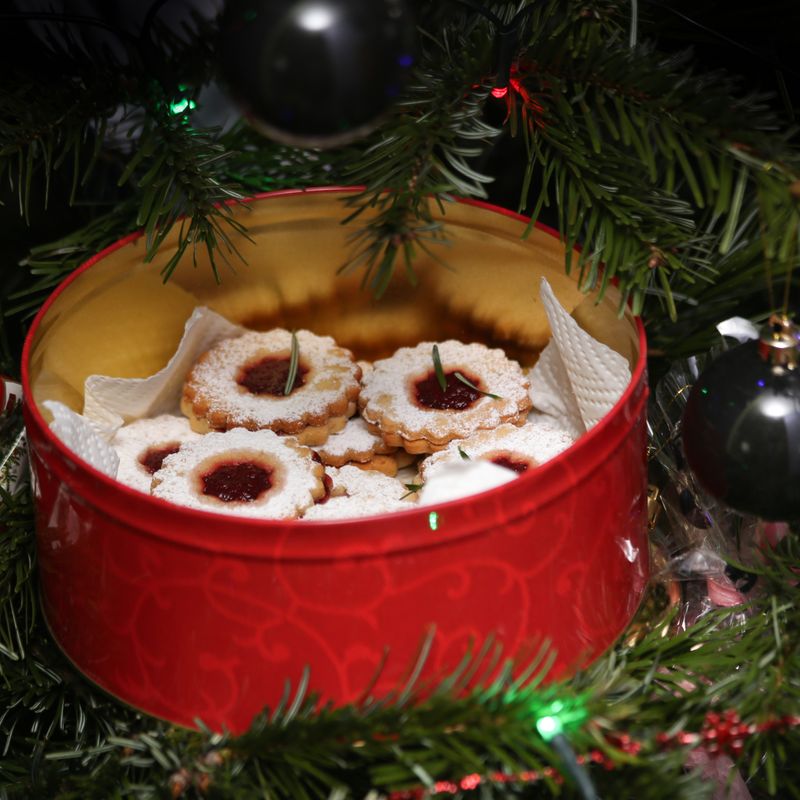
Linzer Cookies with Raspberry Filling
Classic Austrian linzer cookies feature a crisp, tender almond-butter dough sandwich with tart-sweet raspberry jam. These elegant cookies have a distinctive appearance with their decorative cutout windows that reveal the jewel-toned filling. Perfect for gift-giving or special occasions, they're easier to make than they look.
- Prep
- 30 min
- Cook
- 12 min
- Wait
- 1 hr 45 min
- Total
- 2 hr 27 min
- Makes
- 24 sandwich cookies (12 pairs)
Steps
Before you start
- Soften butter to cool room temperature (about 65°F/18°C) for 1 hour before starting
- Preheat oven to 350°F (175°C) 15 minutes before baking
- Have a 1½-inch (4 cm) and ¾-inch (2 cm) round cutter ready, or use small cookie cutters of similar sizes
Cream butter and sugar
- In a large mixing bowl, beat the softened butter and powdered sugar together with a wooden spoon or whisk for 2–3 minutes, until pale and fluffy.
- The mixture should look light and creamy.
+ Show details− Hide details
Ready when: Pale and fluffy in texture
Tip: Don't use a mixer—hand-mixing with a wooden spoon helps prevent overdevelopment of gluten and keeps the dough tender.
Mix in egg yolk
- Add the room-temperature egg yolk and vanilla extract to the butter mixture.
- Stir until well combined, scraping down the sides of the bowl to ensure even mixing.
- The dough should look smooth and slightly glossy.
+ Show details− Hide details
Ready when: Smooth and fully combined
Tip: A room-temperature yolk emulsifies more easily and creates a more cohesive dough.
Combine dry ingredients
- In a medium bowl, whisk together the all-purpose flour, almond flour, ground cinnamon, ground cloves, freshly grated nutmeg, and fine sea salt.
- Make sure the spices are evenly distributed throughout the flour mixture with no clumps.
+ Show details− Hide details
Ready when: Spices are evenly distributed with no clumps
Tip: Whisking the dry ingredients prevents streaks of spice in the finished cookies.
Fold in dry mixture
- Pour the dry ingredient mixture into the butter mixture.
- Using a rubber spatula, fold gently until just combined—do not overmix.
- Stop folding as soon as you no longer see streaks of flour.
- The dough will be soft and slightly crumbly at this stage.
+ Show details− Hide details
Ready when: No visible flour streaks remain
Tip: Overmixing develops gluten and makes the cookies tough instead of tender. Fold until just combined.
Chill dough
- Divide the dough into two disks, wrap each in plastic wrap, and refrigerate for at least 45 minutes, until firm but still pliable.
- The dough should be cold enough to roll without sticking but not so hard that it cracks.
+ Show details− Hide details
Ready when: Dough is firm but still pliable when pressed
Tip: If dough becomes too hard, let it soften at room temperature for 5 minutes before rolling.
Preheat and line pansOven 350°F / 175°C
- Position your oven racks in the upper and lower thirds.
- Preheat the oven to 350°F (175°C).
- Line two large baking sheets with parchment paper.
+ Show details− Hide details
Tip: Starting with a preheated oven ensures even baking and prevents the cookies from spreading too much.
Roll and cut cookies
- On a lightly floured surface, roll one disk of chilled dough to ⅛-inch (3 mm) thickness between two sheets of parchment paper.
- Using a 1½-inch (4 cm) round cutter, cut out cookies and place them 1 inch (2.5 cm) apart on a prepared baking sheet.
- Using a ¾-inch (2 cm) cutter, cut out a small circle from the center of half of the cookies (these will be the tops).
- Place the cutout pieces on the baking sheet—they'll be snacked on or discarded.
- Repeat with the second disk.
- You should have approximately 24 whole cookies (12 pairs: 12 bottoms with no cutout, 12 tops with a cutout window).
+ Show details− Hide details
Ready when: Cookies cut cleanly with no cracks or tears
Tip: Rolling between parchment prevents sticking and makes cleanup easier. Keep trimmings and scraps chilled.
Bake cookiesOven 350°F / 175°C
- Bake both sheets at 350°F (175°C) for 11–13 minutes, rotating the pans from top to bottom halfway through baking.
- The cookies should be pale golden on the edges with no browning on the bottoms.
- They will feel slightly firm to the touch but give just a little when pressed.
- Do not overbake—they firm up significantly as they cool.
+ Show details− Hide details
Ready when: Pale golden edges, cookies feel just set when lightly pressed, no browning on bottoms
Tip: Baking time varies by oven—start checking at 11 minutes. Underbaked cookies are better than overbaked ones; they'll harden as they cool.
Cool on racks
- Let the baked cookies cool on the baking sheets for 3 minutes, then transfer them to cooling racks using a thin spatula.
- Let them cool completely at room temperature for at least 30 minutes before assembling.
- The cookies must be completely cool or the jam will soften them.
+ Show details− Hide details
Ready when: Cookies are completely cool to the touch and firm to the touch
Tip: Cooling on a rack (not the baking sheet) allows air to circulate underneath and prevents them from becoming soft.
Warm jam slightly
- In a small saucepan, warm the raspberry jam over low heat for 1–2 minutes, stirring occasionally, until it's loose enough to spread but not hot.
- You want it just warm enough to be spreadable, not steaming.
- Remove from heat and let it cool slightly.
+ Show details− Hide details
Ready when: Jam is loose and spreadable, not hot or steaming
Tip: Warming the jam makes it much easier to spread without tearing the delicate cookies, but letting it cool slightly prevents it from seeping through.
Assemble sandwich cookies
- Working with completely cooled cookies, place the solid cookies (without cutouts) flat-side up on a work surface.
- Spread about 1 teaspoon (5 ml) of warm jam onto the flat side of each solid cookie, spreading it gently to the edges.
- Top each with a cookie that has a center cutout window, pressing gently so the jam shows through the window.
- The jam should peek through just slightly but not overflow.
+ Show details− Hide details
Ready when: All cookies are sandwiched with jam peeking through cutout windows
Tip: Use a small offset spatula or butter knife to spread jam evenly. Less jam is better than more—too much will squeeze out or make cookies soggy.
Dust with powdered sugar
- Once the jam has set (about 15 minutes), dust the assembled cookies generously with powdered sugar using a fine mesh sieve.
- The sugar will cling to the jam and the cookie surface, creating the classic snowy appearance.
+ Show details− Hide details
Ready when: All visible surfaces are evenly dusted with powdered sugar
Tip: Dust the cookies just before serving so the powdered sugar stays white and doesn't absorb moisture from the jam.
Good to know
Tips
- The key to tender linzer cookies is cold butter and minimal mixing. Don't use a stand mixer—hand-folding prevents overdeveloping the gluten.
- The decorative cutout window is not just for looks; it allows you to see the gem-like jam filling and prevents the cookie from tasting too dry by adding moisture.
- If your jam is very thick, thin it with 1 teaspoon of water at a time while warming, stirring until it reaches a spreadable consistency.
- These cookies are best eaten within 2–3 days. The flavors meld beautifully on day two, but they do soften over time as the jam releases moisture.
Make ahead
You can prepare the dough up to 3 days ahead: wrap the dough disks tightly in plastic wrap and refrigerate. You can also bake the unfilled cookies up to 5 days ahead, storing them in an airtight container at room temperature between layers of parchment paper. Assemble and dust with powdered sugar no more than 4 hours before serving for best appearance.
Storage & reheating
At room temperature in an airtight container between layers of parchment paper for up to 4 days. The cookies soften slightly over time as jam moisture migrates, which some prefer. Do not refrigerate (moisture makes them soggy). Unfilled baked cookies freeze well in an airtight container for up to 1 month; thaw at room temperature before filling. Filled cookies are not recommended for freezing as the texture suffers.
Substitutions
- seedless raspberry jam → Apricot preserves or seedless strawberry jam. Any seedless jam works; use your favorite flavor. Apricot is traditional in some Austrian versions.
- almond flour (finely ground) → Finely ground hazelnuts or a 50/50 mix of almond and hazelnut. Maintains the nut-forward flavor and tender texture. Adjust the amount to match the weight.
- all-purpose flour → 80% all-purpose flour + 20% whole wheat pastry flour by weight. Adds a subtle nuttiness but may make cookies slightly less tender; adjust by reducing spices slightly if desired.
- ground cinnamon → Omit and use ½ tsp finely grated lemon zest mixed with the dry ingredients. Creates a citrus-forward cookie that pairs beautifully with raspberry. Skip the other spices if you prefer.
More cookies
See all →


Find more like this
- Meal
- Dessert
- Cuisine
- Middle Eastern
- Diet
- VegetarianHalal
- Method
- Oven