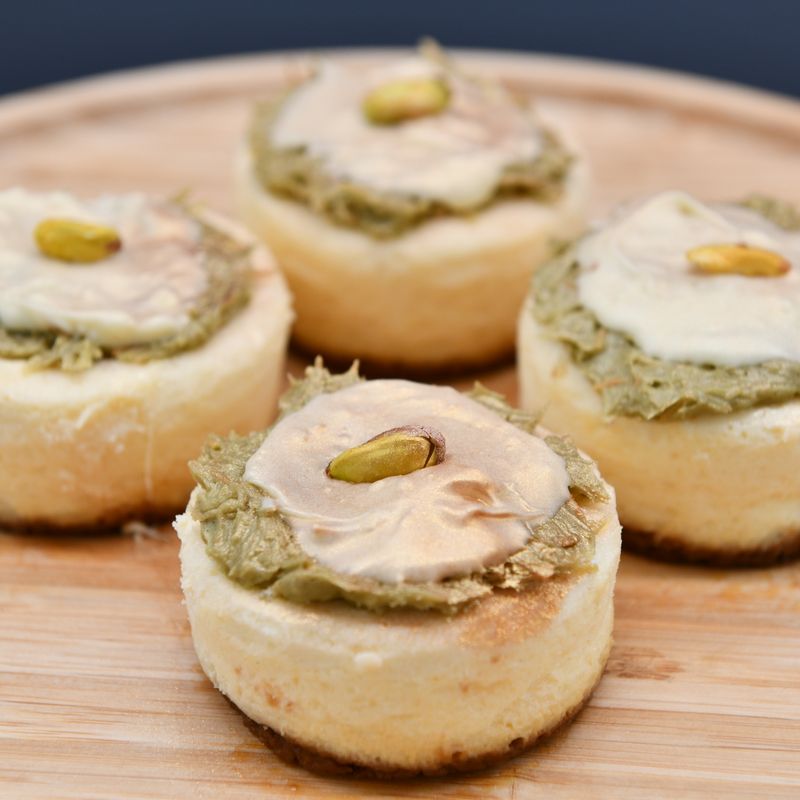
New York Style Cheesecake
A tall, dense, creamy cheesecake with a buttery graham cracker crust, a subtle tang from sour cream and lemon, and a smooth, crack-free top thanks to a gentle water bath and a slow cool-down.
- Prep
- 55 min
- Cook
- 1 hr 25 min
- Wait
- 9 hr 30 min
- Total
- 11 hr 50 min
- Makes
- 1 cheesecake, 9-inch (23 cm), 14 slices
Steps
Before you start
- Set out the cream cheese, eggs, egg yolk, sour cream and heavy cream 90 minutes ahead. Cold ingredients make a lumpy batter and a cracked cake.
- Plan for a long timeline: about 2.5 hours of work and baking, then at least 6 hours (ideally overnight) of chilling.
- Use full-fat block cream cheese, not whipped or spreadable tub cream cheese, and not low-fat.
- Have a kettle or pot of water ready to boil when the batter is nearly done, since the water bath needs about 6 cups (1.5 liters) of boiling water.
- Position an oven rack in the center and remove any racks above it so the tall cake has room.
Bring ingredients to room temperature
- Cut the cream cheese into 1-inch (2.5 cm) chunks and spread them on a plate.
- Leave the cream cheese, eggs, egg yolk, sour cream and heavy cream on the counter for 90 minutes.
- The cream cheese should be soft enough to dent easily with a finger but still hold its shape (about 68 to 70°F / 20 to 21°C).
+ Show details− Hide details
Ready when: Cream cheese yields to gentle finger pressure but is not greasy or melting
Tip: Do not microwave the cream cheese to hurry it. Warm spots turn the batter greasy.
Prepare the panOven 325°F / 165°C
- Position a rack in the center of the oven and preheat to 325°F (160°C).
- Grease the bottom and sides of a 9-inch (23 cm) springform pan with the 1 tablespoon softened butter.
- Lock the base in place.
- Tear off two 18-inch (45 cm) sheets of heavy-duty foil and lay them crosswise in a plus shape.
- Set the pan in the center and fold the foil up and tightly around the sides, reaching at least to the rim, so water cannot seep in.
- Set the pan in a roasting pan.
+ Show details− Hide details
Ready when: Foil is seamless up the sides with no gaps or tears
Tip: Use wide foil if you can find it. Seams are where leaks happen, so do not use thin foil.
Mix the crust
- In a medium bowl, stir the graham crumbs, 50 g (¼ cup) sugar and ¼ teaspoon salt together.
- Pour in the melted butter and stir with a fork until the mixture looks like wet sand and clumps when squeezed in your fist.
+ Show details− Hide details
Ready when: Crumbs hold together when pinched, with no dry patches
Press and bake crustOven 325°F / 165°C
- Tip the crumbs into the foil-wrapped pan.
- Press them firmly across the bottom and about 1 inch (2.5 cm) up the sides using the flat bottom of a measuring cup.
- Bake at 325°F (160°C) for 10 minutes until the crust smells toasty and looks slightly darker at the edges.
- Leave the oven on.
+ Show details− Hide details
Ready when: Crust is fragrant and just beginning to darken at the edges
Tip: Press hard, especially into the corner where the base meets the wall, so the crust holds when sliced.
Beat cream cheese and sugar
- Put the cream cheese in the bowl of a stand mixer fitted with the paddle.
- Beat on low speed for 2 minutes until smooth and creamy, scraping the bowl and paddle twice.
- Add the 250 g (1¼ cups) sugar, the flour and ½ teaspoon salt.
- Beat on low for 2 more minutes, scraping down well, until no lumps or streaks remain.
- Put the kettle on now so the water is boiling when you need it.
+ Show details− Hide details
Ready when: Batter is completely smooth and glossy with no cream cheese lumps
Tip: Keep the mixer on low. High speed whips in air, which makes the cake puff, then crack and sink.
Add the creamy ingredients
- With the mixer on low, add the sour cream, heavy cream, vanilla and lemon zest.
- Mix for about 1 minute until just combined.
- Scrape the bottom and sides of the bowl thoroughly with a spatula, then mix for 10 seconds more.
+ Show details− Hide details
Ready when: Mixture is uniform and pourable like thick pancake batter
Tip: Unmixed cream cheese hides at the bottom of the bowl, so scrape all the way down.
Mix in the eggs
- Add the 4 whole eggs and the yolk one at a time, mixing on low for about 15 seconds after each, just until the yellow disappears.
- Stop mixing as soon as the last egg is blended.
- Finish by folding the batter a few times with a spatula, scraping the bottom of the bowl.
+ Show details− Hide details
Ready when: Batter is silky, with no streaks of egg and no visible bubbles on the surface
Tip: Overmixing after the eggs go in is the leading cause of cracks. If you see large bubbles, rap the filled pan on the counter a few times.
Fill pan and add water bathOven 325°F / 165°C
- Pour the batter over the warm crust and smooth the top.
- Rap the pan firmly on the counter 3 or 4 times to release air bubbles.
- Slide the roasting pan onto the oven rack, then carefully pour boiling water into the roasting pan until it comes about halfway up the side of the springform pan (about 6 cups / 1.5 liters).
+ Show details− Hide details
Ready when: Water is about 1½ inches (4 cm) deep around the pan with no water inside the foil
Tip: Pour the water after the pan is on the oven rack. Carrying a full pan of hot water to the oven risks spills and burns.
Bake the cheesecakeOven 325°F / 165°C
- Bake at 325°F (160°C) for 70 to 80 minutes.
- The cake is ready when the top is pale golden at the edges, the outer 2 inches (5 cm) look set and matte, and the center 3 inches (7.5 cm) wobbles like gelatin when you nudge the pan.
- An instant-read thermometer inserted in the center should read 150°F (65°C).
- Do not open the oven in the first 60 minutes.
+ Show details− Hide details
Ready when: Edges set, center jiggles slightly, center reads 150°F (65°C)
Tip: If the center still looks liquid or sloshes, bake 5 more minutes at a time. Overbaking dries it out and cracks the top.
Rest in the turned-off oven
- Turn the oven off.
- Prop the door open about 1 inch (2.5 cm) with a wooden spoon handle and leave the cheesecake in the water bath for 60 minutes.
- The center will finish setting from residual heat, reaching about 160°F (71°C).
+ Show details− Hide details
Ready when: Center barely jiggles and the top has stopped moving when the pan is nudged
Tip: Moving a hot cheesecake to cool air quickly makes the top shrink and crack.
Cool and loosen
- Lift the roasting pan out carefully (the water is still hot), then use oven mitts to transfer the springform pan to a wire rack and peel off the foil.
- Run a thin knife, wiped clean and dipped in hot water, around the inside edge of the pan to loosen the cake.
- Leave the cake in the pan, undisturbed, on the rack for 60 minutes until completely at room temperature.
+ Show details− Hide details
Ready when: Pan feels neutral to the touch with no warmth on the base
Tip: Loosening the edge lets the cake shrink away from the pan evenly as it cools, rather than tearing the top.
Chill until firm
- Cover the pan loosely with plastic wrap, without it touching the surface, and refrigerate at least 6 hours, ideally overnight (12 hours), until the center is fully cold and firm.
+ Show details− Hide details
Ready when: Center feels firm, with no jiggle when the pan is nudged
Tip: Chilling overnight gives the creamiest texture and cleanest slices.
Unmold and slice
- Release the springform latch and lift off the ring.
- Dip a long sharp knife in hot water and wipe it dry.
- Slice, wiping and re-dipping the knife between each cut, to make 14 slices.
+ Show details− Hide details
Ready when: Slices have smooth, clean sides with no smearing
Tip: Leave the cake on the pan base for serving. Sliding it off risks breaking the crust.
Good to know
Tips
- Do not overmix once the eggs go in. Extra air makes the cake puff in the oven and then crack as it cools.
- Check the water level halfway through baking; if the roasting pan looks low, add a little more boiling water.
- A small crack is not a failure. Cover it with fruit compote, sour cream topping or whipped cream.
- For the sharpest slices, chill the cake fully, then dip the knife in hot water and wipe it dry before each cut.
Make ahead
"Cheesecake is best made 1 day ahead. After chilling overnight, the flavor and texture improve. The baked crust and the whole cake can be prepared up to 2 days before serving."
Storage & reheating
"Room temperature: no more than 2 hours. Refrigerator: covered, up to 5 days. Freezer: freeze whole or in slices, wrapped tightly in plastic and foil, up to 2 months. Thaw overnight in the refrigerator and serve cold or at cool room temperature; do not reheat."
Substitutions
- graham cracker crumbs → digestive biscuit or vanilla wafer crumbs, same weight (200 g). Digestives give a slightly less sweet crust; wafers a more buttery one.
- full-fat sour cream → full-fat plain Greek yogurt, same amount (180 g). Gives a similar tang; avoid low-fat versions, which can turn the filling watery.
- all-purpose flour → cornstarch, 1 tablespoon (8 g). Makes the cake gluten-free if the crust also uses gluten-free cookie crumbs.
- lemon zest → ½ teaspoon more vanilla extract (2.5 ml). Skips the citrus note for a plainer, classic flavor.
More cakes
See all →
Find more like this
- Meal
- Dessert
- Cuisine
- American
- Main ingredient
- Cream Cheese
- Diet
- VegetarianHalal
- Method
- Oven
- Quick & Easy
- Make Ahead