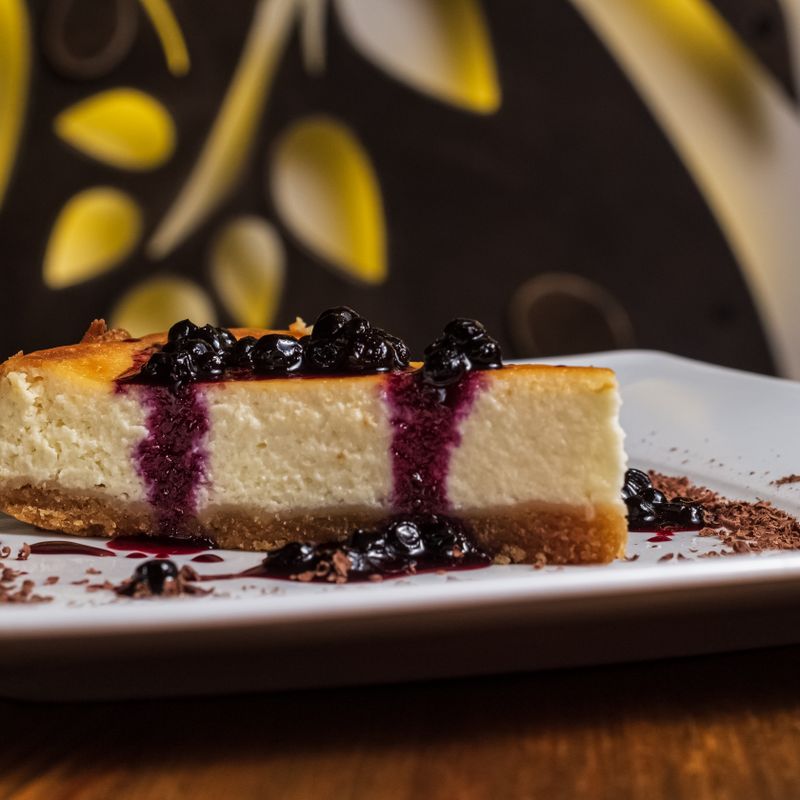
Classic New York Cheesecake
A tall, dense, creamy cheesecake with a buttery graham cracker crust and a subtle lemon tang. A gentle water bath and slow cooling give a smooth, crack-free top and a velvety texture.
- Prep
- 40 min
- Cook
- 1 hr 20 min
- Wait
- 8 hr
- Total
- 10 hr
- Makes
- 1 cheesecake, 9-inch (23 cm), 12 slices
Steps
Before you start
- Set the cream cheese, sour cream, heavy cream and eggs out on the counter 2 hours before you start. Cold ingredients make a lumpy batter that bakes unevenly.
- Plan ahead. The cheesecake needs about 2 hours of baking and cooling, then at least 6 hours in the fridge. Making it the day before serving works best.
- Use full-fat block cream cheese (the foil-wrapped bricks). Spreadable tub cream cheese and low-fat versions will not set properly.
- Boil about 2 liters (2 quarts) of water in a kettle shortly before you fill the pan. You need it for the water bath.
Prep pan and ovenOven 325°F / 165°C
- Position a rack in the center of the oven and heat it to 325°F (165°C).
- Tear off two 18-inch (45 cm) sheets of heavy-duty foil.
- Set the springform pan in the middle of one sheet, then fold the foil up and around the outside of the pan.
- Repeat with the second sheet so the pan is wrapped in two seamless layers up to the rim.
- This keeps water from leaking in during the water bath.
- Put the kettle on to boil.
+ Show details− Hide details
Ready when: The foil comes up the sides of the pan with no gaps or tears at the bottom.
Tip: Do not use a pan with a loose or warped base. Check that the foil has no holes before moving on.
Make the crust
- In a medium bowl, stir the graham cracker crumbs, crust sugar and crust salt together.
- Pour in the melted butter and mix with a fork until the crumbs look like damp sand.
- Tip them into the springform pan.
- Press firmly and evenly across the bottom and about 1 inch (2.5 cm) up the sides, using the flat bottom of a measuring cup.
+ Show details− Hide details
Ready when: A pinch of crumbs holds together when squeezed, and the pressed crust is even and compact.
Bake the crustOven 325°F / 165°C
- Bake the crust at 325°F (165°C) for 10 minutes.
- Set it on a wire rack while you make the filling.
- Leave the oven on.
+ Show details− Hide details
Ready when: The crust smells toasty and looks slightly darker and dry at the edges.
Beat cream cheese base
- In a stand mixer with the paddle attachment, or in a large bowl with a hand mixer, beat the cream cheese on medium-low speed for 2 minutes until smooth and creamy.
- Scrape down the bowl and paddle.
- Add the sugar, flour and filling salt.
- Beat on medium-low for another 2 minutes, stopping to scrape the bowl and paddle once or twice.
+ Show details− Hide details
Ready when: The mixture is smooth, glossy and has no visible lumps of cream cheese.
Tip: Keep the speed at medium-low. Whipping in extra air makes the cheesecake puff up and then crack as it cools.
Mix in the dairy
- With the mixer on low, add the sour cream, heavy cream, vanilla, lemon zest and lemon juice.
- Mix for about 1 minute, just until blended.
- Scrape the bottom and sides of the bowl well, then mix on low for 10 more seconds.
+ Show details− Hide details
Ready when: The batter is uniform in color with no streaks of sour cream.
Add the eggs
- Add the whole eggs one at a time on low speed, mixing each for about 15 seconds, just until it disappears into the batter.
- Add the egg yolk and mix 15 seconds.
- Stop the mixer and scrape the bowl one last time.
- Fold with a spatula a few times to catch any pockets of unmixed cream cheese.
+ Show details− Hide details
Ready when: The batter is smooth, thick and pourable, like a very thick pancake batter.
Tip: Do not overmix after adding the eggs. Too much mixing is the most common cause of a cracked top.
Fill pan, add waterOven 325°F / 165°C
- Pour the batter onto the cooled crust and smooth the top with the spatula.
- Tap the pan firmly on the counter 3 or 4 times to bring air bubbles to the surface, and pop any that remain with a toothpick.
- Place the pan in the roasting pan and set it on the oven rack.
- Carefully pour boiling water into the roasting pan until it reaches halfway up the sides of the springform pan, about 1 inch (2.5 cm) deep.
+ Show details− Hide details
Ready when: The surface is flat and level, and the water comes about halfway up the pan.
Tip: Pull the oven rack out slightly and add the water there, so you don't have to carry a full pan of hot water.
Bake in water bathOven 325°F / 165°C
- Bake at 325°F (165°C) for 65 to 75 minutes.
- Do not open the oven door during the first 55 minutes.
- The cheesecake is done when the edges are set and the top looks matte, and the center 2 to 3 inches (5 to 7 cm) still wobbles like set gelatin when you nudge the pan.
- An instant-read thermometer in the center should read about 150°F (65°C).
+ Show details− Hide details
Ready when: Edges are set and matte, the center jiggles slightly, and the center reads about 150°F (65°C).
Tip: The center will finish setting as it cools. If you bake until the whole top is firm, the texture will be dry and may crack.
Rest in the oven
- Turn the oven off.
- Prop the door open about 1 inch (2.5 cm) with a wooden spoon handle.
- Leave the cheesecake in its water bath in the oven for 1 hour.
+ Show details− Hide details
Ready when: The cheesecake is no longer jiggling much and the top is still smooth.
Tip: Moving a hot cheesecake straight to cool air makes the top contract fast and crack.
Cool on the counter
- Lift the roasting pan out of the oven with oven mitts and take the springform pan out of the water.
- Remove the foil.
- Run a thin knife around the inside edge of the pan to loosen the cheesecake, so the top doesn't pull and crack as it shrinks.
- Set the pan on a wire rack to cool for 1 hour, until it feels barely warm at the sides.
+ Show details− Hide details
Ready when: The pan sides are barely warm to the touch and the top has no wet shine.
Tip: Leave the springform ring on the pan while chilling. The cake is fragile until it is fully cold.
Chill until firm
- Cover the cooled cheesecake loosely with plastic wrap, tenting it so the wrap does not touch the surface.
- Refrigerate for at least 6 hours, or overnight for the best texture and the cleanest slices.
+ Show details− Hide details
Ready when: The cheesecake is completely cold and firm, and the center does not wobble when you tilt the pan.
Unmold and slice
- Run a thin knife around the edge of the pan once more, then release the springform clasp and lift off the ring.
- Dip a long sharp knife in hot water and wipe it dry.
- Cut the cheesecake into 12 slices, wiping and rewarming the knife between cuts.
- Serve chilled, plain or with fresh berries.
+ Show details− Hide details
Ready when: Slices come away with clean edges and a smooth, creamy cut face.
Tip: Leave the cake on the pan base for serving. Sliding it off the base risks breaking the crust.
Good to know
Tips
- Room-temperature ingredients are essential. If the cream cheese is still cool in the middle, cut it into chunks and let it sit for 30 more minutes rather than microwaving it.
- Scrape the bowl often. Unmixed cream cheese at the bottom of the bowl bakes into small lumps in the finished cake.
- If the top does crack, cover it with whipped cream, fresh berries or a fruit sauce. The texture will still be excellent.
- For clean slices, use a long thin knife dipped in hot water and wiped dry between every cut.
Make ahead
"Bake the cheesecake up to 2 days before serving. Chill it, covered, in the springform pan until ready to unmold and slice. The flavor and texture are best after 12 to 24 hours in the fridge."
Storage & reheating
"Refrigerator: cover and keep for up to 5 days. Freezer: freeze whole or in slices. Chill fully, freeze uncovered on a tray until solid (about 2 hours), then wrap tightly in plastic wrap and foil for up to 2 months. To serve from frozen, thaw overnight in the refrigerator. Do not reheat. Serve cold or let sit at room temperature for 15 minutes. Do not leave it out for more than 2 hours."
Substitutions
- graham cracker crumbs → Digestive biscuit crumbs or crushed vanilla wafers (same weight). Digestives give a slightly less sweet crust. Vanilla wafers give a more buttery one.
- full-fat sour cream → Full-fat plain Greek yogurt (same amount). The cheesecake will be a little tangier and slightly less rich.
- heavy cream → Whole milk (same amount). The texture will be slightly less creamy but still set well.
- lemon zest → Orange zest (same amount). Gives a softer, sweeter citrus note. Keep the lemon juice for tang.
More cakes
See all →



Find more like this
- Meal
- Dessert
- Cuisine
- American
- Main ingredient
- Cream Cheese
- Diet
- VegetarianHalal
- Method
- Oven
- Quick & Easy
- Make Ahead