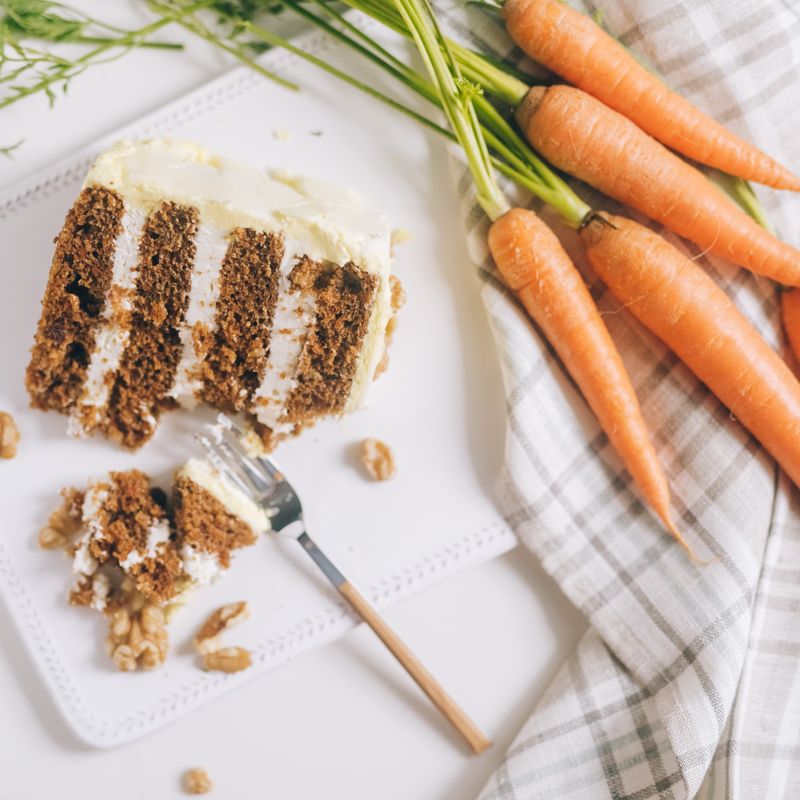
Classic Carrot Cake with Cream Cheese Frosting
A tall, two-layer carrot cake with a moist, tender crumb, warm spices, brown sugar depth and toasted walnuts, finished with tangy, fluffy cream cheese frosting.
- Prep
- 54 min
- Cook
- 41 min
- Wait
- 2 hr
- Total
- 3 hr 35 min
- Makes
- 1 two-layer 9-inch (23 cm) cake (12 slices)
Steps
Before you start
- Set out the eggs, buttermilk, butter and cream cheese 1 hour ahead so they come to room temperature (about 68°F/20°C). Cold cream cheese makes lumpy frosting.
- Use block-style cream cheese, not the spreadable tub kind, which makes loose, runny frosting.
- Grate the carrots on the small holes of a box grater (or a food processor's fine shredding disk). Large shreds stay firm and make the cake uneven.
- Plan on about 3½ hours from start to finish. Most of that is cooling and chilling, and the layers must be fully cool before you frost them.
Toast the walnutsOven 350°F / 175°C
- Position a rack in the center of the oven and heat to 350°F (175°C).
- Spread all the walnuts (the 1 cup for the cake plus the ¼ cup for garnish, if using) on a rimmed baking sheet in a single layer.
- Toast for 8 minutes, stirring once halfway.
- Slide them onto a plate to stop the cooking, let cool, then chop.
- Leave the oven on.
+ Show details− Hide details
Ready when: Walnuts smell nutty and are a shade darker, with no dark brown spots.
Tip: Walnuts burn quickly and turn bitter. Pull them out as soon as they smell toasty.
Prepare the pans
- Grease two 9×2-inch (23×5 cm) round pans with the softened butter or baking spray.
- Trace a pan onto parchment, cut out two circles, and press one into the bottom of each pan.
- Grease the parchment too.
+ Show details− Hide details
Ready when: Pan bottoms and sides are evenly coated and the parchment lies flat.
Tip: Use pans at least 2 inches deep. Shallower pans can overflow.
Grate the carrots
- Peel the carrots and grate them on the small holes of a box grater until you have 4 lightly packed cups (400 g).
- Do not squeeze out the moisture.
- It keeps the cake tender.
+ Show details− Hide details
Ready when: Carrot shreds are fine and short, about 400 g on the scale.
Tip: Weigh the carrots. Too many make the cake gummy, and too few make it dry.
Whisk the dry ingredients
- In a large bowl, whisk together the flour, baking soda, baking powder, salt, cinnamon, ginger and nutmeg for about 30 seconds, until the spices are evenly distributed with no streaks.
+ Show details− Hide details
Ready when: Flour mixture is a uniform tan color.
Mix the wet ingredients
- In a second large bowl, whisk the brown sugar, granulated sugar and oil for 1 minute.
- Whisk in the eggs one at a time, then the buttermilk and vanilla.
- Whisk for about 1 minute, until the mixture looks glossy and slightly thickened, with no streaks of egg.
+ Show details− Hide details
Ready when: Mixture is smooth, glossy and uniform, with no visible egg or oil streaks.
Tip: Break up any brown sugar lumps with your fingers first so they don't end up in the cake.
Fold the batter together
- Add the dry ingredients to the wet ingredients in two additions.
- With a rubber spatula, fold gently after each until only a few flour streaks remain.
- Add the carrots and the 1 cup of chopped walnuts.
- Fold 10 to 12 strokes, until the carrots and nuts are evenly distributed and no dry flour remains.
- Divide the batter evenly between the pans (about 790 g each if weighed) and smooth the tops.
+ Show details− Hide details
Ready when: Batter is thick but pourable, with no dry flour pockets.
Tip: Stop mixing once the flour disappears. Overmixing makes the cake tough.
Bake the layersOven 350°F / 175°C
- Bake in the 350°F (175°C) oven for 30 to 35 minutes, rotating the pans front to back at 20 minutes.
- The cakes are done when the tops are deep golden brown and spring back when lightly pressed, and a toothpick in the center comes out clean or with a few moist crumbs.
+ Show details− Hide details
Ready when: Tops spring back, edges pull slightly from the pan, and a toothpick comes out clean or with a few moist crumbs.
Tip: Do not open the oven in the first 20 minutes, or the layers may sink in the middle.
Cool the layers
- Cool the pans on a wire rack for 15 minutes.
- Run a thin knife around the edges, invert each cake onto the rack, peel off the parchment, and turn right side up.
- Cool completely, about 75 more minutes, until the cakes feel neutral or cool to the touch on the bottom.
+ Show details− Hide details
Ready when: Layers are completely cool to the touch, including the centers.
Tip: Frosting a warm cake makes it slide and melt. If you're short on time, chill the layers on a rack in the fridge for 20 minutes.
Beat the frosting
- With an electric mixer on medium speed, beat the butter for 1 minute, until creamy.
- Add the cream cheese and beat for 1 to 2 minutes, scraping the bowl, until completely smooth with no lumps.
- Reduce the speed to low and add the powdered sugar a little at a time, then the vanilla and salt.
- Increase to medium and beat for 30 to 60 seconds, just until fluffy and spreadable.
+ Show details− Hide details
Ready when: Frosting is smooth and fluffy and holds a soft peak on the spatula.
Tip: Don't overbeat after the sugar goes in. Cream cheese frosting loosens quickly. If it turns soft, chill it for 15 minutes.
Assemble the cake
- Level the layers with a serrated knife if they have domed.
- Place one layer, flat side up, on a serving plate and spread about 1¼ cups of frosting over the top, right to the edge.
- Set the second layer on top, flat side up.
- Spread a thin layer of frosting over the top and sides to catch crumbs, then cover with the remaining frosting in generous swoops.
- Press the chopped garnish walnuts around the base or over the top, if using.
+ Show details− Hide details
Ready when: Cake is fully covered with no bare patches and the top is level.
Tip: If crumbs get into the frosting, chill the cake for 15 minutes after the thin first coat, then add the final layer.
Chill and slice
- Refrigerate the frosted cake, uncovered, for 30 minutes, until the frosting is set and firm to a light touch.
- For clean slices, use a long sharp knife dipped in hot water and wiped dry between cuts.
- Let slices sit for 15 minutes before serving for the best flavor.
+ Show details− Hide details
Ready when: Frosting is set and no longer sticky when touched lightly.
Good to know
Tips
- Weigh the flour and carrots. These are the two ingredients most likely to throw off the texture when measured by volume.
- Grate the carrots finely and fold gently. Fine shreds melt into the crumb and keep the layers tender.
- The cake tastes better the next day, once the spices have settled, so it's a good one to bake ahead.
- If the frosting turns soft or runny, chill it for 15 to 20 minutes and stir gently. Don't add more powdered sugar, which makes it too sweet.
Make ahead
Bake the layers up to 2 days ahead. Cool completely, wrap each layer tightly in plastic, and keep at room temperature, or freeze for up to 2 months. Thaw frozen layers, still wrapped, at room temperature for about 2 hours. The frosting can be made up to 3 days ahead and refrigerated. Soften it at room temperature for 30 minutes, then re-whip briefly before using.
Storage & reheating
Because of the cream cheese frosting, the cake can sit at room temperature for no more than 2 hours. Refrigerate leftovers, covered, for up to 4 days. Let slices stand at room temperature for 15 to 20 minutes before serving. To freeze, chill the frosted cake until firm, wrap slices tightly in plastic and foil, and freeze for up to 2 months. Thaw overnight in the refrigerator.
Substitutions
- walnut halves or pieces → toasted pecans. Use the same weight. For a nut-free cake, leave them out and add 60 g (½ cup) raisins or shredded coconut if you like.
- buttermilk → plain whole-milk yogurt thinned with a little milk. Use 120 ml (½ cup) total, whisked until pourable. You can also stir 1½ tsp lemon juice into 120 ml milk and let it stand 5 minutes.
- light brown sugar → dark brown sugar. Gives a deeper molasses flavor and a slightly darker, moister crumb.
- neutral oil (vegetable or canola) → melted and cooled unsalted butter. Use the same volume. The flavor is richer, but the cake is slightly less moist after a day or two.
More cakes
See all →
Find more like this
- Meal
- Dessert
- Cuisine
- American
- Main ingredient
- Cream CheeseCarrots
- Diet
- VegetarianHalal
- Method
- Oven
- Quick & Easy
- Make Ahead