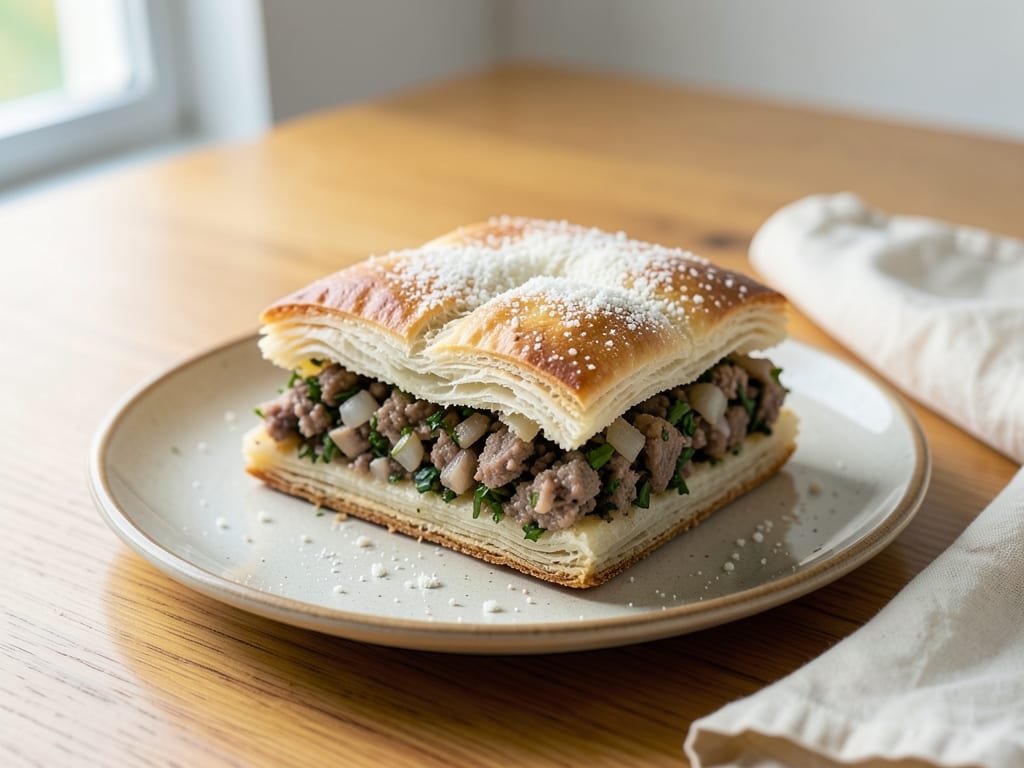
Moroccan Msemen Stuffed with Spiced Lamb
Square, flaky layered pastries made from a soft yeasted semolina dough, folded around a cumin-scented lamb, onion and parsley filling, then baked until golden and crisp-edged. Serve warm for breakfast or brunch with mint tea.
- Prep
- 50 min
- Cook
- 37 min
- Wait
- 1 hr 25 min
- Total
- 2 hr 52 min
- Makes
- 8 stuffed square msemen (about 4 inches / 10 cm each)
Steps
Before you start
- Read the whole recipe first: the dough needs about 1 hour to rise and 20 minutes to rest, and you cook the filling while the dough rises.
- Use fine semolina (sold as 'fine semolina' or 'semolina flour'), not coarse, for a tender dough and a crisp, flaky bake.
- Lightly oil your work surface, hands and rolling pin throughout. The dough is soft and sticky by design, and oil is what lets it stretch thin.
- Melt the butter for lamination and let it cool slightly so it is liquid but not hot.
Mix and knead dough
- In a large bowl or stand mixer bowl, whisk the flour, 1 cup semolina, yeast, sugar and 1½ teaspoons salt.
- Pour in the warm water and stir until no dry flour remains.
- Knead by hand on a lightly oiled surface for 10 minutes, or 8 minutes on medium-low speed with the dough hook.
- The dough will be soft, tacky and elastic.
+ Show details− Hide details
Ready when: Dough is smooth, stretchy and springs back slowly when poked; it should stick to your fingers a little but not to the bowl.
Tip: Resist adding extra flour. A soft dough stretches much thinner and gives flakier layers.
First rise
- Form the dough into a ball, place it in a lightly oiled bowl, and turn to coat.
- Cover with plastic wrap and leave in a warm spot for 45 minutes, then make the filling in the next step while it finishes rising for a total of about 60 minutes.
+ Show details− Hide details
Ready when: Dough looks puffy and a fingertip dent springs back slowly.
Cook the filling
- Heat the olive oil in a 12-inch skillet over medium heat.
- Add the onion and ½ teaspoon of the filling salt and cook, stirring, for 5 minutes until soft and translucent.
- Add the garlic and cook 30 seconds.
- Add the lamb, cumin, paprika, ginger, cinnamon, pepper and remaining salt.
- Break the meat into small crumbles and cook, stirring, 6 to 8 minutes.
- Stir in the parsley and cilantro, if using, and cook 1 minute more.
- Tip into a bowl, spread it out, and let it cool completely while the dough finishes rising.
+ Show details− Hide details
Ready when: Lamb is browned with no pink, an instant-read thermometer reads 160°F (71°C), and the mixture looks moist but not wet, with no pooling liquid.
Tip: If any liquid or fat pools in the pan, drain it off. A wet filling will make the dough soggy and tear. The filling must be fully cooled before you use it.
Divide and rest
- Oil your work surface, hands and a baking sheet generously.
- Divide the risen dough into 8 equal pieces (about 85 g each).
- Roll each into a smooth ball by cupping your hand and rotating it against the surface.
- Place the balls on the oiled sheet, brush the tops with oil, cover with plastic wrap and rest for 20 minutes.
+ Show details− Hide details
Ready when: Balls look smooth and feel very soft and relaxed.
Stretch and layer
- Oil a clean work surface.
- Working with one ball at a time, flatten it with oiled palms, then gently stretch it outward with your fingertips into a very thin, roughly 10-inch (25 cm) square, thin enough to see your fingers through.
- A few small holes are fine.
- Brush the surface with about 1½ teaspoons of the melted butter and sprinkle with about 1 teaspoon of the dusting semolina.
- Keep the other balls covered.
+ Show details− Hide details
Ready when: Dough is translucent and evenly thin, with edges no thicker than the center.
Tip: Stretch with the flats of your fingertips, working from the center out. Pulling from the edges tears the dough.
Fill and fold
- Spoon about ¼ cup (60 g) of cooled filling into the center of the stretched square in a 3-inch (8 cm) mound.
- Fold the bottom edge up over the filling, then the top edge down, then fold in the left and right sides like an envelope to make a neat square of about 4 inches (10 cm).
- Press gently.
- Flip it seam side down onto a parchment-lined baking sheet.
- Repeat with the remaining dough balls, leaving 1 inch (2.5 cm) between squares, four per sheet.
+ Show details− Hide details
Ready when: Each pastry is a closed square with no filling showing at the seams.
Tip: Use a light hand with the filling. Overfilled squares burst open in the oven.
Preheat and restOven 425°F / 220°C
- Place oven racks in the upper and lower thirds and preheat to 425°F (220°C).
- Brush the top of each square with some of the 4 tablespoons of butter set aside for layering.
- Let the squares rest while the oven heats.
Bake until goldenOven 425°F / 220°C
- Bake both sheets at 425°F (220°C) for 20 to 22 minutes, swapping the sheets between racks and rotating them front to back after 10 minutes.
- Bake until the pastries are deep golden brown and crisp at the edges.
+ Show details− Hide details
Ready when: Tops are deep golden brown with darker crisp edges, and the center reads at least 165°F (74°C) on an instant-read thermometer.
Tip: If the bottoms brown faster than the tops, move that sheet to the upper rack for the last few minutes.
Brush and cool
- Move the pastries to a wire rack and brush the tops with the remaining 2 tablespoons (28 g) melted butter.
- Let them cool for 10 minutes so the filling settles, then serve warm.
+ Show details− Hide details
Ready when: Pastries feel crisp on the outside and are warm, not piping hot, in the middle.
Good to know
Tips
- Make sure the filling is completely cool and not wet, or steam will make the dough soggy and tear it.
- Don't skip the 20-minute rest after shaping; a relaxed dough stretches thin without springing back.
- Oil, not flour, is your friend: flour on the surface prevents stretching and makes the layers dry.
- Serve with harissa, yogurt with mint, or a squeeze of lemon, plus sweet mint tea.
Make ahead
"Cook the filling up to 2 days ahead and refrigerate it in an airtight container; bring to room temperature before using. You can also fill and fold the squares, cover them tightly, and refrigerate up to 12 hours; bake straight from the fridge, adding 3 to 5 minutes."
Storage & reheating
"Room temperature: up to 2 hours after baking. Fridge: airtight up to 3 days. Freezer: freeze cooled pastries on a tray, then bag for up to 2 months. Reheat from the fridge at 375°F (190°C) for 8 to 10 minutes, or from frozen for 15 to 18 minutes, until hot (165°F / 74°C) and crisp. Avoid the microwave, which makes the layers soft."
Substitutions
- ground lamb → ground beef (80% lean) or ground turkey thigh. Beef is a close match. Turkey is leaner, so add an extra tablespoon of olive oil to the filling. Cook either to 160°F (71°C).
- fine semolina → additional all-purpose flour. The dough will be softer and the pastries less crisp and nutty, but still good. Use 165 g more flour and add 1 to 2 tablespoons extra water if needed.
- unsalted butter → ghee or more neutral oil. Ghee gives a similar, nutty flavor. Oil makes a slightly crisper, less rich pastry.
- fresh flat-leaf parsley → fresh mint or extra cilantro. Use the same amount; mint adds a cooler flavor that suits lamb.
More breakfast bakes
See all →


Find more like this
- Meal
- Breakfast
- Cuisine
- Moroccan
- Main ingredient
- Ground Lamb
- Diet
- Halal
- Method
- Oven