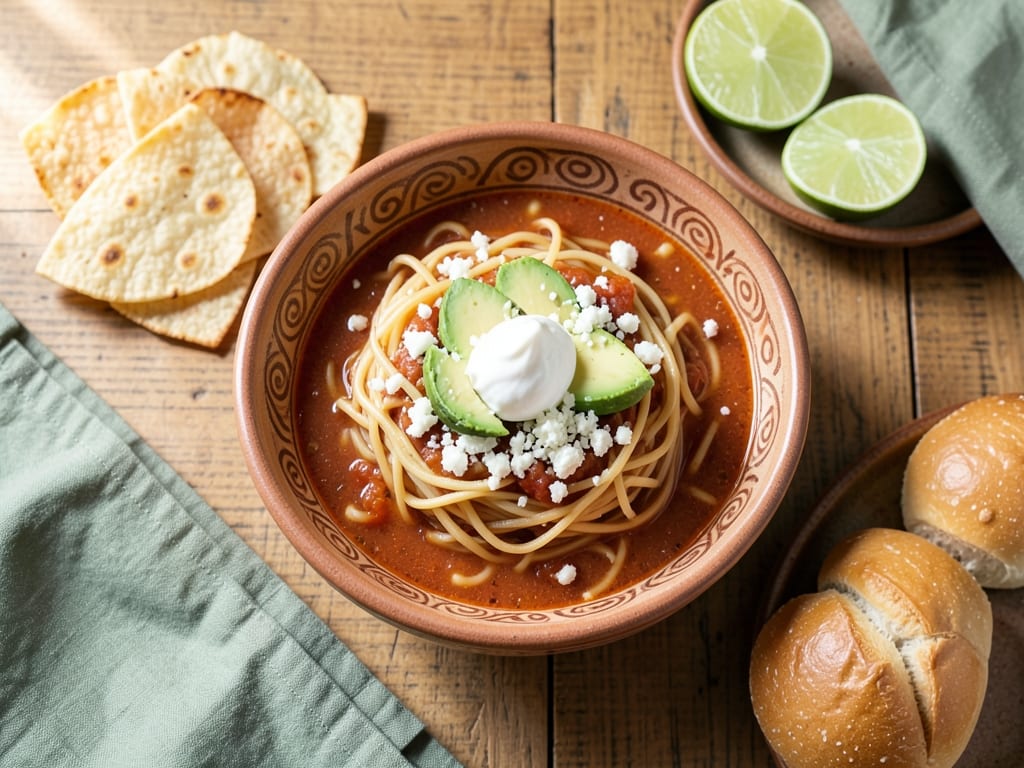
Mexican Sopa de Fideo Seco with Queso Fresco
A beloved Mexican dry noodle soup where thin pasta is toasted until golden, then braised in a savory tomato-broth mixture. The noodles absorb all the flavors while remaining tender. Finished with creamy toppings of queso fresco, crema, and fresh avocado for a comforting one-pan meal.
Steps
Before you start
- Have all ingredients measured and ready to add
- Use fideo or thin Mexican pasta noodles if available
- Choose ripe but not overly soft avocados for serving
- Read through the toasting step—this requires active attention
Toast the fideo
- Heat the vegetable oil in a large 4-quart (3.8 L) pot over medium heat.
- Once shimmering, add the fideo and stir constantly with a wooden spoon for 5–7 minutes until the noodles turn golden brown with a toasted aroma.
- Be careful not to let them darken too much or they'll taste bitter.
- The noodles should smell nutty and look light amber.
+ Show details− Hide details
Ready when: Noodles are light golden brown and smell nutty
Tip: Don't walk away during toasting—burned fideo will ruin the dish. Keep the heat at medium so they brown evenly rather than scorch.
Sauté aromatics
- Add the diced white onion to the toasted fideo and stir well.
- Cook for 2–3 minutes, stirring occasionally, until the onion softens and becomes translucent at the edges.
- Add the minced garlic and cook for another 1 minute, stirring constantly, until fragrant.
+ Show details− Hide details
Ready when: Onion is softened and garlic is fragrant
Tip: The residual oil from toasting the fideo should be enough to prevent sticking. Don't add extra oil.
Add tomato sauce
- Pour in the canned tomato sauce and stir to combine with the noodles.
- Let it cook for 2–3 minutes, stirring frequently, so the raw tomato flavor mellows and the sauce deepens slightly in color.
- You'll notice the mixture becoming more cohesive.
+ Show details− Hide details
Ready when: Tomato sauce is warmed through and slightly darker in color
Tip: Cooking the tomato sauce with the toasted noodles builds flavor. This step is important; don't skip it.
Add broth and simmer
- Pour in the chicken or vegetable broth and stir well to combine.
- Increase the heat to medium-high and bring the mixture to a boil.
- Then reduce the heat to medium-low and season generously with salt and freshly ground black pepper to taste.
- Partially cover the pot with a lid, leaving it slightly ajar so some steam escapes.
+ Show details− Hide details
Ready when: Mixture comes to a full boil
Tip: Bring the broth to a boil before reducing heat so the noodles cook evenly from the start.
Simmer until noodles absorb liquid
- Simmer the sopa de fideo for 12–15 minutes, stirring occasionally (every 3–4 minutes), until the noodles are tender and have absorbed most of the broth.
- The final texture should be moist but not soupy—the noodles should cling together slightly but not be swimming in liquid.
- If there's still excess liquid, uncover and simmer for another 2–3 minutes.
+ Show details− Hide details
Ready when: Noodles are tender, most liquid is absorbed, and mixture is moist but not soupy
Tip: Stir occasionally to prevent the bottom from sticking. If noodles are still hard after 12 minutes and liquid is gone, add a splash more broth and continue cooking.
Taste and adjust seasoning
- Remove the pot from heat and taste a spoonful.
- Add more salt and pepper as needed.
- The sopa should taste well-seasoned and savory.
- Adjust the consistency: if it's too dry, add a splash of warm broth; if it's too wet, let it rest uncovered for 1–2 minutes to allow excess moisture to evaporate.
+ Show details− Hide details
Ready when: Seasoning is balanced and texture is as desired
Tip: Taste before serving—this is your last chance to correct the flavor.
Prepare toppings
- While the sopa finishes, slice the ripe avocados in half, remove the pit, and thinly slice the flesh.
- Have the crumbled queso fresco, Mexican crema, cilantro (if using), and lime wedges ready on the counter.
+ Show details− Hide details
Ready when: All toppings are prepped and arranged
Tip: Prep avocados just before serving so they don't brown. A light squeeze of lime juice on the slices will help prevent oxidation.
Serve
- Divide the sopa de fideo seco among four large serving bowls.
- Top each bowl generously with crumbled queso fresco, a dollop of Mexican crema, a handful of avocado slices, and a pinch of fresh cilantro if desired.
- Serve with lime wedges on the side for squeezing over the top.
- Guests can adjust toppings and lime to their preference.
+ Show details− Hide details
Tip: Serve immediately while the sopa is still hot so the contrast with cool toppings is most pleasant.
Good to know
Tips
- Toasting the fideo is essential—it adds a nutty, deep flavor that defines this dish. Don't skip this step or use pre-cooked pasta.
- The name 'sopa seca' (dry soup) means the noodles should absorb the broth so there's minimal liquid left. If you prefer a brothier consistency, add extra broth at the end.
- Queso fresco, crema, and avocado are not optional—they provide cooling contrast and richness that balance the hot, savory noodles.
- Leftovers reheat better with a small splash of broth stirred in, as the noodles continue to absorb moisture over time.
Make ahead
The cooked sopa de fideo (without toppings) can be made 1–2 days ahead. Cool and refrigerate in an airtight container. To serve, reheat gently on the stovetop over medium-low heat, adding a splash of warm broth if the noodles have absorbed too much liquid. Don't add toppings until just before serving.
Storage & reheating
Room temperature: not recommended. Refrigerator: store the cooked sopa (without toppings) in an airtight container for up to 3–4 days. Reheat gently on the stovetop with an extra splash of broth, as the noodles continue to absorb liquid when stored. Freezer: not recommended, as the texture of the noodles becomes mushy when frozen and thawed.
Substitutions
- fideo or thin Mexican pasta noodles → Angel hair pasta or thin spaghetti. Use the same weight (8 oz / 227 g). Angel hair mimics fideo's thin, delicate texture and cooks in about the same time.
- chicken broth or vegetable broth → Vegetable broth or chicken stock. Use the same amount. Vegetable broth works perfectly for a vegetarian version.
- Mexican crema or sour cream → Sour cream, Greek yogurt, or crème fraîche. Use the same amount. Sour cream is the most authentic substitute if Mexican crema is unavailable.
- queso fresco or cotija cheese → Cotija cheese, feta cheese, or crumbled ricotta salata. Use the same amount. Any crumbly, salty cheese works. Cotija is most authentic.
More noodle soups
See all →
Find more like this
- Meal
- Dinner
- Cuisine
- Mexican
- Diet
- HalalSugar-Free
- Method
- Stovetop