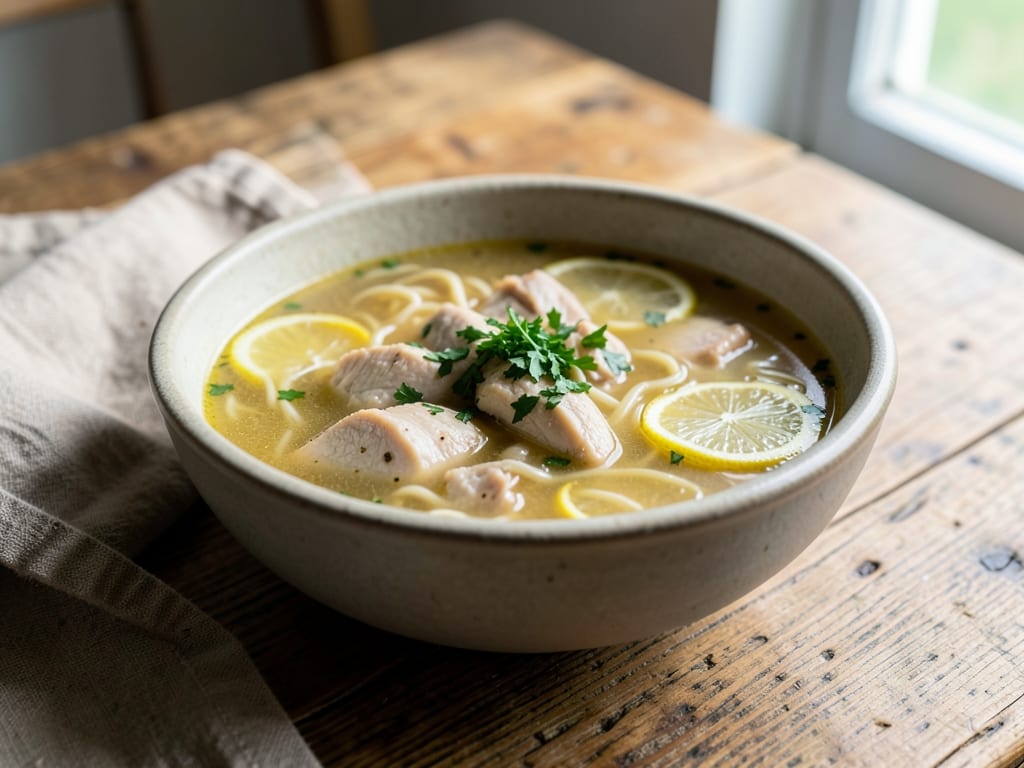
Brazilian Canja with Macarrão Cabelo de Anjo
A traditional Brazilian chicken and angel hair pasta soup—pure comfort in a bowl. Chicken breasts simmer gently with aromatic vegetables in a light, healing broth, then silky angel hair pasta is stirred in at the end. A squeeze of fresh lemon and shower of parsley brighten each spoonful. Often served to those recovering from illness, but equally welcome at any table seeking warmth and simplicity.
- Prep
- 15 min
- Cook
- 35 min
- Wait
- 10 min
- Total
- 1 hr
- Makes
- 4 servings (about 10 cups total)
Steps
Before you start
- Have all ingredients prepped and ready before you start—this soup comes together quickly once the pot is on the stove
- Pat the chicken breasts dry so they brown slightly and release good flavor into the broth
- Use fresh lemon juice, not bottled, for the brightest finish
- Read through the timing: pasta cooks very quickly at the end, so don't wander away
Sauté aromatics
- Heat olive oil in your large pot over medium heat.
- Add the quartered onion, minced garlic, carrot slices, and chopped celery.
- Stir frequently until the vegetables soften and become fragrant, about 3 minutes.
- The garlic should become pale and fragrant but not brown.
+ Show details− Hide details
Ready when: Vegetables soften and garlic becomes pale and fragrant
Tip: Don't let garlic brown or it will taste bitter. Keep the heat at medium so vegetables soften gently.
Build the broth with chicken
- Pour in the 8 cups of water and add the bay leaf if using.
- Nestle the patted-dry chicken breasts into the pot, submerging them as much as possible.
- Increase heat to medium-high and bring the liquid to a gentle boil, skimming off any white foam that rises to the surface with a spoon.
+ Show details− Hide details
Ready when: Liquid reaches a gentle boil; foam appears on surface
Tip: Skimming the foam keeps the broth clear and removes impurities. A gentle boil (not a rolling one) keeps the chicken tender.
Poach chicken until cooked throughOven 165°F / 75°C
- Once boiling, reduce heat to medium-low, partially cover the pot, and maintain a gentle simmer.
- Cook for 15–18 minutes.
- The chicken is done when an instant-read thermometer inserted into the thickest part of a breast reads 165°F (74°C).
- The chicken should be white throughout with no pink inside.
+ Show details− Hide details
Ready when: Internal temperature reaches 165°F (74°C); no pink inside
Tip: Use a meat thermometer to avoid guessing. Overcooking will make the chicken dry; a gentle simmer prevents this.
Remove and shred chicken
- Use tongs to carefully transfer the cooked chicken breasts to a cutting board.
- Let them rest for 5 minutes (this allows the fibers to relax and makes shredding easier).
- Using two forks, pull the chicken into bite-sized shreds.
- Discard any cartilage or connective tissue.
- Set the shredded chicken aside.
+ Show details− Hide details
Ready when: Chicken pulls apart easily into thin, tender shreds
Tip: Resting the chicken for even just 5 minutes makes a big difference in how cleanly it shreds. Work while it's still warm.
Return chicken and season broth
- Stir the shredded chicken back into the simmering broth.
- Taste the broth and add salt and black pepper as needed.
- The broth should be flavorful and well-seasoned—this is the foundation of the soup.
+ Show details− Hide details
Ready when: Broth is seasoned to taste
Tip: Taste as you go. The vegetables have already given their flavor, so adjust with salt and pepper to balance.
Cook pasta until tender
- Increase heat to medium so the broth comes to a gentle boil.
- Add the angel hair pasta all at once and stir immediately to prevent clumping.
- Cook uncovered for 5–7 minutes, stirring occasionally, until the pasta is tender but not mushy.
- Angel hair cooks very quickly, so watch it carefully.
- It should have a slight resistance when you bite it.
+ Show details− Hide details
Ready when: Pasta is tender with a slight firmness when bitten; no chalky center
Tip: Don't walk away from the stove during this step. Angel hair is delicate and can go from perfect to mushy in seconds. The pasta continues to soften slightly after cooking stops.
Finish with lemon and parsley
- Remove the pot from heat.
- Stir in the fresh lemon juice and most of the chopped parsley, reserving about a tablespoon for garnish.
- Taste again and add more salt, pepper, or lemon if needed.
- The soup should be bright, herbaceous, and comforting.
+ Show details− Hide details
Ready when: Lemon juice is evenly distributed and parsley is incorporated
Tip: Add lemon juice off the heat so the bright citrus flavor doesn't cook away. Taste before serving and adjust—canja should be gently seasoned, not aggressive.
Good to know
Tips
- Canja is meant to be gentle and healing—don't oversalt or overly spice it. The focus is on the tender chicken, delicate pasta, and bright lemon finish.
- Angel hair is very thin and finishes cooking almost as soon as the water comes back to a boil. Don't use a stovetop timer; watch the pot and taste after 5 minutes. It's better to slightly undercook and let it soften in residual heat than to overcook.
- For a richer broth, use bone-in thighs instead of breasts, or add a splash of chicken stock. Some cooks add a pinch of ginger or a small piece of fresh turmeric for extra warmth and healing properties.
- Canja is traditionally served very hot in deep bowls with extra parsley on the side. Serve with crusty bread for dipping or alongside rice for a more filling meal.
Make ahead
You can make the broth and poach the chicken up to 1 day ahead. Cool the chicken, shred it, and refrigerate the shredded meat and broth separately in airtight containers. Before serving, bring the broth to a gentle boil, return the chicken to reheat it through (about 2 minutes), then cook the fresh pasta as directed. This strategy keeps the angel hair from becoming waterlogged.
Storage & reheating
Refrigerate in an airtight container for up to 3 days. The pasta will gradually soften and absorb more broth; add a splash of water or chicken stock when reheating if it becomes too thick. Freeze the broth separately (without pasta) for up to 3 months. Thaw overnight in the refrigerator and reheat gently on the stovetop over medium-low heat, stirring occasionally. Cook fresh pasta just before serving thawed broth.
Substitutions
- boneless, skinless chicken breasts → bone-in, skin-on chicken thighs (about 2 lb / 910 g total). Thighs produce a richer, more flavorful broth and stay tender longer. Add 5–10 minutes to the poaching time. Remove skin before shredding if preferred.
- angel hair pasta (macarrão cabelo de anjo) → ditalini or small pasta shells (3 oz / 85 g). Shorter pastas are easier to eat from a spoon and won't break apart as easily. Cook time remains about 5–7 minutes, but stir more frequently.
- fresh lemon → fresh lime juice. Lime adds a different brightness and is common in some regional variations of canja. Use the same amount.
- fresh flat-leaf parsley → fresh cilantro. Cilantro is popular in Brazilian cuisine and adds an herbaceous, slightly peppery note. Use the same amount but add it mostly at the end since its flavor is delicate.
More noodle soups
See all →
Find more like this
- Meal
- Dinner
- Main ingredient
- Chicken BreastPasta
- Method
- Stovetop
- Quick & Easy
- Easy