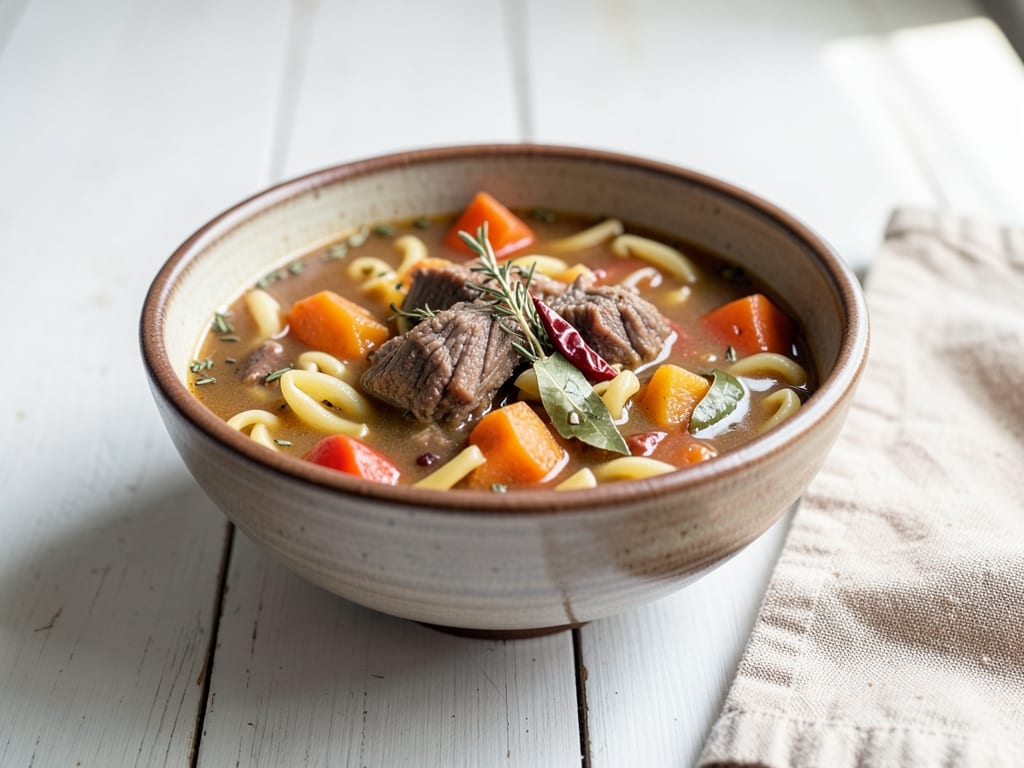
Haitian Soup Joumou with Pasta
A hearty, traditionally significant Haitian soup featuring tender braised beef, calabaza (pumpkin squash), root vegetables, and pasta in a rich, savory broth flavored with thyme, bay leaf, and a hint of scotch bonnet heat. Once forbidden to enslaved people, eating soup joumou after gaining freedom became a powerful symbol of liberation. It's traditionally served on New Year's Day and remains a beloved family dish.
- Prep
- 25 min
- Cook
- 1 hr 40 min
- Wait
- 5 min
- Total
- 2 hr 10 min
- Makes
- 1 large pot (about 3 quarts/2.8 L); serves 6–8 depending on portion size
Steps
Before you start
- Pat the beef dry with paper towels before browning—moisture prevents caramelization and deep color.
- Cut all vegetables into consistent bite-sized pieces before you start cooking; mise en place keeps the recipe moving smoothly.
- Have all ingredients prepped and at hand—once you start browning the beef, the cooking goes quickly.
- Read through the recipe and timing notes so you understand when each ingredient joins the pot.
Brown the beef
- Heat the oil in a large heavy-bottomed pot or Dutch oven (6-quart capacity) over medium-high heat until shimmering, about 2 minutes.
- Working in two batches to avoid crowding, add the beef chunks and let them sit undisturbed for 3–4 minutes until deeply browned on one side.
- Stir and cook another 3–4 minutes until most surfaces are caramelized and golden.
- Transfer the beef to a plate.
- Don't worry about cooking it through—you're building flavor through browning.
+ Show details− Hide details
Ready when: Beef is deeply browned on multiple surfaces
Tip: Dry the beef thoroughly before cooking—any surface moisture prevents browning. Don't stir too early; let each side develop a crust for maximum flavor.
Sauté aromatics and tomato paste
- Reduce heat to medium.
- Add the diced onion directly to the pot and cook for 3 minutes, stirring occasionally, until softened and lightly golden.
- Add the minced garlic and cook for 1 minute until fragrant.
- Stir in the tomato paste and cook for 2 minutes, stirring constantly, to darken slightly and cook off the raw, acidic taste.
+ Show details− Hide details
Ready when: Tomato paste is dark and fragrant, onion is soft and translucent
Tip: Toasting the tomato paste in fat for a few minutes removes its raw, acidic bite and deepens the soup's savory flavor.
Add broth and simmer beef
- Pour in the beef broth, scraping the bottom of the pot with a wooden spoon to release any browned, flavorful bits (fond).
- Return the beef and any accumulated juices to the pot.
- Add the fresh thyme sprigs and bay leaves.
- Bring to a simmer over medium-high heat, then reduce heat to medium-low so the liquid barely bubbles—just a gentle bubble every few seconds.
- Simmer, partially covered with the lid slightly ajar, for 45 minutes, until the beef is very tender when pierced with a fork.
+ Show details− Hide details
Ready when: Beef is very tender and shreds easily with a fork; broth is savory and rich
Tip: Partially covering the pot slows evaporation while allowing gentle simmering. Avoid a hard boil—this toughens the beef and creates a cloudy broth.
Add calabaza and root vegetables
- Stir in the calabaza cubes, carrot rounds, celery pieces, and potato cubes.
- The vegetables should be submerged or mostly covered by broth.
- Return to a gentle simmer over medium heat and cook uncovered for 20 minutes.
- The calabaza will soften and begin to break down slightly, naturally thickening and enriching the broth without added flour or cream.
+ Show details− Hide details
Ready when: Calabaza is very soft and beginning to break apart and dissolve, carrots are fork-tender
Tip: Calabaza naturally breaks down and thickens the broth with subtle sweetness—this is part of what makes soup joumou special. Don't skip it.
Add cabbage and pasta
- Stir in the chopped cabbage and the whole scotch bonnet pepper (piercing it with a knife tip in a few places to release heat and flavor without breaking it apart).
- Bring back to a gentle simmer and cook for 5 minutes until the cabbage begins to soften and wilt.
- Add the pasta and cook for the time indicated on the package—typically 7–10 minutes for small shapes like ditalini—stirring occasionally to prevent the pasta from sticking to the bottom.
- The pasta should be tender but not mushy.
+ Show details− Hide details
Ready when: Pasta is tender, cabbage is soft and cooked through, broth is flavorful and rich
Tip: Check pasta package directions—cook until just tender, not beyond. It will continue to soften as the soup sits, and overcooked pasta turns mushy.
Season and finish
- Remove the pot from heat.
- Fish out and discard the bay leaves, thyme sprigs, and scotch bonnet pepper (or leave it in if you enjoy intense heat).
- Taste the broth and season generously with salt and freshly ground black pepper.
- Stir in the butter (if using) for extra richness and a silky texture.
- Let the soup rest, uncovered, off heat for 5 minutes while the flavors meld and settle.
+ Show details− Hide details
Ready when: Soup is well-seasoned, flavors are balanced and harmonious
Tip: Taste the broth before adding salt—the beef, broth, and vegetables contribute sodium. Start with less salt; you can always add more.
Good to know
Tips
- Soup joumou is deeply rooted in Haitian history and freedom—traditionally eaten on New Year's Day, eating it symbolizes liberation. The family preparation, cooking together, and sharing the meal are as meaningful as the dish itself.
- Don't discard the calabaza that breaks down into the broth—it naturally thickens the soup with body and subtle sweetness. This is part of what distinguishes soup joumou from other vegetable soups.
- For a vegetarian version, use vegetable broth instead of beef broth and substitute the beef with extra calabaza, cooked chickpeas, white beans, or lentils (add them at step 4 so they have time to warm through and absorb flavor).
- Leftovers improve dramatically overnight in the fridge as flavors meld and deepen. Make this soup a day ahead if you can, store it covered, and gently reheat it before serving—it tastes even better.
Make ahead
Soup joumou actually improves with time as flavors deepen and meld overnight. Make it up to 3 days ahead, store in an airtight container in the fridge, and gently reheat before serving. To freeze: prepare the soup without pasta, cool completely, and freeze up to 3 months. Thaw overnight in the fridge, then reheat gently. Cook fresh pasta separately just before serving for the best texture.
Storage & reheating
Room temperature: up to 2 hours. Refrigerator: up to 4 days in an airtight container (the flavors actually deepen). Freezer: up to 3 months (freeze before adding pasta for best texture; cook fresh pasta separately when reheating). To reheat: thaw overnight in the fridge if frozen, then warm over medium heat, stirring occasionally, until heated through. Add hot broth or reheat pasta separately if needed to restore consistency.
Substitutions
- calabaza or butternut squash → butternut squash or sugar pumpkin. Both have similar texture and subtle sweetness; peel, seed, and cube exactly the same way. Butternut squash is most readily available in US markets.
- beef chuck roast → beef brisket or beef short ribs. Both braise beautifully and become very tender. Brisket adds extra richness; short ribs yield a more deeply flavored broth.
- fresh thyme → 1 teaspoon (1 g) dried thyme or ½ teaspoon fresh oregano. Dried herbs are more concentrated; use about ¼ the amount. Add at the same time as fresh would go in.
- scotch bonnet pepper → habanero, serrano, or jalapeño pepper. Habanero is closest in heat and fruity flavor; serrano is milder; jalapeño is much milder. Start with one pepper and taste as you cook; adjust quantity to your heat preference.
More noodle soups
See all →
Find more like this
- Meal
- Dinner
- Cuisine
- Caribbean
- Main ingredient
- Beef RoastPasta
- Diet
- HalalSugar-Free
- Method
- Stovetop