Japanese Barley Rice with Umeboshi
A traditional Japanese rice dish that combines short-grain rice with chewy pearl barley and salty-sour umeboshi (pickled plum). This humble, nourishing side pairs beautifully with grilled fish, simmered vegetables, or miso soup. The umeboshi adds a distinctive bright flavor and aids digestion. Perfect for a weeknight dinner or meal prep.
- Prep
- 5 min
- Cook
- 45 min
- Wait
- 10 min
- Total
- 1 hr
- Makes
- 4 servings (about 3 cups cooked)
Steps
Before you start
- Measure both rice and barley accurately by volume (not weight) for proper water absorption
- Rinse the short-grain rice under cold water until water runs mostly clear (about 30 seconds)
- Have your umeboshi and scallions ready before starting the cooker
Rinse rice and barley
- Place the short-grain rice in a fine-mesh sieve and rinse under cold running water, gently rubbing the grains with your fingers, for about 30 seconds, until the water runs mostly clear (a little cloudiness is fine).
- This removes excess starch.
- The pearl barley does not need rinsing.
- Drain well.
+ Show details− Hide details
Ready when: Water runs mostly clear and barley is in a dry bowl
Tip: Don't over-rinse; you want to remove starch but keep some grains intact for proper cooking.
Combine in rice cooker
- Add the rinsed rice and pearl barley to your rice cooker bowl.
- Pour in 2 cups (480 ml) of water.
- Pit the umeboshi and lightly mash it with a spoon (you want it broken into several pieces, not pureed), then add it directly to the water and rice mixture.
- Stir gently once or twice to distribute the umeboshi throughout.
+ Show details− Hide details
Ready when: Umeboshi is broken into pieces and distributed in the water
Tip: Mash the umeboshi slightly so its flavor disperses evenly, but don't crush it to paste.
Cook rice
- Cover the rice cooker, plug it in, and press the cook button (or auto setting).
- Allow the cooker to run through its full cycle until it switches to warm mode automatically.
- This typically takes 40–45 minutes.
+ Show details− Hide details
Ready when: Rice cooker switches to warm/keep-warm mode
Tip: Do not open the lid during cooking; this lets steam escape and prevents even cooking.
Rest and fluff
- Once the rice cooker switches to warm mode, let the rice rest for 10 minutes without opening the lid.
- This allows any remaining moisture to be absorbed evenly.
- Then carefully open the lid and gently fluff the rice with a wooden or plastic rice paddle or fork, folding from bottom to top, breaking up any clumps.
+ Show details− Hide details
Ready when: Rice is fluffy, grains are tender and slightly firm, barley is chewy
Tip: Use a gentle folding motion to avoid mashing the grains.
Finish with scallions
- Scatter the sliced white and light green parts of the scallions over the warm rice.
- Toss gently to combine.
- Taste a spoonful; the umeboshi should have distributed its salty-sour flavor throughout.
- Add a pinch of salt if desired, though the umeboshi usually provides enough seasoning.
+ Show details− Hide details
Ready when: Scallions are mixed in and rice is ready to serve
Tip: Reserve a few slices of the darker green parts of scallions as garnish if desired for color.
Good to know
Tips
- The ratio of 1.5 cups rice to 0.5 cup barley to 2 cups water is designed for a standard rice cooker and yields fluffy, evenly cooked grains. Stick to measuring cups for accuracy.
- Umeboshi adds probiotics and is believed to aid digestion—part of why this dish is popular at home suppers and in bento boxes.
- If your umeboshi is very large, cut the pit out carefully and discard it; the flesh will naturally soften and distribute as it cooks.
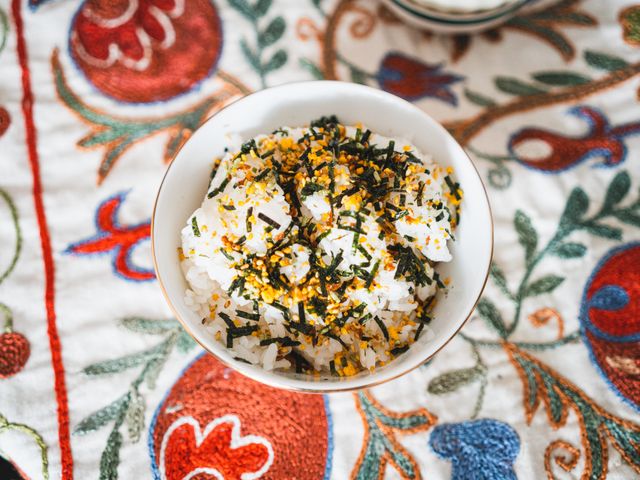
- For a richer version, top each bowl with a soft-boiled egg or a small dollop of Japanese mayo (Kewpie) and a sprinkle of seaweed.
Storage & reheating
Store covered in the refrigerator for up to 3 days. Reheat gently in the microwave (add a splash of water to prevent drying) or in a skillet over medium heat with a little butter or oil. The umeboshi flavor may become slightly sharper when chilled but is still delicious.
Substitutions
- pearl barley → Hulled barley (whole-grain barley). Use the same amount by volume. Hulled barley takes slightly longer to cook (about 50 minutes total). Increase water to 2¼ cups (540 ml).
- umeboshi (pickled plum) → Umeboshi paste (bainiku) or umeboshi liquid. Use 1–1½ teaspoons of paste mixed into the water, or ½ teaspoon of the liquid. Start with less; you can add more after cooking if needed. The paste variant will be more evenly distributed.
- scallions (green onions) → Shichimi (Japanese seven-spice blend) or nori seaweed, toasted and torn. Sprinkle a small pinch of shichimi over each bowl, or tear a strip of nori into pieces. Both add traditional Japanese flavor and aroma.
- short-grain white rice (or sushi rice) → Koshihikari or any Japanese short-grain variety. Different brands may absorb water slightly differently; adjust water by ¼ cup if rice is too wet or dry on your first try.