Katsudon (Japanese Pork Cutlet and Egg Rice Bowl)
Crisp panko-crusted pork cutlets are simmered briefly with sweet-savory dashi-soy onions, then topped with softly set egg and piled over hot rice. It's comforting, deeply savory, and easy to manage once the cutlets are fried.
- Prep
- 30 min
- Cook
- 28 min
- Wait
- 14 min
- Total
- 1 hr 12 min
- Makes
- 4 large rice bowls (1 cutlet each)
Steps
Before you start
- Start cooking the rice first so it is hot and ready when the cutlets are done. Cook 2 cups (400 g) uncooked short-grain rice to yield about 4 cups (740 g) cooked.
- If you don't have dashi, stir ½ teaspoon dashi powder into 1½ cups (360 ml) hot water, or use instant dashi packets as directed.
- Have a thermometer ready for the oil (340°F/170°C) and an instant-read thermometer for the pork.
- Set up a wire rack over a sheet pan for the fried cutlets. Resting them on paper towels would steam the crust soft.
- The egg topping is meant to be soft and barely set. Use pasteurized eggs if serving anyone pregnant, elderly, or immunocompromised.
Pound and season pork
- Place a chop between two sheets of plastic wrap and pound with a mallet or rolling pin to an even ½-inch (1.25 cm) thickness.
- Repeat with the remaining chops.
- Snip the fat edge in 3–4 places with a knife tip (about ½ inch/1 cm deep) so the cutlets don't curl while frying.
- Season both sides evenly with the salt and pepper, then let stand at room temperature.
+ Show details− Hide details
Ready when: Chops are an even ½ inch thick with no thin, torn spots
Tip: Pound gently from the center outward; tearing the meat lets oil in and makes the crust patchy.
Set up breading station
- Put the flour in one shallow dish, the 2 beaten breading eggs in a second, and the panko in a third.
- Line them up in that order next to a clean plate for the breaded cutlets.
+ Show details− Hide details
Ready when: Three dishes are lined up in order, each wide enough to hold a whole cutlet
Tip: Use one hand for dry (flour, panko) and the other for wet (egg) to avoid clumpy fingers.
Bread the cutlets
- Pat each chop dry with paper towels.
- Dredge in flour and shake off the excess, dip in egg and let the extra drip off, then press firmly into the panko, turning to coat both sides and the edges.
- Set on the clean plate.
- Don't stack them.
+ Show details− Hide details
Ready when: Every surface is fully and thickly covered in dry panko with no wet patches
Tip: Press the panko on firmly; loose crumbs will burn in the oil and the coating will slide off in the sauce.
Heat the oilOven 340°F / 170°C
- Pour the oil into the 10-inch heavy skillet (it should be about ½ inch/1.25 cm deep).
- Heat over medium-high until a thermometer reads 340°F (170°C), about 5 minutes.
- A panko crumb dropped in should sizzle steadily right away.
+ Show details− Hide details
Ready when: Thermometer reads 340°F (170°C) and a crumb sizzles immediately
Tip: If the oil starts smoking, lower the heat. Oil that's too cool makes greasy cutlets.
Fry the cutletsOven 350°F / 175°C
- Carefully lay 2 cutlets in the oil, away from you.
- Fry 3 minutes until the underside is deep golden, then flip and fry 2–3 minutes more.
- Adjust the heat to hold the oil at 330–350°F (165–175°C).
- Transfer to the wire rack.
- Let the oil recover to 340°F (170°C), then fry the remaining 2 cutlets the same way.
+ Show details− Hide details
Ready when: Crust is deep golden brown and crisp, and the pork reads 145°F (63°C) in the center
Tip: Don't crowd the pan: more than 2 cutlets drops the oil temperature and the crust turns soggy.
Rest and slice
- Let the cutlets rest on the rack for 4 minutes so the juices settle.
- Using a sharp knife and a sawing motion, slice each cutlet crosswise into ¾-inch (2 cm) strips.
- Keep each cutlet's strips together so they can be slid onto the rice intact.
+ Show details− Hide details
Ready when: Slices are cleanly cut with the crust still crisp and juices not running out
Tip: Slice with a sawing motion rather than pressing down, which crushes the crust.
Simmer onions in sauce
- Discard the frying oil once it has cooled, or set it aside to cool.
- In the clean 10-inch nonstick skillet, stir together the dashi, soy sauce, mirin, and sugar.
- Add the sliced onion and bring to a simmer over medium heat.
- Simmer 4–5 minutes, stirring occasionally.
+ Show details− Hide details
Ready when: Onions are soft and translucent and the sugar has dissolved; the liquid should taste savory-sweet
Tip: Taste the liquid now; it should taste slightly strong because the egg and rice will mellow it.
Assemble first two bowls
- Divide 2 cups (370 g) of the hot rice between two bowls.
- Arrange 2 sliced cutlets over the simmering onions in the skillet.
- Pour half of the beaten topping eggs (about 3 eggs) in a slow circle over the cutlets and onions.
- Reduce to medium-low, cover, and cook 60–90 seconds.
- Scatter in half the scallions, then slide half of the contents of the pan onto each bowl of rice.
+ Show details− Hide details
Ready when: Egg whites are opaque and just set, while the top is still glossy, soft, and slightly runny
Tip: Take the pan off the heat as soon as the egg looks barely set; it continues to cook on the hot rice.
Assemble last two bowls
- Divide the remaining 2 cups (370 g) of hot rice between the other two bowls.
- Return the skillet to medium heat; if the liquid has reduced to less than ½ cup (120 ml), add 2 tablespoons water.
- Bring to a simmer, then repeat: add the remaining 2 sliced cutlets, pour in the remaining beaten eggs, cover on medium-low for 60–90 seconds, scatter with the remaining scallions, and slide onto the rice.
- Serve immediately.
+ Show details− Hide details
Ready when: Egg is opaque at the edges and softly set and glossy in the center
Tip: Serve right away; the crust softens as it sits in the egg and sauce.
Good to know
Tips
- Pound the pork to an even thickness so all the cutlets cook at the same rate and stay juicy.
- Keep the egg soft. It should still look slightly glossy when you slide it onto the rice, because the residual heat finishes it.
- Don't simmer the cutlets in the sauce for more than the egg-setting time, or the crust turns mushy.
- Short-grain rice holds the sauce better than long-grain; spoon a little extra pan liquid over the rice if you like.
Make ahead
"Bread the cutlets up to 4 hours ahead and refrigerate uncovered on a rack-lined tray. The rice can be cooked ahead and kept warm in the cooker. Fry, simmer, and add the egg just before serving."
Storage & reheating
Best eaten immediately. Fridge: store leftover assembled katsudon in an airtight container up to 1 day (the crust will soften). Unsauced fried cutlets keep refrigerated up to 3 days; reheat on a rack in a 400°F (200°C) oven for 8–10 minutes to re-crisp, then simmer with the sauce and fresh egg. Freezer: freeze cooled fried cutlets up to 2 months and reheat from frozen at 400°F (200°C) for 15 minutes. Don't freeze the egg topping.
Substitutions
- boneless pork loin chops → Boneless, skinless chicken thighs or breasts, pounded to ½ inch. Fry until the center reaches 165°F (74°C) instead of 145°F.
- dashi → 1½ cups (360 ml) water plus ½ tsp instant dashi powder. Or use low-sodium chicken broth, though the flavor will be less traditional.
- mirin → 2 tbsp dry sherry or sake plus 1 tsp extra sugar. Sweetness and depth will be close, but not identical.
- panko breadcrumbs → Crushed plain cornflakes or fresh coarse breadcrumbs. Cornflakes brown faster, so lower the heat slightly. Fresh breadcrumbs give a denser crust.
More rice bowls
See all →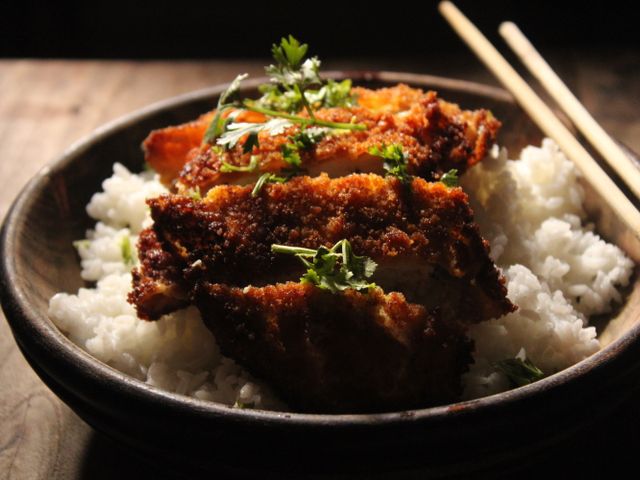
Find more like this
- Meal
- Dinner
- Cuisine
- Japanese
- Main ingredient
- Pork ChopsEggsRice
- Diet
- Dairy-Free
- Method
- Stovetop