
Jamaican Scotch Bonnet and Mango Chutney
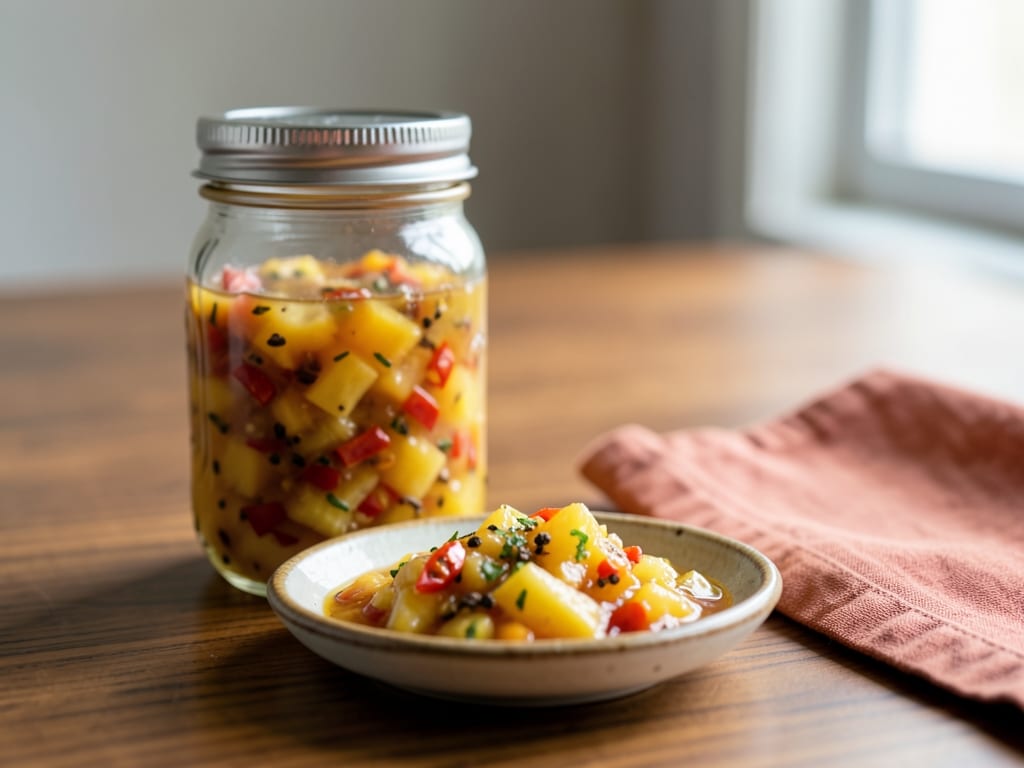
A bright, fiery-sweet chutney that captures the essence of Jamaican flavors. Fresh Scotch bonnet peppers bring serious heat, while ripe mango provides natural sweetness and body. Warm spices—allspice, ginger, and cinnamon—give it depth, and vinegar adds tang and preservation. Perfect alongside jerk chicken, curries, rice and beans, or cheese boards. Make a batch in late summer when both mangoes and peppers are at their peak.
- Prep
- 20 min
- Cook
- 35 min
- Wait
- 15 min
- Total
- 1 hr 10 min
- Makes
- About 2 cups (500 ml), or three 8-oz jars
Steps
Before you start
- Wear gloves when handling Scotch bonnets to protect your hands from the capsaicin oils; wash your hands thoroughly afterward and avoid touching your face
- Choose ripe but firm mangoes that yield slightly to pressure—overripe fruit will break down too much and become mushy
- If canning for long-term storage, sterilize your jars and lids in boiling water for 10 minutes before use
- Read through the entire recipe; the chutney requires attention while simmering but no stirring is necessary
Prep the ingredients
- Wearing gloves, stem and seed the Scotch bonnet peppers, then mince them finely (you should have about ⅓ cup / 80 ml).
- Peel, pit, and cut the mangoes into ½-inch dice; you should have about 2 cups (500 ml).
- Finely dice the onion, mince the ginger and garlic, and have the vinegar and brown sugar measured and ready.
+ Show details− Hide details
Tip: If the mango is very soft, work quickly and gently to avoid crushing the pieces. Don't remove all the fiber from the ginger; a little texture is good in the finished chutney.
Combine base ingredients
- In a medium heavy-bottomed saucepan (2-quart / 2 L), combine the minced Scotch bonnets, diced mango, diced onion, minced ginger, and minced garlic.
- Add the vinegar, brown sugar, salt, allspice, and cinnamon.
- Stir gently until the sugar begins to dissolve and the ingredients are evenly mixed.
- If using mustard seeds and turmeric, add them now.
+ Show details− Hide details
Tip: Stir gently to avoid breaking up the mango pieces too much; they should remain visible chunks in the finished chutney.
Bring to a simmer
- Set the saucepan over medium-high heat and bring the mixture to a gentle boil, stirring occasionally.
- Once it reaches a boil, reduce the heat to medium and maintain a gentle, steady simmer.
- You should see small, lazy bubbles breaking the surface, but not a rolling boil.
+ Show details− Hide details
Ready when: Mixture reaches a gentle boil
Tip: Watch for the mango pieces to soften slightly at the edges but remain mostly intact. Adjust heat down if the mixture threatens to boil vigorously.
Simmer until thickened
- Let the chutney simmer gently for 30–35 minutes, stirring occasionally (every 5 minutes or so).
- The mixture will reduce, the mango will soften further and begin to break down slightly, and the liquid will thicken.
- When finished, the chutney should coat the back of a spoon and fall back slowly when you draw a line through it; it will continue to thicken as it cools.
+ Show details− Hide details
Ready when: Chutney coats the back of a spoon and falls back slowly when a line is drawn through it; no watery liquid pools on the surface
Tip: Stir gently and scrape the bottom of the pan to prevent sticking. If the bottom begins to brown too much, reduce heat to medium-low. The chutney will seem a bit loose while hot but will set as it cools.
Cool and jar
- Remove the saucepan from heat and let the chutney cool for 15 minutes at room temperature.
- While it cools, prepare your jars: either sterilized mason jars (for long-term storage) or clean glass jars with tight-fitting lids (for refrigerator storage).
- Once cooled slightly, spoon the chutney into the jars, leaving ½-inch headspace if canning, or fill to ¼ inch below the rim if storing in the fridge.
- Wipe the jar rims clean and seal.
+ Show details− Hide details
Ready when: Chutney has cooled to warm (you can hold the side of the pan with your palm)
Tip: If you are not canning for long-term storage, simply fill clean jars and refrigerate once fully cooled. The chutney will continue to thicken as it chills.
Finish and serve
- Let the chutney sit at room temperature overnight before opening or tasting; this allows the flavors to meld and mature.
- It is excellent served warm, at room temperature, or chilled.
- Use it as a condiment alongside jerk chicken, curries, roasted meats, cheese, or rice and beans.
+ Show details− Hide details
Tip: The chutney will mature and deepen in flavor over 3–7 days. Taste and adjust the balance of heat and sweetness if needed by stirring in a touch more vinegar or brown sugar.
Good to know
Tips
- Scotch bonnets are seriously hot; wear gloves when handling and do not touch your face. If you are sensitive to heat, remove the white placental membranes and some (but not all) of the seeds, or use fewer peppers.
- The chutney will thicken further as it cools due to natural pectin in the mango. If it seems too thick after cooling, stir in 1–2 tablespoons of vinegar to loosen it slightly.
- For a smoother chutney, pulse the cooked mixture in a food processor or blender until your desired consistency is reached, then return to the jar. For a chunkier style, leave as is.
- This chutney pairs beautifully with sharp cheddar, smoked meats, curried dishes, and rice and beans. It also makes an excellent gift when bottled in small jars with a handwritten label.
Make ahead
Make the chutney up to 2 weeks ahead and store in the refrigerator, or process in a water bath for shelf-stable storage up to 6 months (see Storage section). The chutney actually improves with a day or two of rest, as the flavors deepen and the texture sets slightly.
Storage & reheating
Room temperature (unopened jars, if properly canned): up to 6 months in a cool, dark place. Refrigerator (opened jars or fresh chutney): up to 3 weeks in a sealed container. Freezer: up to 1 year in a freezer-safe container; thaw in the refrigerator overnight before serving. Reheat gently in a small saucepan over low heat, stirring frequently, or serve chilled straight from the jar.
Substitutions
- fresh Scotch bonnet peppers → Habanero or ghost peppers (if Scotch bonnets are unavailable). Ghost peppers are significantly hotter; use 2–3 instead of 4 for similar heat level. Habaneros are slightly milder; use 5–6.
- packed light brown sugar → White granulated sugar or coconut sugar. White sugar will result in a lighter-colored chutney with slightly less molasses flavor; use the same amount. Coconut sugar adds subtle caramel notes and may require 1–2 minutes longer simmering.
- white vinegar or apple cider vinegar → White wine vinegar or lime juice (or a combination). White wine vinegar is milder and rounder; lime juice adds brightness but is less acidic, so increase the amount slightly to 9 tablespoons (135 ml) and use within 1 week of making.
- ground allspice → A pinch each of clove, nutmeg, and cinnamon mixed together. Whole allspice berries (½ teaspoon) can be used but must be strained out or warned about before serving.
More pickles & chutneys
See all →


Find more like this
- Meal
- Snack
- Cuisine
- Caribbean
- Main ingredient
- MangoesBell Peppers
- Method
- Stovetop
- Quick & Easy
- EasyBeginnerMake Ahead
- Season
- Summer