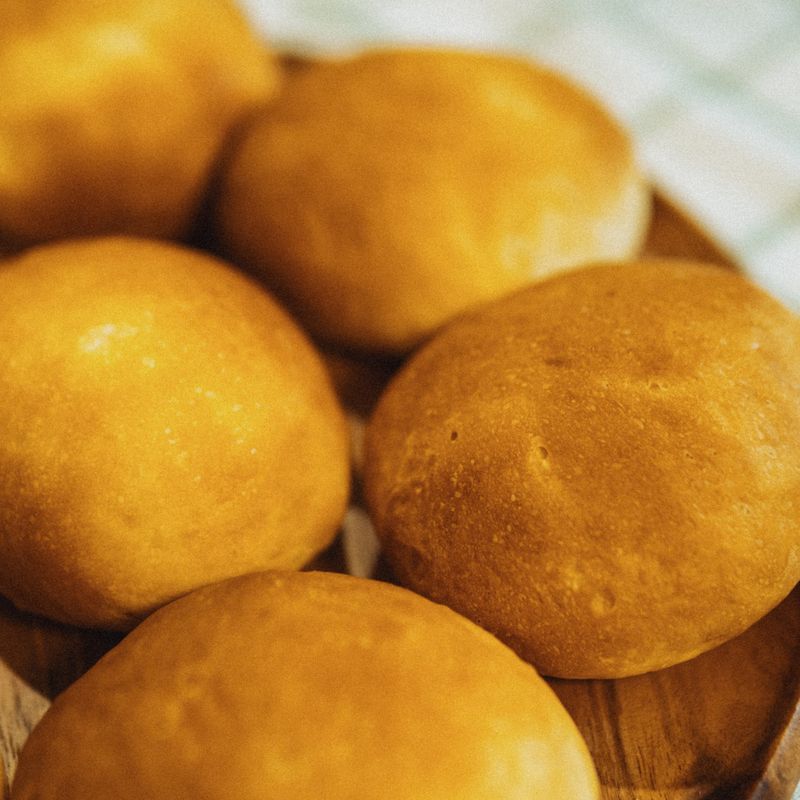
Italian Pane Toscano Salt-Free Rolls
Rustic Tuscan rolls with a crisp, golden crust and tender, open crumb. Made without salt—a centuries-old tradition from Tuscany where sea salt taxes once made it prohibitively expensive. The simplicity of flour, water, yeast, and olive oil allows the quality of each ingredient to shine. Perfect for serving alongside soups, stews, or antipasti, or for tearing and dipping in good olive oil.
- Prep
- 20 min
- Cook
- 25 min
- Wait
- 2 hr 40 min
- Total
- 3 hr 25 min
- Makes
- 8 rolls
Steps
Before you start
- Have all ingredients at room temperature (70–72°F / 21–22°C)
- Preheat oven to 475°F (245°C) 30 minutes before baking
- Use a kitchen scale for accuracy; salt-free doughs are sensitive to hydration
- Do not add salt; it is historically omitted and changes the flavor profile
Mix the dough
- In a large bowl, combine 437g (3.5 cups) flour and 1.5g (½ tsp) instant yeast.
- Add 295ml (1¼ cups) room-temperature water and 30ml (2 tbsp) extra-virgin olive oil.
- Mix with a stand mixer on low speed using the dough hook for 8–10 minutes, or by hand with a wooden spoon and then knead on a counter for 10 minutes, until the dough is smooth and elastic.
- The dough should feel slightly tacky but not sticky—without salt, it will be more delicate than salted doughs.
+ Show details− Hide details
Ready when: Dough is smooth, elastic, and holds together without tearing
Tip: Salt-free dough hydrates faster; if it feels sticky, knead in flour 1 tbsp at a time. Do not over-hydrate.
First rise
- Shape the dough into a loose ball and place it in a lightly oiled bowl.
- Cover with a damp tea towel.
- Let rise at room temperature for 90 minutes until increased in volume by about 50% (not quite doubled, as salt-free doughs rise more gradually).
- The dough should pass the poke test: press a finger into it; the indent should slowly spring back halfway.
+ Show details− Hide details
Ready when: Dough has risen noticeably but still has some spring-back when poked
Tip: In a cool kitchen (below 68°F / 20°C), this may take 2 hours. In a warm kitchen (above 75°F / 24°C), check at 75 minutes.
Preheat ovenOven 475°F / 245°C
- About 30 minutes before shaping, preheat your oven to 475°F (245°C).
- If using a Dutch oven, place it inside to preheat as well.
- This ensures maximum oven spring and crust development.
+ Show details− Hide details
Ready when: Oven thermometer reads 475°F (245°C)
Tip: A preheated Dutch oven traps steam, which creates a crispy, blistered crust.
Divide and pre-shape
- Turn the dough onto a lightly floured counter.
- Divide it into 8 equal pieces (about 60g each) using a bench scraper or knife.
- Pre-shape each piece into a loose round by folding the edges underneath.
- Let them rest uncovered for 10 minutes.
+ Show details− Hide details
Ready when: Pieces hold their round shape; dough is soft and relaxed
Tip: Handle gently—salt-free dough is more fragile and tears easily. Avoid over-handling.
Final shape
- Gently shape each piece into a taut round or oblong roll by cupping your hands around it and rolling it toward you on the counter, creating surface tension.
- Place rolls seam-side down on a parchment-lined baking sheet, about 2 inches (5 cm) apart, or in a lined banneton if you have one.
+ Show details− Hide details
Ready when: Rolls are uniform in shape with taut, smooth surfaces
Tip: Create tension by rolling each piece toward you; this helps them rise upward rather than spreading sideways.
Second rise
- Cover the rolls loosely with a tea towel or place them in a proofing box.
- Let them rise at room temperature for 60 minutes until they are puffy and have increased by about 50–75% in size.
- The rolls should feel airy but still slightly springy when gently poked.
+ Show details− Hide details
Ready when: Rolls are visibly puffier; a gentle poke springs back slowly
Tip: Avoid over-proofing; if they double completely, they may collapse in the oven. Slightly under-proofed is better.
Score and bakeOven 475°F / 245°C
- Carefully transfer the baking sheet to the preheated 475°F (245°C) oven, or if using a Dutch oven, place rolls on a parchment-lined sheet and transfer inside.
- Bake for 22–25 minutes until the rolls are deep golden brown and sound hollow when tapped on the bottom.
- The interior should register 205–210°F (96–99°C) on an instant-read thermometer.
+ Show details− Hide details
Ready when: Rolls are deep golden-brown; they hollow when tapped; interior reaches 205–210°F (96–99°C)
Tip: If rolls are browning too fast, loosely tent with foil for the final 5 minutes. Steam helps crust develop, so keep the oven closed while baking.
Cool and serve
- Transfer rolls to a wire rack and cool for at least 15 minutes before serving.
- They continue to firm up as they cool.
- Serve warm or at room temperature, ideally within a few hours of baking, with good olive oil for dipping or alongside soups and stews.
+ Show details− Hide details
Ready when: Crust is firm; rolls are cool enough to handle without burning
Tip: Do not slice while hot; the crumb is still steaming and will tear. A 15-minute rest ensures better texture.
Good to know
Tips
- Salt-free doughs ferment faster and are more delicate than salted ones. Handle them gently and avoid over-proofing. Under-proof slightly if unsure.
- Without salt to control gluten development, use a kitchen scale for accuracy. Even small changes in flour or water ratio affect the dough's hydration.
- The lack of salt means these rolls are best enjoyed within hours of baking, before they begin to stale. They pair beautifully with soups, stews, or good olive oil for dipping.
- If your kitchen is very warm (above 76°F / 24°C), reduce first-rise time to 75 minutes and check the second rise at 45 minutes to prevent over-proofing.
Make ahead
Dough can be made up to 1 day ahead. After the first rise, divide, pre-shape, and refrigerate on a parchment-lined baking sheet (uncovered or loosely covered) for up to 12 hours. Remove from fridge 45 minutes before the final shape and proof to bring to room temperature, then proceed with final shaping and baking.
Storage & reheating
Room temperature: in a bread box or paper bag for up to 2 days. Refrigerator: in an airtight container for up to 5 days. Freezer: wrap individually or in groups in plastic wrap and foil for up to 3 months. Reheat frozen rolls at 375°F (190°C) wrapped in foil for 15–20 minutes until warmed through. Thawed rolls: warm at 350°F (175°C) for 8–10 minutes.
Substitutions
- bread flour or all-purpose flour → all-purpose flour (use 3¼ cups / 406g for a slightly less structured crumb). All-purpose works fine and produces a slightly softer interior. Bread flour gives more gluten structure and chew.
- instant yeast → active dry yeast (¾ tsp / 2.25g, activated in ¼ cup / 60ml warm water for 10 minutes first). Active dry yeast works but requires rehydration. Results are equally good.
- extra-virgin olive oil → neutral oil like sunflower or grapeseed oil. Olive oil is traditional and contributes flavor. Neutral oil still works but the rolls will lack the characteristic Tuscan flavor.
- room-temperature water → filtered water if your tap water is heavily chlorinated or mineral-heavy. Chlorine can interfere with fermentation. Use filtered if you notice sluggish rise.
More rolls & buns
See all →

Find more like this
- Meal
- Dinner
- Cuisine
- Tuscan
- Method
- Oven
- Quick & Easy
- 5 Ingredients or Less