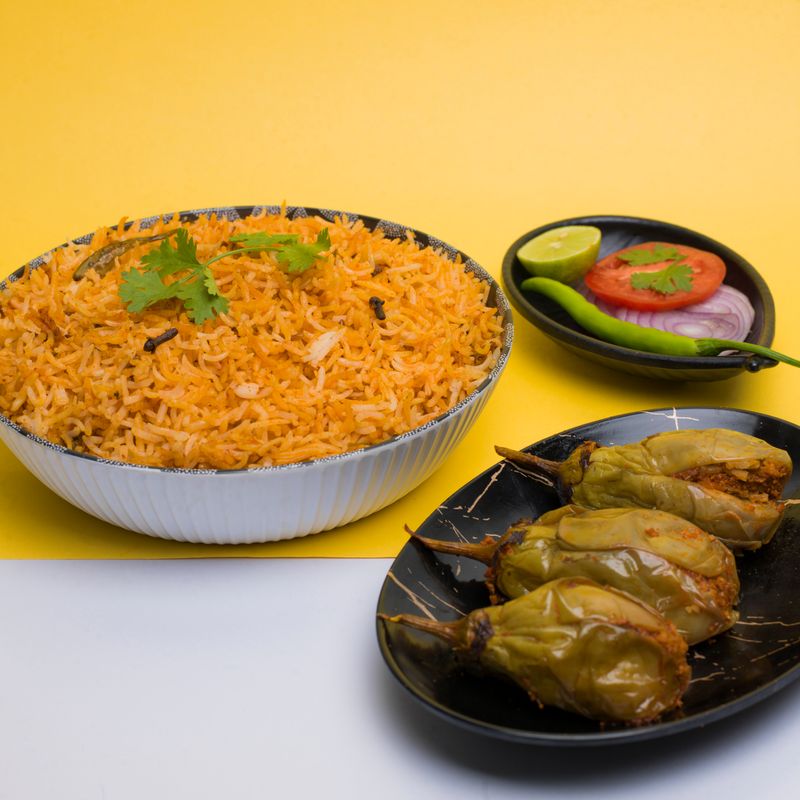
Italian Eggplant and Tomato Biryani
A fusion biryani layering fragrant basmati rice with roasted eggplant, sun-dried tomato, fresh tomato sauce, mozzarella, and basil, then sealed and slow-cooked using the traditional dum pukht method. Aromatic with saffron and cardamom, creamy from the cheese, and brightened by Italian herbs and fresh basil. A surprising cross-cultural marriage that works beautifully.
- Prep
- 30 min
- Cook
- 45 min
- Wait
- 30 min
- Total
- 1 hr 45 min
- Makes
- 4 servings (about 1½ cups per person)
Steps
Before you start
- Soak basmati rice in cold water for 20 minutes, then drain.
- Cut and salt eggplant; let sit 15 minutes to draw out moisture, then pat dry.
- Preheat oven to 425°F (220°C) for roasting eggplant.
- Have all ingredients measured and ready; the layering and sealing happen quickly.
Roast the eggplantOven 425°F / 220°C
- Toss the diced eggplant (after salting and patting dry) with 4 tablespoons (60 ml) of olive oil, salt, and black pepper on a large baking sheet.
- Spread in a single layer.
- Roast at 425°F (220°C) for 20–25 minutes, stirring halfway, until golden and tender.
- Set aside.
+ Show details− Hide details
Ready when: Eggplant is golden-brown and easily pierced with a fork
Tip: Salting the eggplant ahead removes excess moisture so it roasts instead of steaming.
Make tomato sauce
- Heat the remaining 2 tablespoons (30 ml) olive oil in a medium saucepan over medium heat.
- Add the sliced onion and sauté for 3–4 minutes until softened.
- Stir in the minced garlic and cook for 1 minute until fragrant.
- Add the canned crushed tomatoes, chopped sun-dried tomatoes, oregano, and a pinch of salt and pepper.
- Simmer gently for 10 minutes, stirring occasionally.
- The sauce should be rich and slightly reduced.
+ Show details− Hide details
Ready when: Sauce is fragrant and slightly thickened, onions soft
Tip: Simmering the sauce gently allows flavors to meld without burning the bottom.
Boil the rice
- Bring a large pot of salted water to a rolling boil.
- Add the drained basmati rice and boil uncovered for 6–7 minutes until three-quarters cooked (rice should still have a slight firmness in the center when bitten).
- Drain in a colander and set aside.
- The rice will finish cooking in the biryani pot.
+ Show details− Hide details
Ready when: Rice is opaque and tender but still has a firm bite in the center
Tip: Parboiling ensures rice cooks evenly in the sealed pot without turning mushy.
Steep saffron
- While the rice boils, pour ¼ cup (60 ml) of warm broth into a small bowl and add the saffron threads.
- Let steep for 5 minutes to release the color and flavor.
+ Show details− Hide details
Ready when: Broth is golden-yellow and fragrant
Tip: Steeping saffron in warm liquid unlocks its full flavor and color before adding to the rice.
Prepare biryani pot
- Heat the ghee in a large ovenproof Dutch oven or heavy pot (4–5 quart / 4–5 liter) over medium heat.
- Add the cardamom pods and bay leaves, and toast for 1–2 minutes until fragrant.
- Pour in the remaining 2.75 cups (660 ml) of broth and bring to a simmer.
- Season to taste with salt and pepper.
+ Show details− Hide details
Ready when: Broth is simmering and cardamom is fragrant
Tip: Toasting cardamom in ghee blooms its essential oils for deeper flavor.
Layer the biryani
- Begin layering: spread half of the cooked rice evenly in the bottom of the simmering broth pot.
- Over the rice, scatter half of the roasted eggplant, then half of the tomato sauce, and half of the mozzarella pieces.
- Drizzle with half of the saffron-steeped broth.
- Then layer the remaining rice, remaining eggplant, remaining tomato sauce, and remaining mozzarella.
- Pour the remaining saffron broth over the top.
- Finally, scatter the fresh basil evenly over the surface.
+ Show details− Hide details
Ready when: All ingredients are layered and basil is visible on top
Tip: Layering ensures even distribution of flavor. Don't stir—the magic of dum pukht is in the sealed, undisturbed cooking.
Seal and dum pukhtOven 350°F / 175°C
- Cover the pot with a tight-fitting lid.
- If the lid is not snug, wrap the pot's rim with aluminum foil before placing the lid to ensure a tight seal.
- Place the pot over medium heat for 2 minutes to create a bit of steam, then transfer to a preheated 350°F (175°C) oven.
- Cook sealed for 25 minutes.
- You will hear a gentle hissing if the seal is working—this means the biryani is steaming internally.
- Do not open the lid during cooking.
+ Show details− Hide details
Ready when: Gentle steam visible when lid is briefly lifted; rice is tender and fragrant
Tip: Do not lift the lid during cooking or steam and moisture will escape, ruining the biryani. A good seal is essential.
Rest and serve
- Remove the pot from the oven and let it rest, still sealed, for 5 minutes.
- Carefully remove the lid away from your face (steam will be hot) and give the biryani a gentle stir with a fork to fluff the rice and distribute the layers.
- Taste and adjust salt and pepper as needed.
- Serve hot in bowls, ensuring each serving has rice, eggplant, tomato sauce, melted mozzarella, and basil.
+ Show details− Hide details
Ready when: Rice is fluffy and grains separate easily; mozzarella is creamy and warm
Tip: Resting allows the steam to settle and makes the rice easier to fluff without breaking grains.
Good to know
Tips
- The dum pukht seal is critical: if you don't hear gentle hissing or see a bit of steam at the pot's edge, your lid may not be tight enough. If unsure, wrap foil around the rim under the lid.
- Mozzarella is key to the Italian character—its melting creaminess contrasts beautifully with the aromatic rice and eggplant. Don't skip it.
- If you don't have ghee, use clarified butter or a neutral oil (like grapeseed) mixed with a touch of butter for richness.
- This biryani is best enjoyed fresh, the day it's made, while the basil is bright and the mozzarella is still creamy.
Make ahead
You can assemble the biryani pot up to the sealing step 2 hours ahead, keep it covered in the refrigerator, then bring it to room temperature before sealing and cooking in the oven (add 2–3 minutes to the oven time). You can also roast the eggplant and make the tomato sauce up to 6 hours ahead; store them separately in airtight containers and bring to room temperature before layering.
Storage & reheating
Store leftovers in an airtight container in the refrigerator for up to 3 days. Reheat gently in a covered pot over low heat or in a 325°F (160°C) oven for 15 minutes, adding 2–3 tablespoons of broth or water to restore moisture. Do not reheat in the microwave as it will dry out the rice and wilt the basil. Freezing is not recommended due to the fresh mozzarella and basil, which do not freeze well.
Substitutions
- fresh mozzarella → fresh ricotta or fontina cheese. Ricotta adds creaminess without the stringiness of mozzarella; fontina brings deeper, nuttier flavor. Use the same amount.
- fresh basil → fresh Italian parsley or a mix of parsley and mint. Parsley is milder; mint adds a cooling note. Stir in at the end to avoid wilting.
- sun-dried tomatoes (oil-packed) → dried porcini mushrooms, finely chopped. Adds umami depth instead of tomato tang. Rehydrate in warm water first, then chop.
- basmati rice → jasmine or arborio rice. Jasmine works in a pinch but is slightly softer; arborio is creamier. Reduce the boiling time by 1–2 minutes for jasmine.
More biryani
See all →

Find more like this
- Meal
- Dinner
- Main ingredient
- EggplantMozzarella
- Method
- Oven