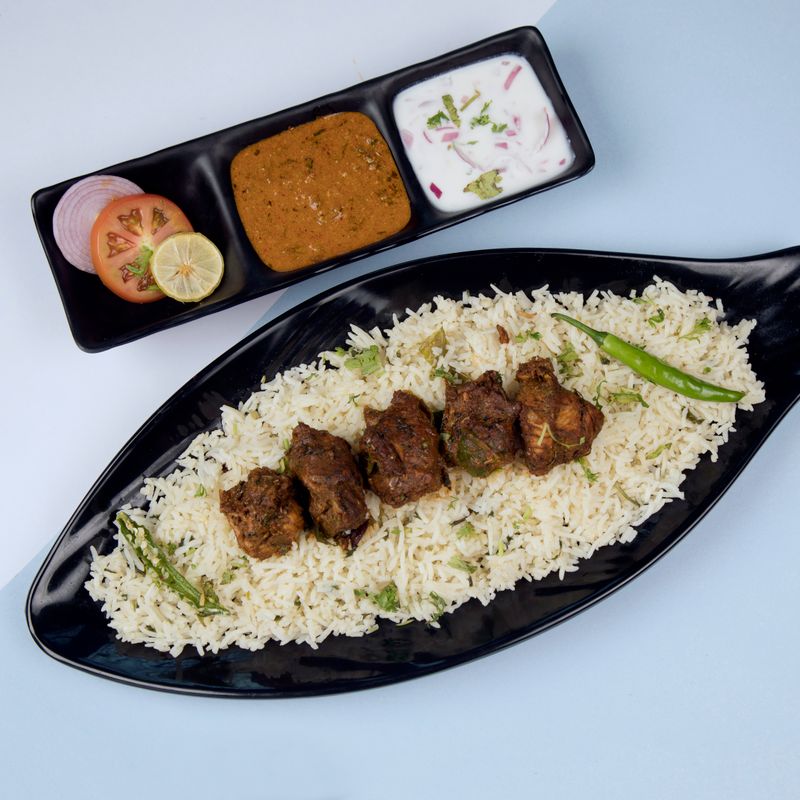
Greek Tzatziki Lamb Biryani
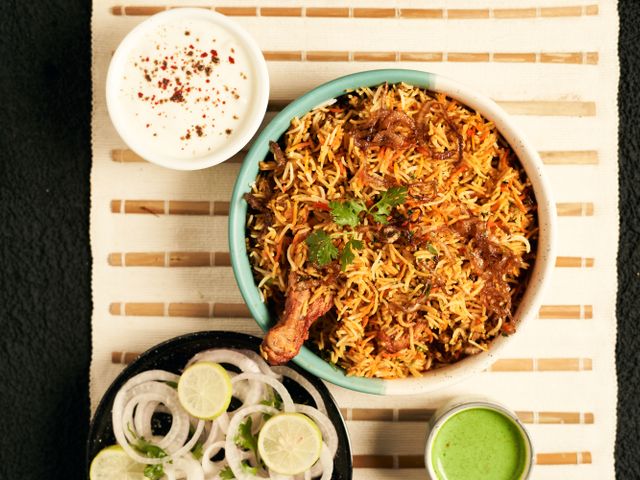
A fusion biryani marrying Indian dum pukht (slow-cooked) technique with Greek tzatziki flavors. Tender lamb slow-cooks in a yogurt and dill marinade layered with fragrant basmati rice, creating a dish where creamy, tangy cucumber and garlic notes meld with warm spices. Finished with fresh dill and cucumber yogurt sauce.
- Prep
- 30 min
- Cook
- 1 hr
- Wait
- 45 min
- Total
- 2 hr 15 min
- Makes
- 4 servings (1½ cups each)
Steps
Before you start
- Cut lamb into 1½-inch cubes and pat dry
- Soak basmati rice in cold water for 20 minutes
- Have all spices measured and ready
- Peel, seed, and finely grate cucumber for the yogurt marinade
Toast whole spices
- In a small dry skillet over medium heat, toast the cumin seeds and coriander seeds for 1–2 minutes, stirring frequently, until fragrant.
- Transfer to a small bowl and let cool for 1 minute, then lightly crush with the back of a spoon.
- Set aside.
+ Show details− Hide details
Ready when: Spices are fragrant and begin to darken slightly
Tip: Don't let them burn; they'll continue to toast off heat
Marinate the lamb
- In a large bowl, combine Greek yogurt, chopped dill, minced garlic, lemon juice, grated cucumber, crushed cumin and coriander, turmeric, salt, and black pepper.
- Stir until smooth.
- Add the lamb cubes and fold gently until every piece is coated.
- Cover with plastic wrap and refrigerate for at least 30 minutes (or up to 12 hours).
+ Show details− Hide details
Ready when: Lamb is fully coated and glistening
Tip: Pat lamb dry before marinating so it browns better in the biryani
Crisp the onions
- Heat 2 tablespoons (30 ml) ghee in a large heavy-bottomed Dutch oven (5-quart/5 L) over medium-high heat.
- Add the sliced onions in a single layer (work in batches if needed) and cook for 4–5 minutes, stirring occasionally, until deep golden and crispy at the edges.
- Using a slotted spoon, transfer the fried onions to a paper towel–lined plate, leaving the ghee in the pot.
- Measure out 2 tablespoons of the crispy onions for garnish and set aside.
+ Show details− Hide details
Ready when: Onions are deep golden brown and crunchy
Tip: Slice onions thin and even so they crisp uniformly; don't stir too much or they'll break apart
Boil the rice
- Fill a large pot with 2 quarts (2 L) of water and bring to a boil over high heat.
- Add the drained basmati rice and salt.
- Stir once and boil, uncovered, for 5–6 minutes until the rice is about 60–70% cooked (it should still have a slight firmness in the center).
- Drain in a fine-mesh sieve immediately and set aside.
+ Show details− Hide details
Ready when: Rice is cooked about 60–70% through; center is still slightly firm
Tip: Don't fully cook the rice; it will finish cooking in the dum pukht (sealed pot) with residual steam
Layer the biryani
- In the Dutch oven with the remaining ghee and fried onion residue, spread half of the parboiled rice in an even layer on the bottom.
- Scatter half of the marinated lamb over the rice (reserve the marinade liquid).
- Top with the remaining rice, then the rest of the lamb, followed by a final thin layer of rice.
- Reserve all the yogurt marinade that clings to the bowl—drizzle it evenly over the top layer of rice.
+ Show details− Hide details
Ready when: Layers are even and marinade is drizzled on top
Tip: Don't mix the layers; keep them distinct so each layer steams separately
Add aromatics and stock
- Distribute the cracked cardamom pods and bay leaves over the top layer of rice.
- Slowly pour the room-temperature stock evenly over the rice, avoiding direct splashing to preserve the layers.
- The stock should come about ¼ inch (6 mm) above the rice surface.
+ Show details− Hide details
Ready when: Stock is distributed evenly and aromatics are in place
Tip: Pour stock slowly and carefully to avoid disturbing the layers
Seal and dum pukht (slow-cook)
- Place the Dutch oven over medium-high heat, uncovered, for 2–3 minutes until you see steam rising and hear a faint sizzle.
- This helps initiate steam buildup.
- Cover the pot tightly with its lid (if your pot's seal isn't perfect, lay a sheet of aluminum foil under the lid to create a tight seal).
- Reduce heat to medium-low and cook, without opening the lid, for 40–45 minutes.
- The bottom of the pot may develop a golden crust; this is desirable.
- You should hear gentle steaming throughout.
+ Show details− Hide details
Ready when: A thin, golden crust (tahdig) forms on the bottom; gentle steam escapes when you lift the lid slightly
Tip: Do not lift the lid during cooking or the steam will escape and rice may not cook evenly. A slightly scorched bottom crust is traditional and delicious, not burnt.
Rest and fluff the biryani
- Turn off the heat and let the biryani rest, covered, for 3–5 minutes.
- Carefully remove the lid (watch for steam) and gently fluff the rice with a fork, mixing the layers lightly to incorporate the lamb and distribute aromatics.
- Discard the bay leaves and cardamom pods.
+ Show details− Hide details
Ready when: Rice is tender and fluffy; lamb is fork-tender
Tip: Fluff gently with a fork to avoid mashing the grains
Make the tzatziki sauce
- While the biryani rests, in a small bowl whisk together the Greek yogurt, diced cucumber, minced garlic, chopped fresh dill, lemon juice, and salt until well combined.
- Taste and adjust salt and lemon juice as needed.
- The sauce should taste bright and garlicky with fresh herb notes.
+ Show details− Hide details
Ready when: Sauce is smooth, well-blended, and creamy
Tip: Squeeze the diced cucumber well so the sauce isn't watery; taste as you go with salt
Plate and garnish
- Divide the biryani evenly among four bowls or plates, making sure each serving includes rice and tender lamb.
- Top each portion with a generous dollop (3 tablespoons/45 ml) of the tzatziki sauce.
- Garnish with the reserved crispy fried onions, fresh dill sprigs, and a few thin cucumber slices if desired.
- Serve immediately with extra tzatziki sauce on the side.
+ Show details− Hide details
Ready when: Biryani is plated, garnished, and ready to serve
Tip: Serve the sauce alongside so diners can add as much as they like; the cool tzatziki balances the warm spiced biryani
Good to know
Tips
- The dum pukht technique is critical: a tight seal prevents steam from escaping, which cooks the rice through residual heat while keeping grains separate. Don't skip the foil under the lid if your pot's seal isn't perfect.
- A thin, golden crust (tahdig) on the bottom of the pot is a sign of success, not a mistake. It adds a crispy, nutty layer. If it becomes charred black, heat was too high.
- Fresh dill is essential to this fusion—it ties the Greek yogurt and biryani together. Dried dill loses much of its delicate flavor and is not a good substitute.
- Let the yogurt marinade cling to the lamb; those droplets add richness and flavor to the biryani. Don't drain them off before layering.
Make ahead
Marinate the lamb up to 12 hours ahead, covered in the refrigerator. The tzatziki sauce can be made 4 hours ahead, covered, and chilled. Crisp the onions up to 2 hours before assembly; store at room temperature in an airtight container. The complete biryani does not reheat well; it is best served fresh from the pot.
Storage & reheating
Leftovers (if any) keep refrigerated in an airtight container for up to 2 days. To reheat, transfer to a heavy pot with a splash of stock, cover tightly, and warm over medium-low heat for 8–10 minutes, stirring gently halfway through. The rice will firm up but remain edible; the tzatziki sauce should be served fresh. Freezing is not recommended due to the rice texture degrading significantly.
Substitutions
- lamb shoulder or leg, cut into 1½-inch cubes → goat shoulder or venison shoulder, cut into 1½-inch cubes. Goat has a lighter, more delicate flavor but works beautifully in this fusion. Venison is gamier; use if you prefer a bolder taste.
- basmati rice → jasmine rice or long-grain white rice. Basmati is ideal, but jasmine or long-grain rice will work; you may need to reduce cooking time by 2–3 minutes in the boiling step as they cook faster.
- ghee → unsalted butter or neutral cooking oil (canola, vegetable). Ghee gives the most authentic biryani flavor, but butter or oil is acceptable; avoid olive oil as its flavor overwhelms the spices.
- fresh dill, finely chopped → fresh mint leaves, finely chopped. Mint is another classic Greek herb and will lighten the marinade; use the same amount. Cilantro is not recommended as it will compete with the Greek flavor profile.
More biryani
See all →


Find more like this
- Meal
- Dinner
- Main ingredient
- Basmati RiceLamb Shoulder
- Method
- Oven
- Quick & Easy
- One-Pot