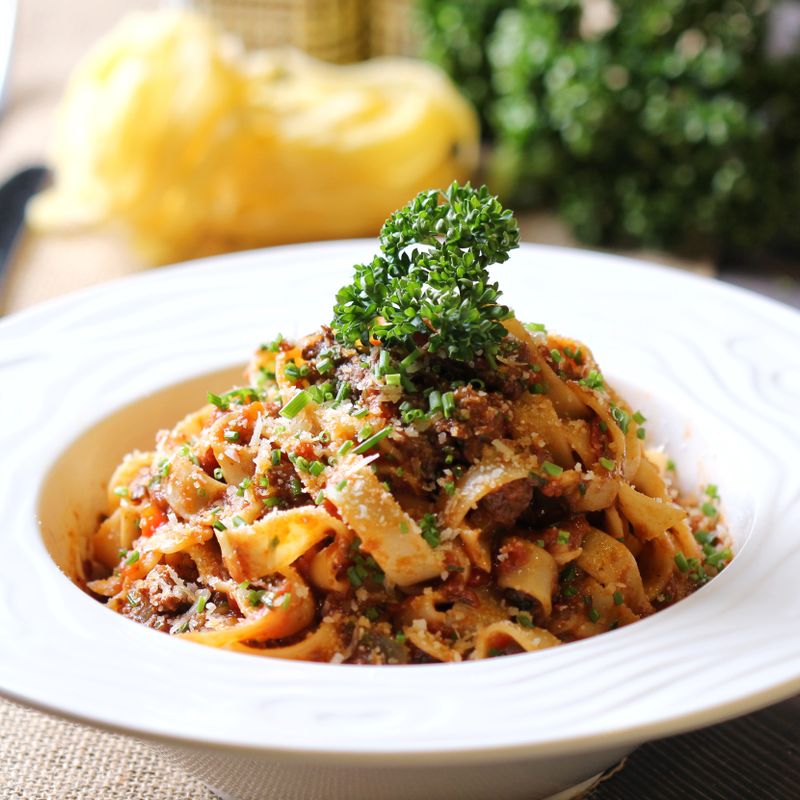
Italian Bolognese Tagliatelle in Broth
A Northern Italian classic where ground beef is browned and simmered with vegetables, tomatoes, and herbs in a rich beef broth, then finished with tender tagliatelle pasta cooked directly in the sauce. The result is a soupy, deeply satisfying dish where the pasta absorbs all the savory flavors—different from a drier Bolognese, this version is meant to be eaten with both a fork and spoon, with plenty of flavorful broth to slurp. Rustic, comforting, and ready in under an hour.
- Prep
- 20 min
- Cook
- 22 min
- Wait
- 18 min
- Total
- 1 hr
- Makes
- 4 bowls (about 1½ cups each)
Steps
Before you start
- Gather and prep all vegetables (onion, carrot, celery, garlic) before starting—the browning steps move quickly
- Have your beef broth warm or at room temperature and ready to add
- Decide whether you'll use fresh or dried tagliatelle: fresh cooks in 3–4 minutes, dried in 10–12 minutes
- Use finely grated Parmigiano-Reggiano, not pre-shredded, for best melting and flavor
- Read through the recipe so you understand the one-pot timing and sequential steps
Brown the ground beef
- Heat the olive oil in the large pot over medium-high heat until shimmering, about 2 minutes.
- Add the ground beef in one clump, pressing it against the hot pot bottom to encourage caramelization.
- Let it sit undisturbed for 2 minutes, then break it into smaller pieces with your wooden spoon.
- Continue cooking, stirring every 1–2 minutes, until the beef reaches an internal temperature of 160°F (71°C) on an instant-read thermometer, with no pink remaining, about 5–6 minutes total.
- You should see flavorful dark fond stuck to the pot bottom.
+ Show details− Hide details
Ready when: Beef reaches 160°F (71°C) internal temperature; no pink remains; brown color throughout; excess fat has rendered slightly
Tip: Avoid stirring constantly—let the meat caramelize undisturbed at first. This develops deep savory flavor through the Maillard reaction. Use an instant-read thermometer for precise food safety.
Sauté aromatics until soft
- Add the diced onion, carrot, and celery directly to the pot with the beef, stirring well and scraping the bottom to loosen any browned bits.
- Cook over medium heat, stirring occasionally, until the vegetables soften and the onion turns translucent, about 3–4 minutes.
- The pot should smell fragrant and sweet.
+ Show details− Hide details
Ready when: Onion is translucent and softened; vegetables are fork-tender at edges; aroma is fragrant and sweet
Tip: The vegetables should soften gently without browning too dark. If the pot is very hot, reduce heat slightly.
Add garlic and tomato paste
- Add the minced garlic and tomato paste to the pot.
- Stir constantly for 1–2 minutes, coating all the meat and vegetables evenly.
- The mixture should smell deeply savory and aromatic, with no raw garlic notes remaining.
+ Show details− Hide details
Ready when: Tomato paste is fully incorporated and has darkened slightly; mixture is very aromatic
Tip: Don't let tomato paste scorch on the pot bottom—if it seems too hot, reduce heat to medium-low for a moment.
Deglaze with wine (optional)
- If using red wine, pour the ⅓ cup into the pot and use your wooden spoon to scrape the bottom, lifting all the stuck-on flavorful fond.
- Let it simmer for 1 minute until the raw alcohol smell dissipates and the liquid reduces by about half.
- If not using wine, skip this step and proceed to step 5.
+ Show details− Hide details
Ready when: Liquid no longer smells of raw alcohol; has reduced to about half its original volume
Tip: Wine adds depth and balances the richness of beef and tomatoes. Omit it if you prefer, and use additional broth instead.
Add tomatoes, broth, and herbs
- Stir in the crushed tomatoes with their juice, the beef broth, bay leaves, and fresh thyme (if using dried thyme instead, add ½ teaspoon now).
- Bring the liquid to a gentle simmer over medium heat, stirring once to combine all ingredients.
+ Show details− Hide details
Ready when: Mixture begins to bubble gently at edges; no raw tomato smell (mixture smells cooked and integrated)
Tip: Don't let it boil hard—a gentle simmer extracts flavor without concentrating the broth too much or making it taste bitter.
Simmer sauce to deepen flavor
- Reduce heat to medium-low.
- Partially cover the pot with a lid (leave it slightly ajar) and let the sauce simmer undisturbed for 15 minutes.
- Stir once or twice midway through.
- The sauce will thicken slightly and deepen in color and aroma.
+ Show details− Hide details
Ready when: Sauce has lost about a quarter of its liquid and looks slightly thicker; color is rich deep red; flavors smell unified and full
Tip: A gentle simmer is better than a rolling boil. Boiling hard can make the sauce taste bitter or astringent.
Add pasta to broth and cook
- Increase heat to medium.
- Gently break the tagliatelle nests in half and add them to the simmering broth.
- Stir with tongs or wooden spoon to separate the strands and distribute evenly.
- For fresh tagliatelle, cook for 3–4 minutes.
- For dried tagliatelle, cook for 10–12 minutes per package directions.
- Taste a strand at the minimum time to check—it should be tender but still slightly firm when bitten (al dente).
+ Show details− Hide details
Ready when: Pasta is tender but still slightly firm to bite (al dente); broth has absorbed some pasta starch and looks slightly creamy; pasta strands yield slightly to pressure but don't break
Tip: If using dried pasta, it cooks longer (10–12 min). Check at 10 minutes to avoid mushiness. Broth will look creamy from released starch—this is correct.
Finish with butter, salt, and pepper
- Remove and discard the bay leaves.
- Taste the broth and season generously with salt and freshly ground black pepper—start with ½ teaspoon each and adjust to your taste.
- If using, stir in the cold butter, which adds a silky, luxurious finish.
- Remove from heat and let the dish rest, uncovered, for 2 minutes before serving.
+ Show details− Hide details
Ready when: Flavors are balanced and savory; butter is melted and incorporated; pasta and broth are at serving temperature
Tip: Season at the end—broth concentrates as pasta absorbs it, so taste before adding salt. You can always add more, but you can't remove it.
Serve and garnish
- Ladle the tagliatelle and broth into four wide, shallow bowls, dividing the pasta and liquid evenly.
- Top each serving generously with freshly grated Parmigiano-Reggiano (about 3 tablespoons per bowl).
- Serve immediately while steaming hot, with extra Parmesan on the side and crusty bread for soaking up the broth.
+ Show details− Hide details
Ready when: Bowls are filled and ready to eat; cheese is visible and fragrant on top
Tip: This dish is best eaten right away while the broth is piping hot and the pasta is at its best tender-firm texture. Serve with crusty bread for soaking.
Good to know
Tips
- Brown the meat properly. Don't rush step 1—let the beef caramelize undisturbed for the first couple of minutes. This Maillard reaction develops deep, savory flavor that carries through the whole dish. Use an instant-read thermometer to confirm the beef reaches 160°F (71°C) for food safety.
- Use fresh tagliatelle if available. It cooks in minutes and has a silky, tender texture that dried pasta doesn't quite match. Look for it in the refrigerated pasta section of the grocery store.
- Season at the end. The broth concentrates and becomes saltier as the pasta absorbs liquid. Wait until step 8 to taste and adjust salt and pepper.
- Serve with crusty bread. This dish is as much about the broth as the pasta—crusty bread is essential for soaking it up. Garlic bread works beautifully too.
- Grate cheese fresh. Pre-grated Parmesan contains anti-caking agents and won't melt as smoothly into the hot broth. A box grater or microplane gives the best result.
Make ahead
The Bolognese sauce (steps 1–6) can be made up to 2 days ahead. Cool completely, transfer to an airtight container, and refrigerate. When ready to serve, gently reheat the sauce over medium-low heat until simmering, then add fresh pasta and cook as in steps 7–9. The finished dish with pasta is best eaten fresh but can be covered and refrigerated for 1 day; reheat gently on the stovetop with a splash of broth to restore creaminess.
Storage & reheating
Room temperature: Not recommended due to ground beef; do not leave out longer than 1 hour. Refrigerator: 3–4 days in an airtight container. Reheat over medium-low heat on the stovetop with a splash of broth or water until simmering. Freezer: Up to 3 months. Freeze the sauce (steps 1–6) without the pasta. Thaw in the refrigerator overnight and reheat gently before adding fresh pasta and cooking. Do not freeze the finished dish with pasta (texture suffers).
Substitutions
- fresh tagliatelle pasta (or 6 oz / 170 g dried) → 6 oz (170 g) dried tagliatelle. Dried tagliatelle will take 10–12 minutes to cook in step 7 instead of 3–4 minutes. Check the package for specific timing and taste at 10 minutes to avoid mushiness.
- dry red wine → ⅓ cup (80 ml) additional beef broth. Omit the wine entirely and add more broth in step 4 instead. The dish will be slightly less complex but still deeply delicious.
- beef broth or stock → Chicken broth or vegetable broth. Chicken broth gives a lighter, less assertive flavor; vegetable broth makes it vegetarian (adjust salt, as vegetable broth is often saltier).
- fresh thyme leaves (or ½ tsp dried thyme) → 1 tsp Italian seasoning, dried oregano, or dried marjoram. Add dried herbs in step 5 with the tomatoes. Fresh herbs are always preferable for depth, but dried work well here.
More noodle soups
See all →


Find more like this
- Meal
- Dinner
- Cuisine
- Italian
- Main ingredient
- Ground Beef
- Diet
- Sugar-Free
- Method
- Stovetop