
Instant Pot Sourdough Congee with Ginger and Scallions
Creamy, tangy congee made with sourdough discard and short-grain rice, cooked under pressure in minutes. Fresh ginger and scallions build brightness, while a soft-boiled egg and optional sesame oil drizzle finish each bowl. This comfort porridge works for breakfast, lunch, or a light dinner—the sourdough adds complexity that plain rice congee lacks.
- Prep
- 10 min
- Cook
- 36 min
- Wait
- 1 min
- Total
- 47 min
- Makes
- 4 bowls (about 2.5 cups each)
Steps
Before you start
- Have sourdough discard at room temperature before starting
- Arrange equipment: Instant Pot (6-quart or larger), small saucepan for boiling eggs, fine mesh strainer
- Read through timing—steps 5 and 6 happen at the same time to save time
- Use room-temperature eggs so they cook evenly
Rinse rice and prep aromatics
- Rinse the rice under cold water in a fine mesh strainer, stirring gently with your fingers for 2–3 minutes until the water runs mostly clear.
- This removes excess starch that would make the congee gluey.
- Peel and mince the ginger finely to yield about 3 tablespoons.
- Slice the scallions into thin rounds, placing the white and light green parts in one small bowl and the dark green tops in another.
- Set the 4 eggs in a bowl of room-temperature water; you'll use these later.
+ Show details− Hide details
Ready when: Rice is rinsed and opaque white with clear water running off; ginger is finely minced; scallions are thinly sliced and separated by color
Tip: Rinsing rice is essential for congee—it removes starch that would make the porridge pasty rather than creamy.
Combine ingredients in Instant Pot
- Transfer the rinsed rice to the Instant Pot insert.
- Add the sourdough discard; it will be thick and cohesive, so use a spoon to break it into small pieces and stir it in thoroughly.
- Add the minced ginger and the white and light green scallion parts.
- Pour in the chicken broth.
- Stir well for about 1 minute, breaking up the sourdough so it disperses into the liquid in small pieces rather than staying as a solid mass.
- The mixture should look like brothy rice with visible particles and no large clumps of sourdough.
+ Show details− Hide details
Ready when: Sourdough is broken into small pieces and mostly dispersed; rice and ginger are evenly distributed throughout the broth
Tip: Breaking up the sourdough well ensures it integrates into the congee evenly and adds its tangy flavor throughout, rather than leaving chewy bits.
Pressure cook the congee
- Close the Instant Pot lid, making sure the sealing ring is seated properly around the rim.
- Set the pressure release valve to "sealing." Select high pressure and set the timer for 15 minutes.
- The Instant Pot will take 3–5 minutes to come to full pressure (the float pin will rise when pressure is reached).
- Do not open the lid during this time.
- After 15 minutes of cooking, the Instant Pot will beep to signal the end of cooking.
+ Show details− Hide details
Ready when: Float pin has risen (full pressure is reached); 15-minute cooking cycle has completed and Instant Pot beeps
Tip: High pressure ensures the rice breaks down fully and the sourdough integrates smoothly, creating creamy congee rather than a grainy or lumpy texture.
Release pressure and open
- Once the cooking timer beeps, carefully turn the pressure release valve from "sealing" to "venting" to quick-release the steam.
- Steam will hiss out—be cautious and keep your face and hands at a safe distance.
- After about 30 seconds of venting, when the hissing subsides, it is safe to carefully open the lid by tilting it away from you.
- Look inside to see the congee.
+ Show details− Hide details
Ready when: Steam has mostly vented and the lid opens easily; congee is visible, very thick and creamy in appearance
Tip: Quick release stops the cooking immediately and is appropriate here since you want to adjust the consistency right away. Do not use natural release for this recipe.
Adjust consistency
- Give the congee a thorough stir.
- At this point, it should be very thick—most rice grains should be broken down or dissolved into the broth, creating a creamy texture with a pale tan color from the sourdough.
- If the congee is too thick and pasty (like very thick oatmeal), add hot water 1/4 cup at a time, stirring well after each addition, until it reaches your preferred consistency.
- Congee should coat the back of a spoon but still flow off slowly.
- If it is too thin and soupy, select "sauté" mode on the Instant Pot and simmer uncovered, stirring frequently, for 3–5 minutes to reduce and thicken it.
- You should see no large sourdough chunks; it should be smooth and creamy.
+ Show details− Hide details
Ready when: Congee coats the back of a spoon and flows slowly; no large chunks visible; color is pale tan; consistency is between thick soup and thin oatmeal
Tip: The congee will continue to thicken slightly as it cools, so if you are unsure, make it a bit looser than your final desired consistency.
Prepare soft-boiled eggs
- While adjusting the congee, bring a small saucepan of water to a rolling boil on the stove over high heat.
- Gently lower the 4 room-temperature eggs into the boiling water using a slotted spoon.
- Set a timer for 6–7 minutes: 6 minutes for soft, runny yolks, or 7 minutes for slightly firmer but still creamy yolks.
- When the timer goes off, use a slotted spoon to remove the eggs to a bowl of ice water and let them cool for 1 minute.
- Gently crack the shell and peel under cool running water, starting from the wider, flatter end where the air pocket is.
- The egg white should be completely opaque and set, while the yolk should still be soft and give slightly when gently pressed.
+ Show details− Hide details
Ready when: Egg whites are completely opaque and set; yolk is soft and creamy but not liquid (it should jiggle slightly when tilted, not run)
Tip: Room-temperature eggs cook more evenly than eggs straight from the fridge. The ice bath stops cooking immediately, giving you the jammy center you want.
Season the congee
- Stir the soy sauce into the hot congee.
- Taste it.
- The soy sauce brings savory depth and saltiness; add a bit more (up to an additional 1 tablespoon) if you want a more pronounced savory flavor.
- Different brands of soy sauce vary in saltiness, so taste as you go.
- If using white pepper, add it now—it brings a subtle warmth and slightly spicy note that complements the ginger without overpowering it.
- Stir until fully incorporated.
+ Show details− Hide details
Ready when: Congee is well-seasoned and tastes savory and balanced; white pepper, if used, is fully incorporated and not visible
Tip: Taste as you add soy sauce—you want to balance the savory depth with the tangy, rich sourdough flavor, not overwhelm it.
Serve
- Ladle the hot congee into four serving bowls, dividing it evenly (you should have about 2–2.5 cups per bowl).
- Gently place one peeled soft-boiled egg in the center of each bowl.
- Sprinkle the dark green scallion tops over each bowl, distributing them evenly across the surface.
- If desired, drizzle each bowl with about 1/2 teaspoon of sesame oil—this adds a rich, nutty aroma and flavor.
- Serve immediately while the congee is still steaming, with extra soy sauce on the side if anyone wants to adjust the saltiness.
+ Show details− Hide details
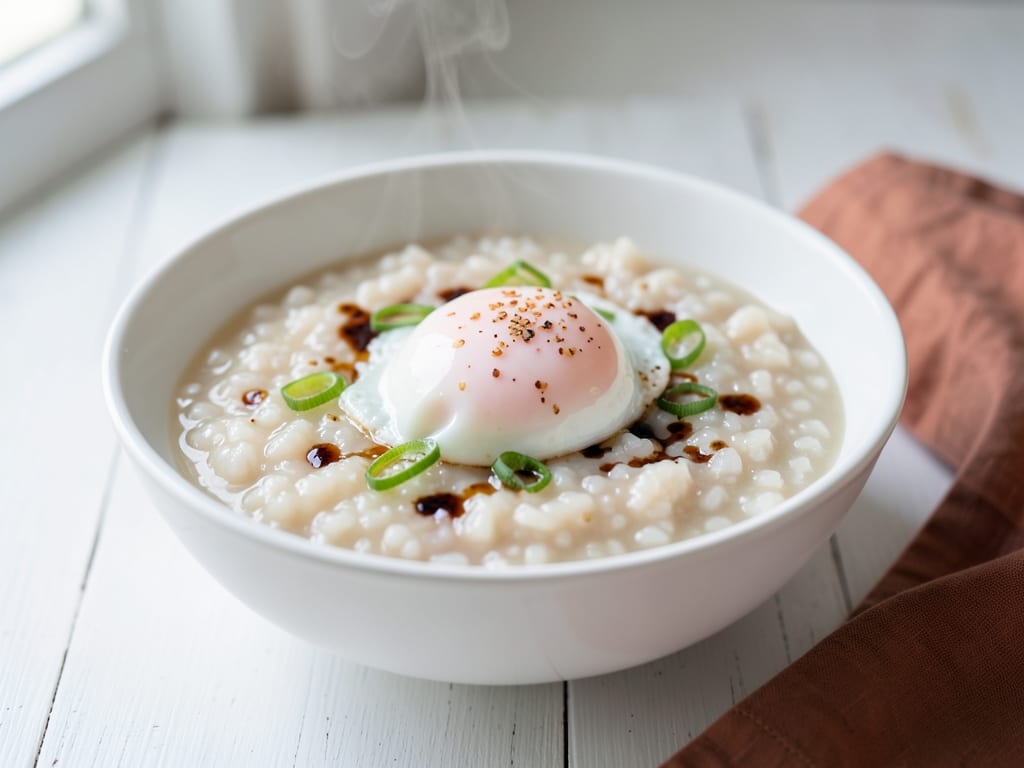
Ready when: Four bowls of steaming congee with a soft-boiled egg in the center of each, green scallion tops scattered on top, and sesame oil shimmering on the surface (if using)
Tip: Sesame oil is optional but highly recommended—just a drizzle adds significant aromatic value and richness to the bowl.
Good to know
Tips
- Sourdough discard creates a naturally tangy, rich congee with more depth than plain rice alone. Fermentation also breaks down the rice faster, contributing to a creamier texture.
- Don't skip rinsing the rice—this removes excess starch and prevents the congee from becoming gluey or pasty instead of smooth and creamy.
- The congee will continue to thicken as it cools, so err on the side of loose when adjusting the consistency. You can always add water later, but you can't remove it.
- For a vegetarian version, use vegetable or bone broth instead of chicken stock, and optionally add more minced ginger (up to 1 tablespoon extra) and an additional tablespoon of soy sauce for deeper flavor.
Make ahead
The congee can be made up to 3 days ahead and refrigerated. Prepare the soft-boiled eggs on the day you serve. Reheat the congee gently in a saucepan over medium-low heat, adding water as needed to restore the creamy consistency, then top with a freshly cooked egg.
Storage & reheating
Refrigerator: Up to 3 days in an airtight container. Reheat gently on the stove over medium-low heat, adding water to loosen the congee as needed. Freezer: Up to 2 months in a freezer-safe container. Thaw overnight in the fridge, then reheat gently with extra water; the texture will be slightly thinner after freezing. Do not freeze the soft-boiled eggs; cook them fresh when serving.
Substitutions
- sourdough discard, unfed (100% hydration) → Active sourdough starter at 100% hydration (1/2 cup), or omit it entirely and use an additional 1/2 cup short-grain rice (1.5 cups total). Sourdough adds tanginess and creaminess due to fermentation; without it, you'll have a milder, more traditional rice congee. If omitted, reduce the broth to 6 cups to keep the liquid-to-rice ratio balanced.
- chicken broth or low-sodium chicken stock → Vegetable broth (for vegetarian), bone broth (for deeper, richer flavor), or water (for a lighter, more delicate base). Bone broth will add body and collagen; vegetable broth keeps it meatless; water lets the sourdough tang and ginger shine. Taste and adjust seasoning accordingly.
- large eggs → Poach the eggs directly in the simmering congee in the final minute before serving (3–4 minutes until whites set), or serve with a beaten raw egg yolk stirred into each hot bowl (Asian style). Poaching in congee integrates the eggs more; stirring in raw yolk (if using very fresh eggs) creates a silky sauce. Both are traditional variations.
- toasted sesame oil → Chili oil (for heat), crispy fried shallots (for crunch and sweetness), fresh cilantro (for brightness), or omit entirely. Each garnish adds a different dimension; sesame oil provides aromatics and richness. Choose based on your preference and what you have on hand.
More oats & porridge
See all →


Find more like this
- Meal
- Breakfast
- Cuisine
- Cantonese
- Method
- StovetopInstant Pot