
Indian Malabar Parotta with Jaggery and Ghee
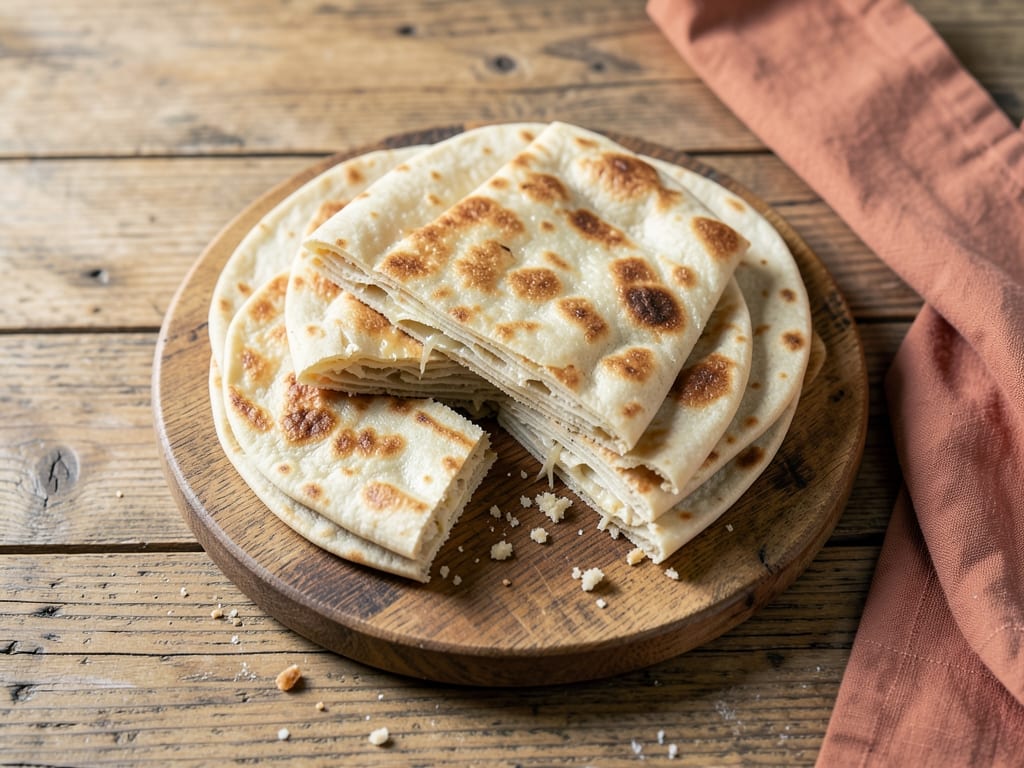
Malabar parotta is a flaky, spiral-layered Indian flatbread from Kerala, traditionally served sweet with jaggery and ghee or savory with curry. This version embraces the sweet preparation, with crumbly jaggery tucked into delicate buttery layers that shatter when torn apart. The dough is stretched paper-thin, brushed with ghee, and coated with jaggery and a pinch of cardamom before being rolled into a tight spiral, then coiled flat and pan-fried until golden. Serve warm with your favorite curry or simply on its own as a dessert bread.
- Prep
- 30 min
- Cook
- 25 min
- Wait
- 1 hr 30 min
- Total
- 2 hr 25 min
- Makes
- 4 parottas (one per person)
Steps
Before you start
- Have all ingredients at room temperature, especially ghee
- Prepare a clean 24×18-inch (60×45 cm) work surface or large cutting board
- Measure jaggery and crush it into fine crumbles
- Heat ghee gently so it's warm but not hot when you use it
Make the dough
- In a large mixing bowl, whisk together 2 cups (250 g) all-purpose flour and ¾ teaspoon (4 g) fine sea salt.
- Create a well in the center and pour in ¾ cup (180 ml) warm water.
- Using your fingers or a fork, gradually mix the flour into the water until a shaggy dough forms.
- Knead by hand in the bowl for 5–6 minutes, adding a few drops more water if needed, until the dough is soft, smooth, and slightly sticky—it should feel like an earlobe.
- The dough will come together cleanly without being stiff.
+ Show details− Hide details
Ready when: Dough is smooth, soft, and slightly sticky; springs back when poked
Tip: A slightly sticky dough is correct—it stretches more easily than a stiff one. Don't add too much water or the parotta will be dense.
First rest and oil
- Cover the dough with a damp cloth or plastic wrap and let it rest at room temperature for 45 minutes.
- This rest allows gluten to relax, making the dough easier to stretch.
- After resting, lightly coat the surface with a little ghee to prevent sticking.
+ Show details− Hide details
Ready when: Dough appears slightly more relaxed and is easy to handle
Tip: Don't skip this rest. It's crucial for being able to stretch the dough thin enough.
Divide into portions
- Divide the dough into 4 equal pieces (about 2.5 oz / 70 g each).
- Roll each piece into a smooth ball by folding the edges underneath toward the center.
- Lightly brush each ball with warm ghee, then place them on a plate and cover with plastic wrap.
- Let them rest for 10 minutes so the gluten relaxes further before stretching.
+ Show details− Hide details
Ready when: Balls are smooth and glossy with ghee
Tip: Rolling balls with tension creates a smooth surface that stretches more easily. Make sure each is truly round.
Stretch the dough
- Place one dough ball on your clean, large work surface (24×18 inches / 60×45 cm minimum).
- Using your fingertips and palms, gently stretch it from the center outward, working all around, until it becomes a thin, nearly transparent rectangle about 16×12 inches (40×30 cm).
- The dough should be so thin you can almost see through it.
- Work slowly and gently—if it tears, pinch it back together.
- It will shrink slightly as you work, which is normal.
+ Show details− Hide details
Ready when: Dough is paper-thin and nearly translucent; no thick areas remain
Tip: Work gently and patiently—rushing causes tears. If the dough resists, let it rest for 1 minute and try again. Small tears can be sealed by overlapping dough slightly.
Brush with ghee and jaggery
- Brush the stretched dough generously with warm ghee, leaving a ½-inch (1.25 cm) border all around.
- Sprinkle about 3 tablespoons (30 g) of crumbled jaggery evenly over the ghee-brushed surface.
- If using cardamom, sprinkle a pinch of crushed cardamom powder over the jaggery.
- The jaggery should be distributed so every bite gets some sweetness.
+ Show details− Hide details
Ready when: Entire surface is ghee-coated and jaggery is evenly scattered
Tip: Crushing jaggery into fine crumbles helps it distribute evenly and prevents clumps that won't melt.
Roll into a spiral
- Starting from one long edge, roll the stretched dough tightly toward you like a fruit roll-up, pressing gently as you roll to keep it snug.
- Once rolled, you'll have a long rope about 2 inches (5 cm) in diameter.
- Pinch the seam lightly to seal.
+ Show details− Hide details
Ready when: Roll is tight and seam is sealed
Tip: Roll tightly but gently—you want an even spiral, not air pockets or loose sections.
Coil and flatten
- Take the rolled rope and coil it into a flat spiral, like a snail shell, on your work surface, tucking the end underneath.
- Gently press it down with your palm until it forms a flat disk about 7 inches (18 cm) across and roughly ½ inch (1.25 cm) thick.
- Brush the top lightly with ghee.
- Let it rest for 5 minutes before cooking.
+ Show details− Hide details
Ready when: Parotta is a flat spiral disk, evenly thick, brushed with ghee
Tip: Don't press too hard or you'll lose the layers. Gentle pressure is all that's needed to flatten it into a disk.
Cook in the skillet
- Heat a 9-inch (23 cm) cast-iron or heavy-bottomed pan over medium-high heat until a drop of water sizzles on contact (about 2–3 minutes).
- Carefully slide the parotta coil onto the hot pan.
- It should sizzle immediately.
- Cook for 2–3 minutes until the bottom is golden brown and crispy, checking by lifting an edge with a spatula.
- Flip carefully and cook the second side for 1.5–2 minutes until it's also golden and crispy with light charred spots.
- The parotta will puff slightly as it cooks.
+ Show details− Hide details
Ready when: Both sides are golden brown to dark golden; bottom is crispy; parotta has puffed slightly and crackles when tapped
Tip: If the parotta browns too fast and the inside isn't cooked, reduce heat to medium for the next batch. Cast iron distributes heat evenly and gives the best results.
Rest and serve
- Transfer the cooked parotta to a plate and let it cool for 1–2 minutes.
- The jaggery inside will set slightly as it cools, and the layers will become more distinct.
- Repeat the stretching, filling, coiling, and cooking process with the remaining 3 dough balls.
- Serve warm, ideally within 30 minutes of cooking, torn into pieces.
+ Show details− Hide details
Ready when: Parotta is warm, layers are visible, jaggery is softened but not runny
Tip: Parotta is best eaten fresh and warm. If made ahead, reheat on a dry pan for 30 seconds per side to re-crisp the layers.
Good to know
Tips
- Warm water (around 100°F / 37°C) is key: water that's too cold slows hydration and makes the dough hard to work with; water that's too hot kills gluten structure. Use lukewarm water you could comfortably hold your finger in for 10 seconds.
- The thinner you stretch the dough, the more delicate and flaky the parotta becomes. Paper-thin is not an exaggeration—you should see your hands through it.
- If the dough tears while stretching, don't panic. Pinch the edges together or overlap them slightly, and continue. Small tears seal during cooking.
- Jaggery can be crumbled with your fingers, grated on a box grater (clean it between uses to avoid residual sugar), or chopped into small pieces. Finer pieces distribute more evenly.
Make ahead
Dough can be made 1 day ahead, wrapped tightly, and refrigerated. Before using, let it come to room temperature (about 1 hour) and proceed from Step 3. Individual parottas can be prepared through Step 7 (coiled and flattened) up to 2 hours ahead, stacked on parchment with plastic between them and kept at room temperature, then cooked to order.
Storage & reheating
Best eaten fresh and warm, but leftovers keep at room temperature in an airtight container for up to 2 days. Reheat in a dry pan over medium-high heat for 30 seconds per side to re-crisp. Can be frozen in an airtight container for up to 1 month; thaw at room temperature and reheat as above. The jaggery and ghee will solidify when cold, which is normal.
Substitutions
- jaggery, crumbled → Brown sugar (use 0.75 cup / 150 g packed brown sugar). Brown sugar is sweeter and less complex, but works well and is easier to find. The flavor will be less caramelly.
- ghee (clarified butter) → Unsalted butter (use 0.5 cup / 115 g). Butter will work but lacks ghee's nutty flavor and higher smoke point. The result will be slightly less flaky.
- green cardamom pods → Ground cinnamon or a pinch of nutmeg. Cinnamon adds warmth; nutmeg gives earthiness. Use about ⅛ teaspoon (0.5 g) of either for a similar flavor impact.
- all-purpose flour → Bread flour (use the same amount by weight). Bread flour's higher protein creates even more structure and flakiness, though the dough is slightly tougher to stretch.
More flatbread doughs
See all →
Find more like this
- Meal
- Breakfast
- Cuisine
- Indian
- Method
- Stovetop
- Quick & Easy
- 5 Ingredients or Less