Flaky Layered Paratha Dough (Whole Wheat, Ghee-Laminated)
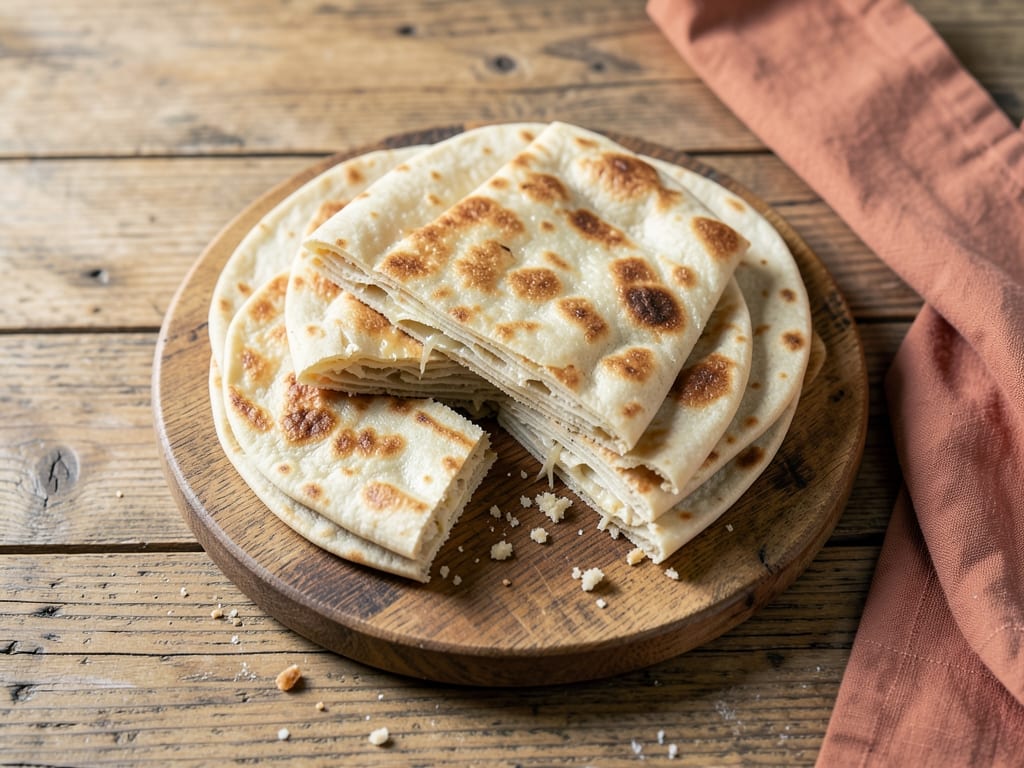
A soft, pliable whole wheat dough that is brushed with ghee and folded into triangles, then pan-fried into golden, flaky, many-layered parathas. Serve with yogurt, pickle, or curry.
- Prep
- 35 min
- Cook
- 22 min
- Wait
- 30 min
- Total
- 1 hr 27 min
- Makes
- 8 parathas (about 6-inch / 15 cm triangles)
Steps
Before you start
- Use fine whole wheat flour labeled atta (chapati flour) if you can; regular whole wheat flour works but needs slightly less water.
- Soften the ghee for layering so it is spreadable but not hot: if solid, warm it gently until just liquid, then let it cool slightly.
- The dough needs a 30-minute rest before rolling, so plan for about 1½ hours total.
- Flours differ in thirst. Hold back the last 2 tablespoons of water and add it only if the dough feels stiff.
Mix flour and salt
- In a large bowl, whisk the 360 g (3 cups) atta and 1 tsp salt together.
- Pour in the 1 tbsp melted ghee and rub it into the flour with your fingertips for about 1 minute, until the mixture looks like damp sand and clumps slightly when squeezed.
+ Show details− Hide details
Ready when: Flour holds together in loose clumps when squeezed.
Tip: Ghee worked into the flour at this stage makes the finished parathas more tender.
Add water, form dough
- Pour in about three-quarters of the 210 ml lukewarm water.
- Mix with your hand in a circular motion until shaggy, then add the remaining water a splash at a time until all the flour is picked up and a rough, slightly tacky dough forms.
- If dry flour remains at the bottom, add water 1 tbsp at a time, up to 2 tbsp total.
+ Show details− Hide details
Ready when: No dry flour left; dough is soft and slightly tacky but doesn't stick to clean fingers.
Knead until smooth
- Turn the dough onto the counter and knead firmly for 8 minutes: push with the heel of your hand, fold, turn, and repeat.
- The dough should become smooth, soft, and springy, like an earlobe.
- If it sticks, dust with a pinch of flour; if it cracks, wet your hands and knead again.
+ Show details− Hide details
Ready when: Surface is smooth and a pressed fingertip dent slowly springs back.
Tip: Under-kneaded dough tears when rolled and bakes up tough rather than flaky.
Rest the dough
- Shape the dough into a ball, place it in the bowl, and cover with a damp towel or plastic wrap.
- Let it rest at room temperature for 30 minutes so the gluten relaxes.
+ Show details− Hide details
Ready when: Dough feels softer and stretches without snapping back.
Tip: Don't skip the rest; it's the difference between easy rolling and a fight.
Divide into balls
- Knead the rested dough for 30 seconds.
- Divide it into 8 equal pieces (about 74 g each).
- Roll each between your palms into a smooth ball and cover them with the damp towel so they don't dry out.
+ Show details− Hide details
Ready when: Eight smooth, crack-free balls of similar size.
Tip: A scale makes the balls even, which means parathas that cook at the same rate.
Roll the first round
- Dust one ball lightly in the dusting flour and flatten it.
- Roll it into a 5-inch (13 cm) circle about ⅛ inch (3 mm) thick, turning it a quarter turn after each roll to keep it round.
- Use only a light dusting of flour.
+ Show details− Hide details
Ready when: An even round circle, not sticking to the counter.
Tip: Too much dusting flour on the surface stops the layers from sticking and makes them dry; tap off any excess.
Laminate with ghee
- Brush the circle all over with about 1 tsp ghee from the layering bowl.
- Fold in half to make a half-moon, brush the top with another ½ tsp ghee, and fold in half again to make a triangle with a rounded edge.
- Dust lightly with flour.
+ Show details− Hide details
Ready when: A neat 4-layer triangle with ghee between each layer.
Tip: Make sure the ghee reaches the edges, or the layers will fuse together and not puff apart.
Roll out the triangle
- Roll the triangle gently with light pressure into a larger triangle about 6 inches (15 cm) per side and ⅛ inch (3 mm) thick, rolling from the center outward.
- Lay it on a plate under a towel.
- Repeat steps 6–7 with the remaining balls, rolling a few while the pan heats.
+ Show details− Hide details
Ready when: Triangle is even in thickness with layers still visibly stacked at the edges.
Tip: Press lightly; heavy pressure squeezes the layers together.
Cook first side
- Heat a skillet or tawa over medium-high heat for 2–3 minutes until a sprinkle of flour browns in about 10 seconds.
- Lay one paratha in the pan and cook 40–60 seconds, until the top shows small bubbles and pale opaque spots appear.
+ Show details− Hide details
Ready when: Surface looks dry with bubbles and a few pale spots.
Tip: If the pan smokes heavily, lower the heat to medium.
Flip and fry in ghee
- Flip the paratha and brush the cooked top with ½ tsp ghee from the cooking portion.
- Cook 40 seconds, flip again, brush the other side with ½ tsp ghee, and cook 30–40 seconds more, pressing gently with a spatula so it puffs and the layers separate.
- Repeat with the rest, reducing heat to medium if browning too fast.
+ Show details− Hide details
Ready when: Both sides are golden brown with darker toasted spots and the paratha feels crisp at the edges but soft in the middle.
Tip: Cook in batches of one at a time unless your pan is very large; crowding drops the temperature and makes parathas pale.
Crush and keep warm
- As each paratha comes off the pan, wrap it loosely in a clean towel or foil.
- Before covering the stack, cup the hot paratha between your palms and push your hands together once or twice to crumple and open the layers.
- Serve warm.
+ Show details− Hide details
Ready when: Visible flaky layers pulling apart when torn.
Tip: Wrapping traps steam, which keeps the parathas soft rather than stiff.
Good to know
Tips
- Keep unused dough balls and rolled parathas under a damp towel; dry surfaces crack and won't layer.
- Roll with light, even pressure from the center out. Heavy rolling squeezes out the ghee layers and makes parathas dense.
- A properly hot pan is key: too cool and parathas turn dry and leathery, too hot and they burn before the layers cook through.
- For a stuffed paratha, use this dough with any dry filling such as spiced potato or grated paneer, sealed in a ball before rolling.
Make ahead
"Make the dough up to 24 hours ahead: after kneading, coat lightly with a few drops of ghee or oil, wrap tightly, and refrigerate. Bring to room temperature for 30 minutes before rolling. Laminated, rolled, uncooked parathas can be stacked between parchment and refrigerated up to 1 day, or frozen up to 2 months and cooked straight from the freezer (add about 1 minute per side)."
Storage & reheating
"Cooked parathas keep at room temperature, wrapped, for up to 6 hours; refrigerated in an airtight container for up to 3 days; and frozen, layered with parchment, for up to 2 months. Reheat in a dry skillet over medium heat for 30–45 seconds per side (from frozen, 1–2 minutes per side) until hot and pliable."
Substitutions
- ghee → unsalted butter or neutral oil (such as sunflower). Butter browns faster, so cook on medium heat; oil works but gives less flavor.
- whole wheat flour (atta) → half whole wheat flour and half all-purpose flour. Gives a lighter, softer paratha; use about 2 tbsp less water.
- water → warm milk. Makes the dough richer and softer; use the same amount.
- ghee → neutral oil. Use the same amount for a vegan paratha when also swapping the other ghee.
More flatbread doughs
See all →
Find more like this
- Meal
- Breakfast
- Cuisine
- North Indian
- Method
- Stovetop
- Quick & Easy
- 5 Ingredients or LessMake Ahead