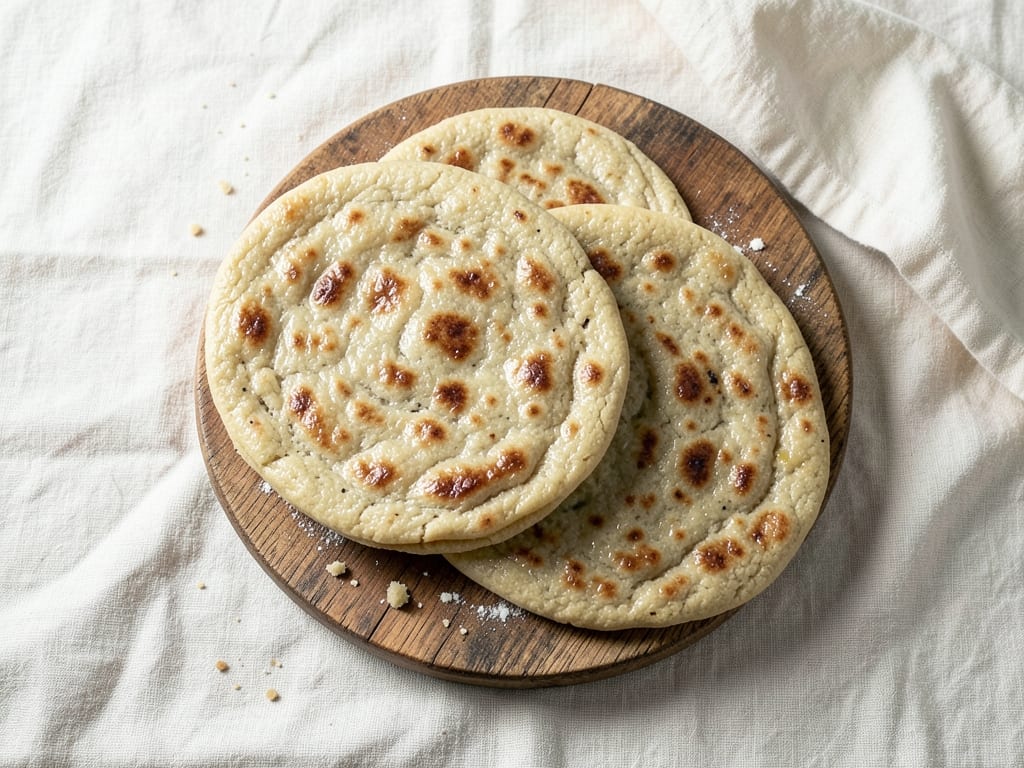
Jamaican Hard Dough Bread Flatbreads
Dense, tight-crumbed and lightly sweet, these oven-baked flatbreads use the classic Jamaican hard dough method: stiff dough, shortening rubbed into the flour and a long knead. They're sturdy enough for sandwiches, saltfish, cheese or soaking up curry and stew gravy.
- Prep
- 47 min
- Cook
- 14 min
- Wait
- 1 hr 45 min
- Total
- 2 hr 46 min
- Makes
- 8 flatbreads (about 6 inches / 15 cm each)
Steps
Before you start
- Use bread flour if you can. Hard dough bread needs high-protein flour for its characteristic dense, chewy crumb.
- Measure the water temperature: it should feel comfortably warm, 105–110°F (40–43°C). Hotter water can kill the yeast.
- The dough is meant to be stiff and much drier than ordinary bread dough. Resist adding extra water.
- Plan on about 2 hours 45 minutes from start to finish, including two rests and a rise.
- Position two oven racks in the upper and lower thirds, but don't preheat until the shaped flatbreads are proofing.
Whisk the dry ingredients
- In a large mixing bowl, whisk together 4 cups (500 g) bread flour, 2 tablespoons (25 g) sugar, 2¼ teaspoons (7 g) instant yeast and 1¾ teaspoons (10 g) fine salt for 30 seconds, until evenly combined.
+ Show details− Hide details
Ready when: No streaks or clumps of yeast or salt are visible.
Tip: Keeping salt and yeast separate until the water goes in isn't necessary with instant yeast, but whisking thoroughly spreads the salt evenly.
Rub in the shortening
- Add the 4 tablespoons (50 g) shortening pieces.
- Using your fingertips, rub the fat into the flour for about 2 minutes, pinching and crumbling until the mixture looks like coarse, slightly damp sand with no visible lumps of shortening bigger than a pea.
+ Show details− Hide details
Ready when: The mixture clumps slightly when squeezed and no large pieces of shortening remain.
Tip: Work quickly so the heat of your hands doesn't melt the shortening completely.
Mix a stiff dough
- Make a well in the center and pour in 1⅛ cups (270 ml) warm water.
- Stir with a wooden spoon or your hand, drawing the flour in from the sides, until a shaggy, stiff dough forms and no dry flour remains at the bottom of the bowl.
- Turn it out onto a clean counter.
+ Show details− Hide details
Ready when: The dough holds together in one rough, firm mass with no dry patches.
Tip: The dough will feel firm and a little dry. That is correct for hard dough bread, so don't add more water.
Knead until smooth
- Knead on an unfloured counter, pushing the dough away with the heel of your hand, folding it back and turning it a quarter turn, for 10–12 minutes.
- (In a stand mixer with the dough hook, knead on medium-low for 8 minutes.) The dough should become smooth, tight and elastic.
+ Show details− Hide details
Ready when: The dough is smooth and springs back slowly when poked with a fingertip. A small piece stretches into a thin, translucent window without tearing right away.
Tip: If the dough feels too hard to knead in the first 2 minutes, let it rest 5 minutes covered. The flour will hydrate and it will soften.
First rise
- Rub the inside of a clean bowl with 1 teaspoon oil.
- Shape the dough into a tight ball, place it in the bowl and turn it once to coat.
- Cover with a towel or plastic wrap and leave in a warm spot (75–80°F / 24–27°C) for about 60 minutes.
+ Show details− Hide details
Ready when: The dough has increased by about half and a fingertip pressed in leaves a dent that springs back slowly.
Tip: Hard dough rises less than soft sandwich dough. Don't wait for it to double.
Divide and rest
- Line two baking sheets with parchment.
- Dust the counter lightly with 2 tablespoons (16 g) flour, turn out the dough and press out the gas.
- Divide into 8 equal pieces of about 108 g each (use a scale).
- Roll each piece into a tight ball, cover with a towel and rest for 10 minutes.
+ Show details− Hide details
Ready when: The balls are smooth and feel noticeably softer and less springy.
Tip: Keep unused dough balls covered so a skin doesn't form.
Roll out the flatbreads
- Roll each ball into a round about 6 inches (15 cm) across and ¼ inch (6 mm) thick, turning it as you roll.
- Place 4 rounds on each lined baking sheet, spaced about 2 inches (5 cm) apart.
- Prick each all over with a fork, which prevents large bubbles.
+ Show details− Hide details
Ready when: Rounds are an even ¼-inch thickness with no thin, see-through edges.
Tip: If a round shrinks back as you roll, cover it and let it rest 3 minutes before rolling again.
Proof brieflyOven 425°F / 220°C
- Cover the sheets loosely with a towel and let the flatbreads proof for 25 minutes.
- Meanwhile, position racks in the upper and lower thirds of the oven and preheat to 425°F (220°C).
+ Show details− Hide details
Ready when: The rounds look slightly puffy, and a gentle fingertip press leaves a dent that fills back in slowly.
Tip: Don't over-proof. The flatbreads should stay dense and chewy, not airy.
BakeOven 425°F / 220°C
- Bake at 425°F (220°C) for 13–15 minutes.
- Switch the sheets between racks and rotate them front to back after 7 minutes so the flatbreads color evenly.
+ Show details− Hide details
Ready when: The tops are deep golden brown with lightly darker spots, and the bottoms are browned and sound hollow when tapped.
Tip: If the bottoms brown faster than the tops, move that sheet to the upper rack for the last few minutes.
Brush and cool
- As soon as the sheets come out, brush the hot flatbreads with the 1 tablespoon (12 g) melted shortening.
- Transfer to a wire rack and cool for at least 10 minutes before serving.
- The crust softens slightly as it rests.
+ Show details− Hide details
Ready when: The surface is glossy and the flatbreads are warm, not steaming hot.
Tip: Stack them under a clean towel while cooling if you prefer a softer crust.
Good to know
Tips
- Weigh the dough pieces so every flatbread is the same thickness and bakes at the same rate.
- A long knead is the key to hard dough bread. Don't stop at 5 minutes, because the dense crumb relies on well-developed gluten.
- For a more traditional loaf-like crumb, roll the rounds a little thicker, about ⅓ inch (8 mm), and add 2–3 minutes to the bake.
- Split the cooled flatbreads and fill them with cheese, fried plantain or saltfish for a classic Jamaican-style sandwich.
Make ahead
"After kneading, the dough can be placed in the oiled bowl, covered tightly and refrigerated for up to 18 hours. Let it sit at room temperature for 45 minutes, then divide, shape, proof and bake as directed. Fully baked flatbreads can also be made a day ahead."
Storage & reheating
"Room temperature: wrap tightly and keep up to 2 days. Fridge: up to 5 days in an airtight bag. Freezer: wrap individually and freeze up to 3 months. Reheat room-temperature or thawed flatbreads in a 350°F (175°C) oven for 5–6 minutes, or in a dry skillet over medium heat for 1–2 minutes per side."
Substitutions
- bread flour → all-purpose flour. Works, but the crumb will be a little less chewy. Reduce the water by 1–2 tablespoons (15–30 ml) if the dough feels sticky.
- vegetable shortening → unsalted butter or margarine. Use the same weight. Butter adds flavor but gives a slightly less tender crumb.
- instant yeast → active dry yeast. Use the same amount, dissolved in the warm water with the sugar for 5–10 minutes until foamy before mixing.
- water → warm whole milk. Gives a softer, richer crumb and deeper browning. Use the same amount.
More flatbread doughs
See all →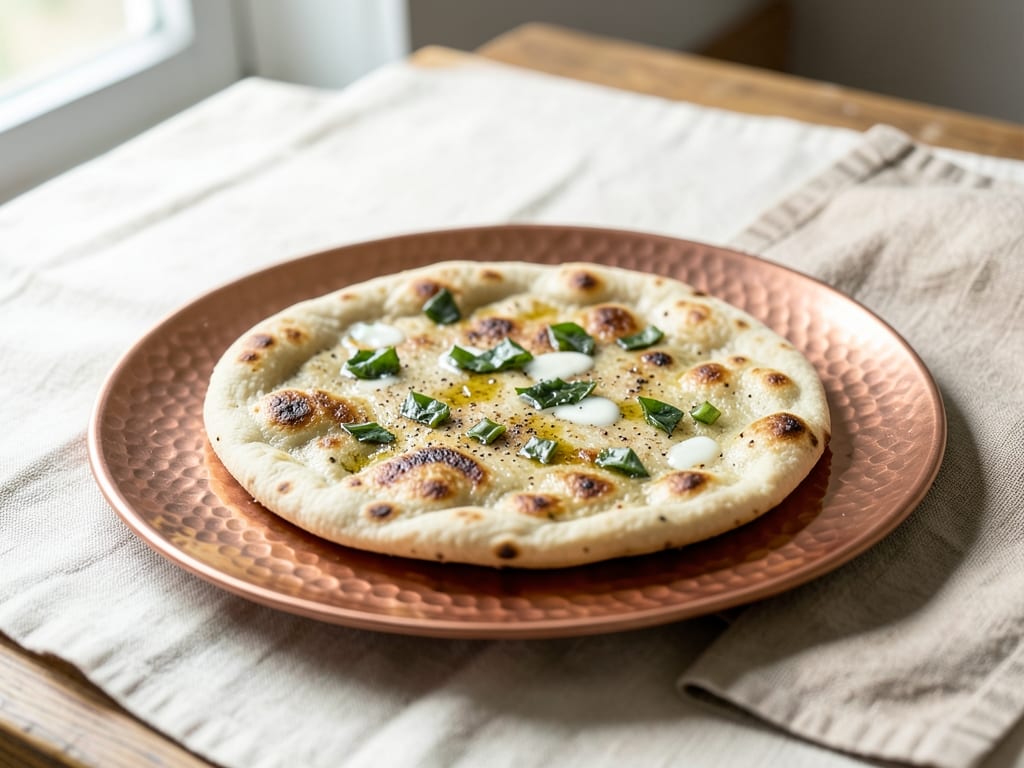
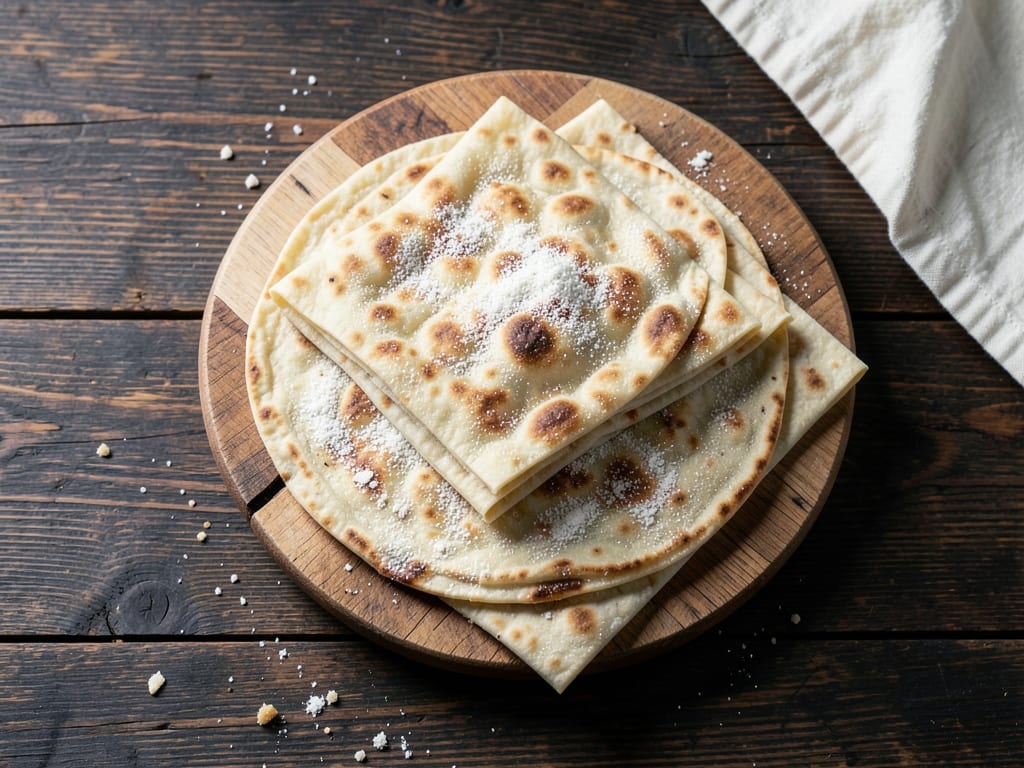
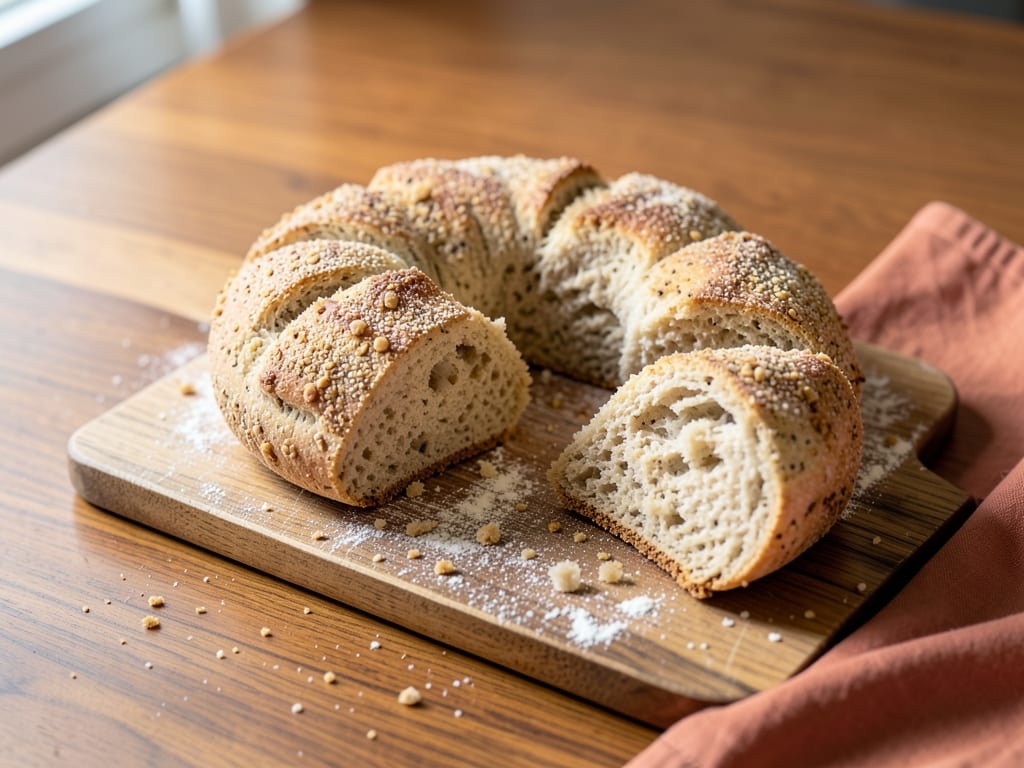
Find more like this
- Meal
- Lunch
- Cuisine
- Caribbean
- Diet
- VegetarianHalal
- Method
- Oven