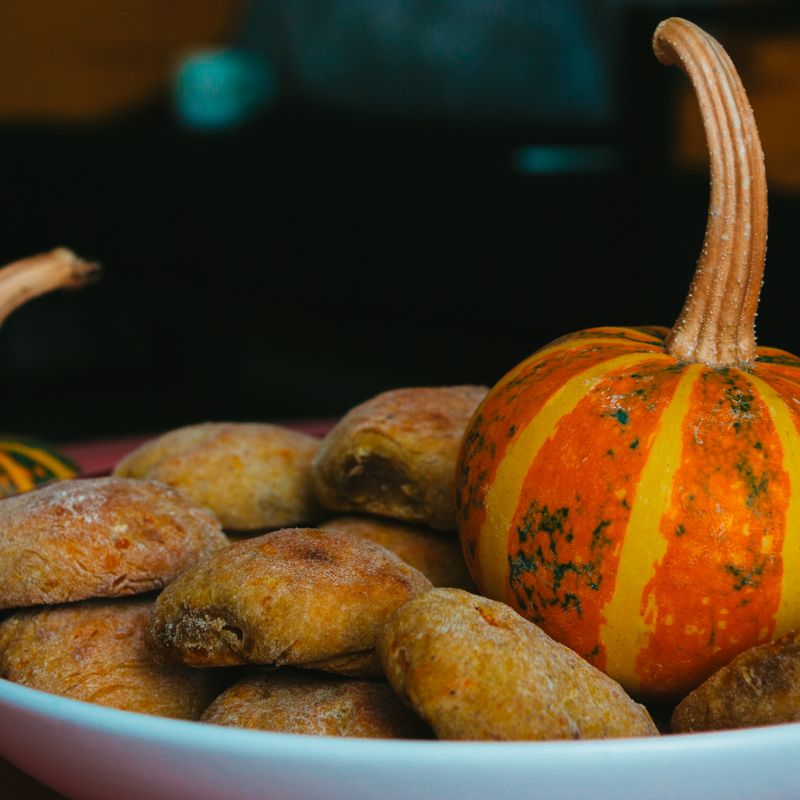
Holiday Eggnog Brioche Buns
Soft, buttery brioche buns infused with the warm spice and rich custard flavor of eggnog. Perfect for holiday breakfasts or as a sweet bread alongside ham and holiday meals. The dough is enriched with eggs, butter, and eggnog, then shaped into individual buns, proofed until pillowy, and baked until golden. A light eggnog glaze finishes them off.
- Prep
- 30 min
- Cook
- 20 min
- Wait
- 2 hr 30 min
- Total
- 3 hr 20 min
- Makes
- 12 buns
Steps
Before you start
- Bring all ingredients to room temperature (65–70°F / 18–21°C) at least 1 hour before starting; cold ingredients will not incorporate properly into brioche dough
- Use a stand mixer with a dough hook for best results; brioche dough is too sticky to knead by hand effectively
- Preheat oven to 375°F (190°C) 15 minutes before baking
Mix the dough
- Add flour, yeast, sugar, and salt to the stand mixer bowl.
- Whisk the 3 eggs with the eggnog and vanilla until combined, then pour into the dry ingredients.
- Using the dough hook on medium speed, mix for 8–10 minutes until the dough is smooth and elastic but still sticky.
- It should pull away slightly from the sides of the bowl but stick to the bottom.
+ Show details− Hide details
Ready when: Dough is smooth, elastic, and slightly sticky; pulls from sides of bowl but sticks to the bottom
Tip: Do not overmix—if you can see the dough hook, you've mixed enough. Overmixing makes brioche tough.
Incorporate the butter
- With the mixer still on medium speed, add the softened butter cubes in 6–8 additions, allowing each portion to be fully incorporated before adding the next (about 2 minutes per addition).
- After each addition, the dough will look shaggy and separated; keep mixing and it will come back together.
- After all butter is added, increase speed to medium-high and beat for another 3–4 minutes until the dough is glossy, smooth, and no longer greasy-looking.
+ Show details− Hide details
Ready when: Dough is glossy, smooth, and elastic; no butter streaks visible; light impression springs back quickly when poked
Tip: Add butter gradually—if you add it all at once, the dough will break and will not emulsify properly.
Add nutmeg and final mix
- Sprinkle the nutmeg over the dough and mix on medium-low speed for about 1 minute until the spice is evenly distributed and the dough has a faint warm beige color.
+ Show details− Hide details
Ready when: Nutmeg is visibly distributed throughout the dough
First rise
- Transfer the dough to a lightly buttered large bowl.
- Cover with plastic wrap or a damp kitchen towel and let rise at room temperature (68–72°F / 20–22°C) for 90 minutes until the dough roughly doubles in size.
- It should look puffy and jiggly when you gently shake the bowl.
- If your kitchen is cool, this may take up to 2 hours.
+ Show details− Hide details
Ready when: Dough has roughly doubled; poking it leaves a slow-to-spring-back indent
Tip: Brioche dough ferments more slowly than standard dough because of the high fat content. Don't rush this step.
Shape the buns
- Turn the dough out onto a work surface lightly dusted with flour.
- Gently punch down the dough to release excess gas (don't be aggressive).
- Using a bench scraper or sharp knife, divide the dough into 12 equal pieces (about 75 g each).
- Gently roll each piece into a tight ball by folding the edges toward the center and rolling it under your palm to seal.
- If the dough is too sticky, chill it for 15 minutes before shaping.
+ Show details− Hide details
Ready when: 12 smooth, evenly sized balls formed
Tip: Don't deflate the dough too much—you want to keep some of the gas bubbles. Tight, smooth buns will proof more evenly.
Place in muffin tin
- Place each ball into a buttered muffin cup, pressing it gently to fit.
- Cover the tin loosely with plastic wrap and let the buns proof at room temperature for 45–60 minutes until they are puffy and rise slightly above the cups.
- They should look soft and full but not leaking over the edges.
+ Show details− Hide details
Ready when: Buns rise above cup rims by about ¼ inch; they jiggle gently when the tin is shaken
Tip: Don't overproof—if they rise too much, they can dome too much in the oven and split unevenly. They should look pillowy but not straining.
Apply egg wash and bakeOven 375°F / 190°C
- Preheat the oven to 375°F (190°C).
- Beat the egg yolk with 1 tablespoon water to make egg wash.
- Lightly brush the top of each bun with egg wash.
- Place the muffin tin in the preheated oven and bake for 18–22 minutes until the buns are deep golden brown on top and a toothpick inserted into the center of a bun reads 190–195°F (88–90°C) on an instant-read thermometer.
+ Show details− Hide details
Ready when: Buns are deep golden brown; internal temperature is 190–195°F (88–90°C); they sound hollow when tapped on the bottom
Tip: Do not underbake—brioche should have a crisp crust but a tender, cooked crumb. A pale bun is underproofed or underbaked.
Cool briefly
- Remove the buns from the oven and let them cool in the muffin tin for 5 minutes.
- Then turn them out onto a wire rack to cool for another 10 minutes before glazing.
- They should still be warm but cool enough to handle.
+ Show details− Hide details
Ready when: Buns are warm and still steaming slightly but can be held without burning fingers
Make the glaze
- While the buns cool, sift the powdered sugar into a medium bowl.
- Add the eggnog a little at a time, whisking until you reach a smooth, pourable consistency similar to heavy cream (you may not need all the eggnog).
- Stir in the nutmeg.
+ Show details− Hide details
Ready when: Glaze is smooth and flows off a spoon; no lumps visible
Tip: Add eggnog gradually—you want a glaze thick enough to coat the buns but thin enough to drip slightly. Too thick and it won't spread; too thin and it runs off.
Glaze the buns
- Drizzle or brush the warm glaze generously over each warm bun, letting it pool slightly on top.
- You can dip the top of each bun directly into the glaze if you prefer.
- Let the glaze set for a few minutes before serving.
+ Show details− Hide details
Ready when: Glaze has stopped dripping and set to a slight crust on top
Tip: Glaze while the buns are still warm so it soaks in slightly and adheres better. Cold buns will cause the glaze to harden too quickly.
Serve
- Serve the buns warm or at room temperature.
- They are best eaten the same day but can be reheated gently.
Good to know
Tips
- Brioche dough relies on the emulsification of butter and eggs—room temperature ingredients are non-negotiable. Cold eggs or butter will cause the dough to break and separate, resulting in a grainy, dense crumb.
- Use a digital scale for flour and butter—scooping directly from the bag compacts the flour and throws off the hydration of the dough. Inaccurate ratios will cause the dough to be too wet or too stiff.
- If your kitchen is very warm (above 75°F / 24°C), the first rise may take only 60–75 minutes. If it is cool (below 65°F / 18°C), allow 2–2.5 hours. Warmer dough ferments faster, but too-fast fermentation can lead to uneven texture.
- Brioche improves in flavor after a few hours of resting—these buns are actually better the next day if stored well. The eggnog flavor becomes more pronounced as the dough ages.
Make ahead
You can prepare the dough through the first rise, then refrigerate it covered for up to 12 hours. Let it come back to room temperature (about 30–45 minutes on the counter) before shaping. Alternatively, shape and freeze the unbaked buns in the muffin tin for up to 3 weeks; thaw overnight in the fridge, then proof for 60–75 minutes before baking.
Storage & reheating
Store cooled buns in an airtight container at room temperature for up to 2 days. Refrigerate for up to 5 days—reheat gently in a 300°F (150°C) oven for 8–10 minutes, covered with foil to prevent over-browning. Freeze in an airtight container for up to 3 weeks; thaw at room temperature, then warm as above. Do not freeze the glazed buns—glaze becomes gritty when frozen.
Substitutions
- whole milk eggnog (not alcohol-free), chilled → heavy cream mixed with whole milk (⅜ cup cream + ⅜ cup milk) plus 1 tablespoon rum and ¼ teaspoon each ground nutmeg and vanilla extract. This gives a richer flavor closer to traditional eggnog, though the brioche will be slightly less sweet.
- unsalted butter → unsalted butter at a slightly warmer temperature (not melted, but closer to 75°F / 24°C) to help it incorporate more smoothly. Warming the butter slightly reduces mixing time and risk of a broken dough.
- bread flour (or all-purpose flour) → all-purpose flour (use the same weight, 440 g), though the crumb will be slightly more tender and less structured. Bread flour gives brioche a slightly sturdier structure; all-purpose will be equally delicious but more delicate.
- instant (rapid-rise) yeast → active dry yeast (increase to 2½ teaspoons / 8 g) or fresh yeast (increase to ½ ounce / 14 g); let the mixture rest for 10 minutes before mixing. Active dry yeast requires a longer fermentation (add 15–20 minutes to the first rise). Fresh yeast will work but is harder to find.
More rolls & buns
See all →
Find more like this
- Meal
- Breakfast
- Diet
- VegetarianHalal
- Method
- Oven
- Occasion
- Christmas