Holiday Cranberry Orange Buns
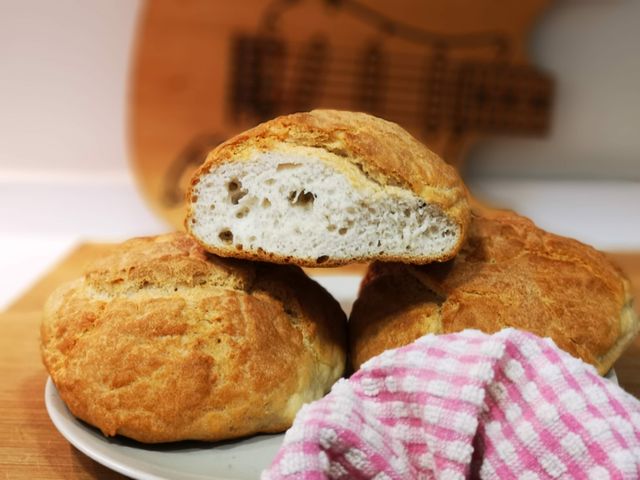
Soft, pillowy buns studded with tart dried cranberries and brightened by fresh orange zest. These yeasted buns are perfect for the holiday table or morning breakfast, with a tender crumb and just enough citrus to balance the sweetness.
- Prep
- 30 min
- Cook
- 25 min
- Wait
- 2 hr 15 min
- Total
- 3 hr 10 min
- Makes
- 12 buns
Steps
Before you start
- Remove milk and eggs from the refrigerator 1 hour ahead so they reach room temperature
- Zest the oranges before juicing or cutting them
- Preheat your oven to 375°F (190°C) about 20 minutes before the second rise is complete
Combine dry ingredients
- In a large mixing bowl or the bowl of a stand mixer, whisk together the flour, instant yeast, sugar, and kosher salt.
- Make sure the yeast is evenly distributed throughout the flour so the dough rises uniformly.
+ Show details− Hide details
Ready when: Mixture appears uniform and no dry streaks remain
Tip: Whisking the yeast into the flour prevents clumping and ensures even rise.
Add wet ingredients
- Add the room-temperature milk, eggs, softened butter, and vanilla extract to the dry ingredients.
- Using a stand mixer fitted with a dough hook (or by hand), mix on medium speed for about 2 minutes until a shaggy dough forms.
+ Show details− Hide details
Ready when: All flour is incorporated and dough is shaggy but cohesive
Tip: Room-temperature milk and eggs mix more smoothly and create a better texture than cold ingredients.
Knead and develop gluten
- Continue mixing on medium speed for 8–10 minutes, stopping to scrape the bowl once or twice.
- The dough should become smooth, elastic, and slightly tacky to the touch but not sticky.
- If mixing by hand, knead on the counter for 10–12 minutes, folding the dough toward you, rotating a quarter turn, and pressing with the heel of your hand.
+ Show details− Hide details
Ready when: Dough is smooth, springs back slowly when poked, and barely sticks to your fingers
Tip: This rest-and-knead approach helps the dough develop structure without overworking it. Stop kneading as soon as the dough is smooth and elastic to avoid dense buns.
Mix in cranberries and zest
- Add the dried cranberries and orange zest to the dough.
- If using a stand mixer, mix on low speed for 1–2 minutes until the fruit and zest are evenly distributed.
- If mixing by hand, knead gently for 2–3 minutes, folding the dough over itself to incorporate the mix-ins without crushing the cranberries.
+ Show details− Hide details
Ready when: Cranberries and orange zest are visible throughout the dough with no white streaks
Tip: Mix gently at this stage to keep the cranberries whole; aggressive mixing can break them up.
First rise
- Shape the dough into a ball and place it in a lightly oiled bowl.
- Cover with a damp kitchen towel or plastic wrap.
- Let the dough rise at room temperature (68–72°F / 20–22°C) for about 60–75 minutes until it has roughly doubled in size.
- To test, poke the dough gently; it should spring back slowly but leave a slight indent.
+ Show details− Hide details
Ready when: Dough has roughly doubled in volume and springs back slowly when poked
Tip: If your kitchen is cold, the rise may take longer (up to 90 minutes). Dough should be puffy but not over-proofed, or the buns will collapse in the oven.
Turn out and divide
- Turn the dough out onto a lightly floured work surface.
- Gently press out excess gas with your hands, then use a bench scraper or knife to divide the dough into 12 roughly equal pieces (about 2 ounces / 55 g each).
- Work carefully to avoid degassing the dough too much.
+ Show details− Hide details
Ready when: Dough is divided into 12 equal pieces with some air pockets still visible
Tip: Use the bench scraper to divide cleanly without tearing the dough, which can cause uneven buns.
Shape buns
- Working with one piece at a time, cup it in your palm and roll it on the counter using gentle pressure to create a smooth ball.
- Repeat with all 12 pieces.
- Place the shaped buns seam-side down in a 9×13-inch (23×33 cm) baking pan, arranging them in 3 rows of 4.
- They should be just barely touching but not crowded.
+ Show details− Hide details
Ready when: All buns are round and smooth with a sealed seam on the bottom
Tip: Rolling each piece creates surface tension that helps the bun rise evenly and prevents deflation.
Second rise
- Cover the pan loosely with a damp kitchen towel or plastic wrap.
- Let the buns rise at room temperature for 45–60 minutes until they are puffy and touching one another.
- They should look soft and pillowy, and a gentle poke should leave a slight indent that doesn't spring back quickly.
+ Show details− Hide details
Ready when: Buns are light, puffy, and touching each other; a poke leaves a slow-rising indent
Tip: Avoid over-proofing, which makes buns collapse or rise unevenly in the oven. If they look puffy after 40 minutes, they're ready.
Bake the bunsOven 375°F / 190°C
- Preheat the oven to 375°F (190°C) about 15–20 minutes before baking.
- Bake the buns uncovered for 22–28 minutes until the tops are golden brown and a toothpick inserted into the center of a bun comes out with just a few moist crumbs clinging to it.
- The internal temperature should reach 190°F (88°C) at the center of a bun.
+ Show details− Hide details
Ready when: Buns are deep golden brown; a toothpick inserted into the center shows moist crumbs; internal temp is 190°F (88°C)
Tip: If the tops brown too quickly, tent loosely with foil in the last 5–8 minutes. Check the center bun for doneness, as edge buns bake faster.
Cool before serving
- Remove the pan from the oven and let the buns cool in the pan for 10 minutes.
- This allows them to set slightly while remaining warm.
- Then turn them out onto a wire rack or serve directly from the pan while still warm.
- The buns will continue to set as they cool.
+ Show details− Hide details
Ready when: Buns are warm but firm enough to handle, bottoms are set
Tip: Cooling in the pan helps the buns stay soft inside while the crust sets. They're best served warm or within a few hours of baking.
Good to know
Tips
- For overnight buns, shape and place in the greased pan, then cover and refrigerate for up to 12 hours. In the morning, remove from the fridge, let come to room temperature (60–90 minutes depending on how cold they were), then proceed with the second rise and bake.
- If your kitchen is very warm (above 75°F / 24°C), reduce the first rise time to 50–60 minutes and the second rise to 35–45 minutes to prevent over-proofing.
- These buns freeze beautifully and reheat to nearly fresh-from-the-oven quality if wrapped tightly in foil and warmed in a 325°F oven for 12–15 minutes from frozen, or 10–12 minutes if thawed.
- For a glossy finish and slight sweetness, brush the warm baked buns with a simple glaze of 1 cup confectioners' sugar mixed with 2–3 tablespoons of fresh orange juice.
Make ahead
Prepare the dough through the end of the first rise the night before. Cover and refrigerate for up to 12 hours. The next morning, shape the buns into the pan and let them come to room temperature (about 1–1.5 hours) before the second rise. Then proceed with the second rise and baking.
Storage & reheating
Store cooled buns in an airtight container at room temperature for up to 2 days. Reheat wrapped in foil in a 325°F (163°C) oven for 10–12 minutes. Freeze baked buns in an airtight container or freezer bag for up to 3 months; thaw and reheat as above, allowing an extra 5 minutes.
Substitutions
- dried cranberries → Dried cherries, dried blueberries, or raisins. Use the same weight. Dried cherries and blueberries will be less tart than cranberries; raisins add more sweetness.
- fresh orange zest, finely grated → Lemon zest or a mix of orange and lemon. Use the same amount. Lemon will be more acidic and sharp; a blend offers complexity.
- whole milk, at room temperature → 2% milk or buttermilk (reduce the amount to 2/3 cup / 160 ml if using buttermilk, and decrease the sugar by 1 tablespoon). 2% milk works directly as a substitute. Buttermilk will make the buns slightly more tender but tangier.
- unsalted butter, softened → Coconut oil or vegetable oil. Use 3 tablespoons (45 ml) of liquid oil in place of the butter. Oil creates a slightly different crumb texture but works well. Coconut oil may impart subtle flavor.