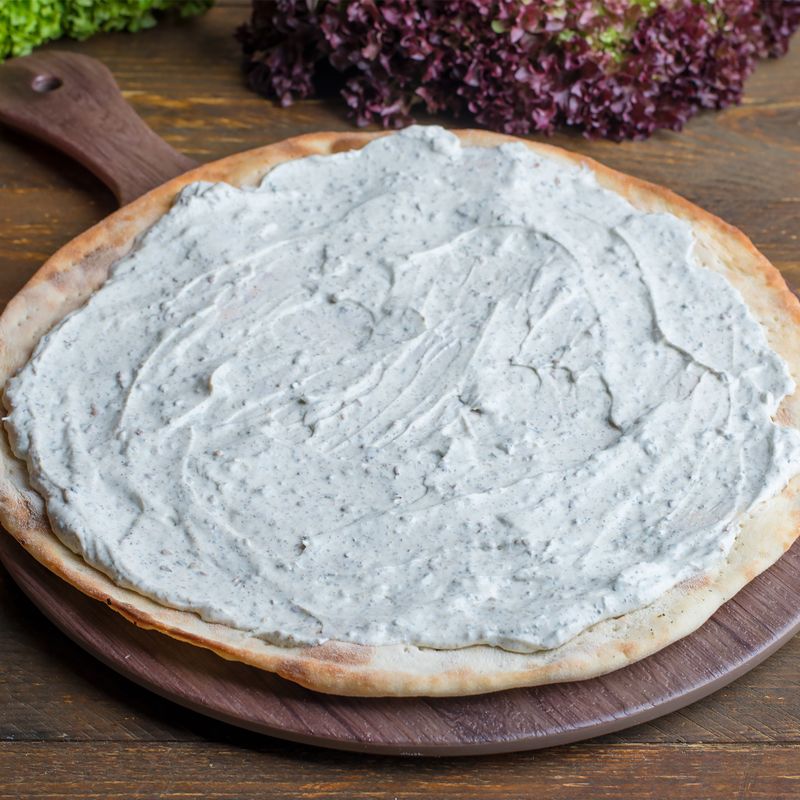
Herb Labneh Spread Flatbread Dough
A tangy, herb-infused flatbread dough made with creamy labneh and mixed fresh herbs. The cultured dairy creates a tender crumb with subtle sourness, while the herbs add brightness. Use this dough to make flatbreads for wraps, dips, or serving alongside mezze platters. The dough is quick to prepare, rests briefly, and cooks fast on a skillet or griddle.
- Prep
- 15 min
- Cook
- 12 min
- Wait
- 30 min
- Total
- 57 min
- Makes
- 4 flatbreads (about 8 inches / 20 cm each)
Steps
Before you start
- Have labneh at room temperature for easier mixing
- Finely chop or measure dried herbs; if using fresh, chop finely and measure by lightly packing
- Heat a cast-iron skillet or nonstick griddle over medium-high heat while dough rests
Mix wet ingredients
- In a large bowl, whisk together the room-temperature labneh and warm water (110°F / 43°C) until smooth and combined.
- The mixture should be creamy with no lumps of labneh remaining.
- This creates the wet base for the dough.
+ Show details− Hide details
Ready when: Labneh is fully dissolved and mixture is smooth
Tip: If labneh is cold, it will lump; warming it first ensures a smooth base.
Add flour, salt, and herbs
- Add the flour, salt, and finely chopped mixed herbs to the wet mixture.
- Stir with a wooden spoon until a rough shaggy dough forms.
- All dry flour should be incorporated; the dough will look slightly sticky and uneven at this stage.
+ Show details− Hide details
Ready when: No dry flour streaks visible; dough is shaggy and holds together
Tip: Don't overwork at this stage; you'll knead next.
Knead the dough
- Turn the dough onto a lightly floured work surface.
- Knead for 8–10 minutes by hand (or 6 minutes in a stand mixer on medium-low speed with the dough hook), adding 1 tablespoon of olive oil partway through.
- The dough should become smooth, elastic, and slightly tacky but not sticky.
- It will feel soft and supple.
+ Show details− Hide details
Ready when: Dough is smooth, springs back when poked, and pulls away cleanly from work surface
Tip: The labneh makes this dough slightly softer than standard wheat dough; don't add extra flour unless it's sticking badly to your hands.
Oil and rest
- Lightly coat the dough ball with the remaining 1 tablespoon of olive oil and place it in a clean bowl.
- Cover with plastic wrap or a damp kitchen towel.
- Let rest at room temperature for 30 minutes.
- During this time, the gluten relaxes and the dough rises slightly.
+ Show details− Hide details
Ready when: Dough appears slightly puffy and relaxed
Tip: Don't skip this rest; it makes the dough much easier to shape and cook evenly.
Divide and shape
- Divide the dough into 4 equal portions.
- Roll each piece into a rough ball, then use your hands or a rolling pin to flatten it into a round or oval about ¼ inch (6 mm) thick.
- If the dough springs back, let it rest for 2–3 minutes, then continue shaping.
- Aim for uniform thickness so each flatbread cooks evenly.
+ Show details− Hide details
Ready when: Each flatbread is ¼ inch thick and holds its shape
Tip: Use a light hand when rolling; overworking the dough will toughen it. A bench scraper helps keep the work surface clear.
Cook on the griddleOven 400°F / 205°C
- Heat a cast-iron skillet or nonstick griddle over medium-high heat (about 400°F / 200°C on a griddle thermometer, or until a drop of water sizzles immediately).
- Place the first flatbread on the hot surface.
- Cook for 2–3 minutes on the first side without moving it.
- You'll see bubbles form and the bottom will turn light golden brown with some light charring.
+ Show details− Hide details
Ready when: Bottom is golden brown with light char; bubbles visible on top surface
Tip: Don't flip too early; give the bottom time to set so it doesn't stick or tear.
Flip and finish
- Flip the flatbread and cook the second side for 1–2 minutes, until it's also light golden and slightly puffed.
- The flatbread should be soft but with some structure.
- Transfer to a plate lined with paper towels.
- Repeat with the remaining three flatbreads, adjusting heat as needed if the skillet is browning too fast or too slowly.
+ Show details− Hide details
Ready when: Second side is golden brown and flatbread is soft and slightly puffed
Tip: Stack the warm flatbreads on a plate and drape with foil to keep them soft and warm while you finish cooking the others.
Good to know
Tips
- The labneh adds moisture and tang that creates a remarkably soft, tender flatbread with a subtle sour note. This is not a tough or chewy dough—it should be pillowy.
- If the dough seems too sticky after mixing, resist the urge to add extra flour; instead, wet your hands lightly as you knead. The warmth and moisture from your hands will help organize the gluten without making it tough.
- For extra flavor and a richer color, toast the herbs lightly in a dry pan for 10 seconds before adding them to the dough. This intensifies their flavor.
- These flatbreads are wonderful warm and fresh, served with hummus, baba ganoush, or labneh spreads, or folded around grilled vegetables and cheese. They also work as wraps for roasted lamb or chicken.
Make ahead
Dough can be made up to 8 hours ahead. After kneading and oiling, cover and refrigerate. Bring to room temperature (about 30 minutes) before shaping and cooking. Alternatively, shape the flatbreads, layer with parchment, wrap tightly, and refrigerate for up to 4 hours; cook directly from the fridge, adding 1 minute to the cooking time.
Storage & reheating
Cooled flatbreads keep in an airtight container at room temperature for 1 day, in the fridge for 3 days, or frozen for up to 3 months. Reheat gently in a dry skillet over medium heat for 1–2 minutes per side, or wrap in foil and warm in a 350°F (175°C) oven for 5 minutes.
Substitutions
- labneh (or Greek yogurt) → Greek yogurt (full-fat or 2% work best). Use the same amount. Greek yogurt has less tang than labneh but gives a similar tender crumb. The dough will behave identically.
- mixed fresh herbs (parsley, mint, dill, oregano) → Dried herbs (oregano, dill, or Italian seasoning). Use 2–3 tablespoons dried herbs instead of fresh. Dried herbs are more concentrated, so start with 2 tablespoons and add more to taste. Mix them in with the flour.
- mixed fresh herbs (parsley, mint, dill, oregano) → Finely chopped scallions or chives. Use the same amount. For a milder herb flavor, substitute or mix with scallions. Add some after kneading to keep them bright, then fold in gently.
- extra-virgin olive oil → Neutral oil (vegetable, canola, or light olive oil). Use the same amount. You'll lose the fruity olive oil flavor but the dough texture will be unaffected.
More flatbread doughs
See all →


Find more like this
- Meal
- Lunch
- Cuisine
- Middle Eastern
- Method
- Stovetop
- Quick & Easy
- 5 Ingredients or LessEasyMake Ahead