Harissa Paste Spice Base
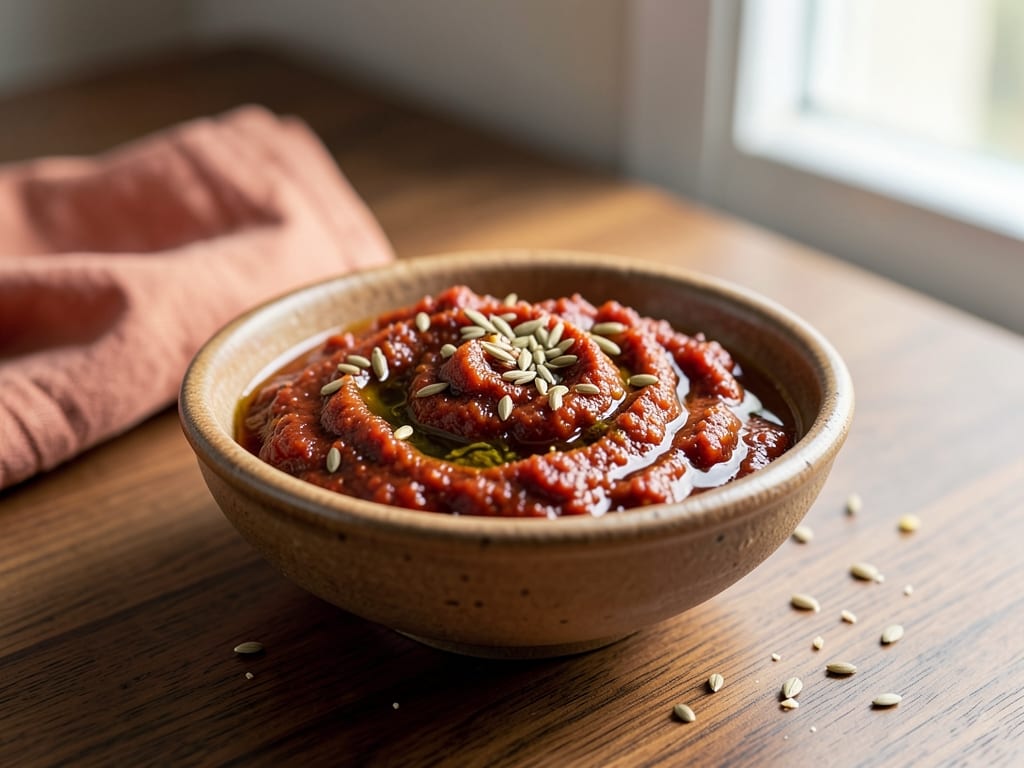
A vibrant, fiery North African spice paste built on dried chiles, warm spices, and garlic. This Tunisian-style harissa is a complex blend of caraway, coriander, cinnamon, and clove balanced with fruity heat from dried red chiles. Make a batch to store in the fridge or freezer for use in tagines, couscous, shakshuka, or as a finishing condiment.
- Prep
- 15 min
- Cook
- 10 min
- Total
- 25 min
- Makes
- About 1 cup (240 ml) harissa paste
Steps
Before you start
- Have a spice grinder or food processor ready
- Toast spices just before grinding for maximum aroma and flavor
- Wear gloves when handling dried chiles to avoid irritating your hands and face
Toast the dried chiles
- Heat a small dry skillet over medium heat.
- Add the destemmed and deseeded dried chiles in a single layer.
- Toast for 2–3 minutes, stirring occasionally, until fragrant and slightly darkened.
- Watch closely so they don't burn.
- Transfer to a bowl and set aside to cool slightly.
+ Show details− Hide details
Ready when: Chiles are fragrant and slightly darker in color
Tip: Toast chiles carefully; burnt chiles taste bitter and will ruin the paste.
Toast the whole spices
- In the same skillet over medium heat, add the caraway seeds, coriander seeds, fennel seeds, and cloves.
- Toast for 2–3 minutes, shaking the pan frequently, until the spices smell warm and toasted.
- Pour into a shallow dish to cool.
+ Show details− Hide details
Ready when: Spices are fragrant and you can hear them popping lightly in the pan
Tip: Toasting releases the essential oils and deepens the flavor; don't skip this step.
Grind the spices
- Once cooled, add the toasted caraway, coriander, fennel, and cloves to a mortar and pestle or spice grinder.
- Grind until they become a coarse powder, about 30 seconds.
- Some small pieces are fine.
- If using a spice grinder, work in batches if needed to avoid overcrowding.
+ Show details− Hide details
Ready when: Spices are broken down into a coarse powder
Tip: Don't over-grind or the spices will release oils and clump; aim for a grainy texture.
Soak the dried chiles
- Place the cooled toasted chiles in a bowl and cover with 1 cup (240 ml) of hot water.
- Let them soak for 5 minutes until softened.
- The water will turn deep red.
+ Show details− Hide details
Ready when: Chiles are tender and easily break apart when pressed
Tip: Save some of the soaking liquid to thin the paste if needed after blending.
Blend the chiles and spices
- Drain the softened chiles, reserving the soaking liquid.
- Add the drained chiles to a food processor along with the ground spice mixture, chopped garlic, salt, and 3 tablespoons (45 ml) of the reserved chile soaking liquid.
- Blend on high speed for 1–2 minutes, scraping down the sides once, until you have a coarse paste.
- Add more soaking liquid a tablespoon at a time if the mixture is too thick to blend.
+ Show details− Hide details
Ready when: Paste is chunky but cohesive, with no large pieces of chile visible
Tip: Don't over-blend; you want texture, not a completely smooth puree.
Stir in the ground cinnamon
- Transfer the blended mixture to a bowl.
- Stir in the ground cinnamon until evenly distributed.
- The cinnamon adds warmth and should be folded in gently rather than blended, which helps preserve its flavor.
+ Show details− Hide details
Ready when: Cinnamon is evenly mixed throughout with no visible white streaks
Tip: If you add cinnamon to the food processor, it can clump; stirring by hand gives better results.
Stream in the olive oil
- Slowly drizzle the olive oil into the harissa paste while stirring constantly with a wooden spoon or rubber spatula.
- The oil should be fully incorporated, creating a smooth, thick paste with a glossy appearance.
- This takes about 2 minutes.
+ Show details− Hide details
Ready when: Harissa is smooth, glossy, and holds together; oil is no longer separating on the surface
Tip: Add the oil slowly so it emulsifies; rushing this step can result in an oily, separated paste.
Taste and adjust
- Spoon a small amount onto a piece of bread or vegetable and taste it.
- Adjust seasoning: if you want more heat, add a pinch more ground dried chile (if you have extra); for more salt, add a few grains at a time.
- Stir well after each adjustment.
+ Show details− Hide details
Ready when: Flavor is balanced between heat, spice warmth, and salt
Tip: Harissa intensifies as it sits; don't over-season on the first taste.
Good to know
Tips
- Wear gloves when handling dried chiles to avoid burning your hands and face; the capsaicin oils linger even after toasting.
- Toast whole spices just before grinding for maximum fragrance and depth; pre-ground spices lose volatile oils quickly and will make a dull paste.
- The soaking liquid from the chiles is precious—it adds chile flavor and natural body to the paste without diluting it with plain water.
- Harissa is a condiment, not a main dish; a spoonful stirred into soups, stews, or grains adds heat and complexity without overwhelming other flavors.
Make ahead
Harissa keeps very well and actually improves after a day as flavors meld. Make a batch and store it for up to 2 weeks in the fridge or 3 months in the freezer. You can also divide it into small jars to give as gifts.
Storage & reheating
Store in an airtight glass jar at room temperature for up to 3 days, in the refrigerator for up to 2 weeks (it develops a deeper color and flavor after 2–3 days), or in the freezer in an ice-cube tray or small jars for up to 3 months. To use frozen harissa, thaw in the refrigerator or scoop out a frozen cube directly into hot dishes. A thin layer of olive oil on top helps preserve it and prevents oxidation.
Substitutions
- dried red chiles (Aleppo or guajillo) → 3 ounces (85 g) dried ancho or New Mexico chiles. These are milder and slightly sweet; use if you prefer less heat. The paste will be less fiery but still complex.
- caraway seeds → 1.5 tablespoons cumin seeds. Cumin adds earthiness instead of caraway's subtle licorice note. Both are warm and traditional in North African cooking.
- coriander seeds → 1.5 tablespoons dried coriander powder (not seeds). If you can't find coriander seeds, use powdered coriander instead; add it with the ground cinnamon in step 6 to avoid over-processing.
- extra-virgin olive oil → 1/2 cup neutral oil (vegetable or light sesame oil). Neutral oils work fine if you prefer a less fruity paste; extra-virgin olive oil is traditional and adds flavor.