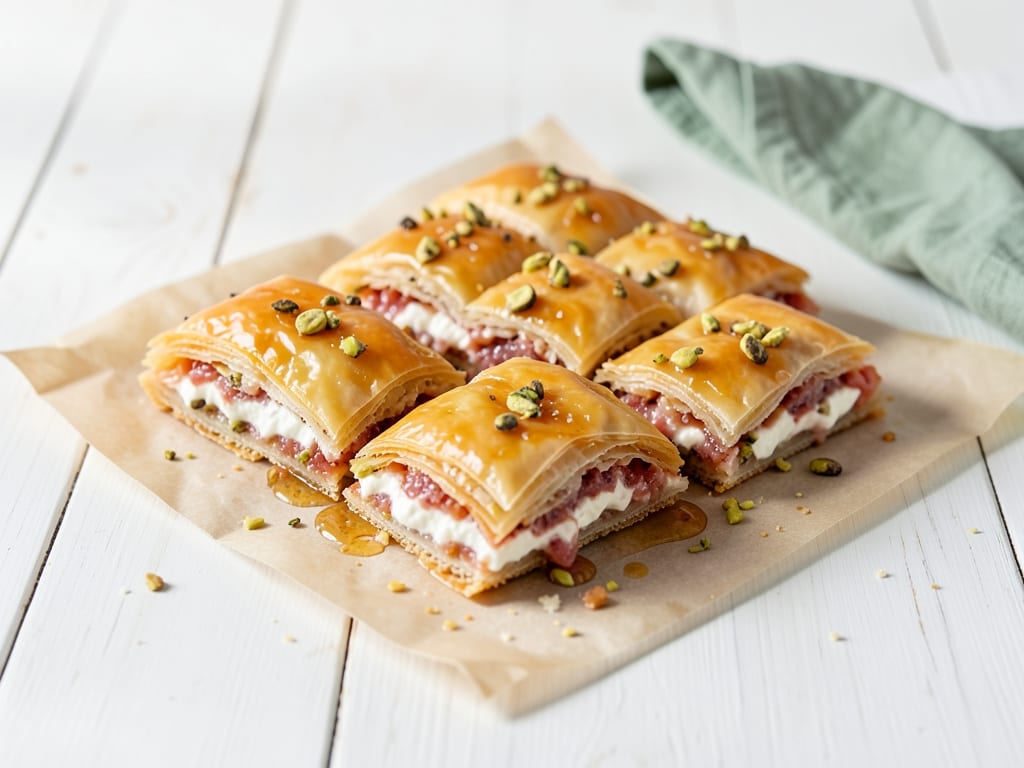
Guava Paste Baklava with Cream Cheese
A fusion of Middle Eastern baklava and Cuban flavors, these delicate phyllo pastries are filled with a creamy mixture of softened cream cheese, sweet guava paste, and finely chopped pistachios. Baked until golden-brown and finished with a warm honey-orange syrup infused with cinnamon, this sophisticated dessert balances richness with tropical fruit notes and the familiar crispness of traditional baklava.
- Prep
- 45 min
- Cook
- 50 min
- Wait
- 1 hr 5 min
- Total
- 2 hr 40 min
- Makes
- 24 pieces (serves 12–16 as a dessert)
Steps
Before you start
- Thaw phyllo dough in the refrigerator for at least 4–5 hours or overnight; never thaw at room temperature as sheets will crack and separate
- Preheat your oven to 350°F (175°C) before you begin assembly
- Have all filling ingredients prepared and at the correct temperature (cream cheese softened, pistachios chopped) before opening the phyllo package
- Keep a damp kitchen towel or plastic wrap ready to cover unused phyllo sheets as you work—phyllo dries out in minutes once exposed to air
- Read through the assembly instructions once before starting so you understand the phyllo layering and can work quickly and confidently
Prepare the honey-orange syrup
- In a small saucepan (1.5 quart / 1.4 liter), combine honey, granulated sugar, water, orange zest, ground cinnamon, and whole cloves (if using).
- Bring to a gentle simmer over medium-high heat, stirring occasionally with a wooden spoon, until the sugar fully dissolves and the mixture is fragrant (about 5 minutes).
- The syrup will appear light amber and slightly thickened.
- Remove from heat and stir in the vanilla extract.
- Let the syrup cool to room temperature for about 20 minutes.
- As it cools, it will thicken further and develop a glossy appearance.
- Do not skip this cooling step—it is essential for achieving crispy baklava.
+ Show details− Hide details
Ready when: Sugar dissolves completely; syrup is fragrant and glossy; no graininess remains
Tip: Do not pour hot syrup onto hot phyllo—the steam will create soggy, droopy pastry and prevent proper browning. Cool the syrup first; you'll pour it on warm (not hot) baklava.
Mix the cream cheese and guava filling
- In a medium mixing bowl, add the softened cream cheese and finely chopped guava paste.
- Using a sturdy wooden spoon or rubber spatula, stir and blend the two together vigorously until completely smooth and uniform with no visible lumps of cream cheese or guava (about 3–4 minutes of steady mixing).
- The mixture should be pale peachy-pink in color.
- Fold in the finely chopped pistachios and fine sea salt with a gentle spatula motion, stirring until the nuts are evenly distributed throughout.
- The final filling should be thick enough to hold its shape when spread, creamy, and studded with visible pistachio pieces.
+ Show details− Hide details
Ready when: Mixture is completely smooth with no lumps; pistachios are evenly distributed; color is uniform throughout
Tip: Make sure the cream cheese is truly softened (not cold from the fridge)—blend it with the guava paste first before folding in the nuts. If you mix nuts in too early, they'll clump and distribute unevenly.
Preheat oven and set up assembly stationOven 350°F / 175°C
- Preheat your oven to 350°F (175°C).
- While the oven heats, brush the 9×13-inch baking pan generously with the cooled melted butter, coating the bottom and all four sides evenly.
- If your phyllo package is older or the sheets appear slightly dried out, lightly mist the stack with a spray bottle of water before opening.
- Lay out all the thawed phyllo sheets in a neat stack and immediately cover them with a damp kitchen towel or large piece of plastic wrap to prevent them from drying out while you work.
- Have your pastry brush, filled butter bowl, and a small bowl of the filling within easy reach.
+ Show details− Hide details
Ready when: Oven reaches 350°F on the display; baking pan is evenly coated with butter
Tip: Phyllo dries out in 2–3 minutes once exposed to air, making it brittle and prone to cracking. The damp towel is your best friend—keep it on whenever you're not actively laying down a sheet. Work as quickly as you can while still being gentle with the delicate sheets.
Layer the phyllo base with butter
- Place one sheet of phyllo dough on the bottom of the buttered 9×13-inch pan, laying it flat.
- Using a soft pastry brush, lightly brush this first sheet with melted butter, starting from the center and working outward toward the edges in smooth, even strokes.
- Cover the phyllo with a light, thin coating—not dripping or puddle-forming, but not dry.
- Lay down a second phyllo sheet on top and brush it with butter in the same manner.
- Repeat this process for a total of 6 phyllo sheets, each brushed on top.
- These six layers form the bottom base of your baklava and provide structure for the filling.
- The layers should be smooth, lightly buttered, and slightly adhered to each other.
+ Show details− Hide details
Ready when: Six phyllo layers are stacked flat in the bottom of the pan; each layer is lightly and evenly buttered
Tip: Use a light, confident hand with the butter. Too much will make the phyllo soggy and overly greasy; too little will result in a tough, crunchy texture. Aim for a thin, visible coat on each sheet. If you apply butter unevenly, the light patches will brown faster than the buttered patches, creating spotty browning.
Spread the filling evenly across the phyllo base
- Using a rubber spatula or the back of a spoon, spread the entire cream cheese and guava filling evenly across the top of the six-layer phyllo base.
- Distribute the filling from edge to edge, leaving a narrow border (about 1/2 inch / 1.25 cm) around the very edges of the pan so the phyllo can crisp up properly.
- Press gently with your spatula to compact the filling slightly so it doesn't shift or mound up when you add the top layers.
- The filling layer should be relatively even in thickness—aim for about 1/4 to 1/3 inch (0.6–0.8 cm) thick.
+ Show details− Hide details
Ready when: Filling is spread in an even layer with no bare phyllo showing through except at the 1/2-inch edge border
Tip: An uneven, thick filling will prevent the top phyllo layers from baking properly and can result in a tough, dense pastry. If the filling is too thick, the layers will steam instead of crisp. Keep it relatively thin and even.
Layer the top phyllo sheets with butter
- Place a new, fresh phyllo sheet directly on top of the filling and brush it lightly with melted butter, using the same light-handed technique as you did with the base layers.
- Repeat this process for 5 more phyllo sheets, brushing each one as you layer it, for a total of 6 top layers.
- On the final (topmost) sheet, apply slightly more butter than usual—about 1.5 times the amount you used on the interior sheets.
- This generously buttered top layer will become beautifully golden-brown and crispy.
- The assembled baklava should feel stable and not shift when you move the pan gently.
+ Show details− Hide details
Ready when: Six top phyllo layers are in place; the topmost layer is generously and evenly buttered
Tip: Apply slightly more butter to the final top layer than the others. This promotes even, even browning and creates that signature crispy, golden-brown finish that makes baklava so appealing. Don't skimp on the top layer's butter.
Score the baklava into individual pieces
- Using a very sharp knife (or a dedicated baklava cutter if you have one), carefully score the entire assembled pastry into 24 individual pieces.
- Cut all the way through the top phyllo layers and the filling, but do NOT cut all the way to the very bottom of the pan—stop about 1/4 inch (0.6 cm) from the pan's base to keep the bottom intact.
- For a classic diamond pattern: first cut 4 parallel lines from top to bottom, dividing the pan into 5 vertical sections.
- Then make 6 angled cuts from left to right (or vice versa) to create diagonal divisions and form diamond shapes.
- Alternatively, cut straight rows (4 columns × 6 rows) for 24 squares.
- Keep your knife sharp and make clean, confident cuts—a dull knife will compress and tear the phyllo layers.
+ Show details− Hide details
Ready when: Pastry is evenly and completely scored into 24 pieces with clean, even cuts; bottom of pan remains intact
Tip: A sharp knife is non-negotiable. A dull knife will mash and compress the delicate phyllo layers instead of cutting cleanly, resulting in uneven pieces and damaged texture. Use a serrated knife or a sharp chef's knife wiped clean between cuts. If you have a pastry cutter or baklava cutter, even better.
Bake until deep golden brownOven 350°F / 175°C
- Place the scored pan in the preheated 350°F (175°C) oven on the middle rack.
- Bake for 40–45 minutes, until the phyllo is deep golden brown all over, including the center and edges.
- The pastry will smell sweet and fragrant—notes of honey, cinnamon, and guava mingling together.
- The edges will be darker and crisper than the center, which is normal and desirable.
- Do not open the oven door frequently; every opening releases heat and extends baking time.
- If you notice the edges browning too quickly before the center looks done (around the 25-minute mark), gently tent the top with a piece of aluminum foil to slow the browning, but make sure the foil doesn't touch the pastry.
- Remove the foil for the final 5–10 minutes to let the center brown.
+ Show details− Hide details
Ready when: Top and sides are deep golden brown (the color of a slightly toasted almond); edges are darker; phyllo is visibly crisp and curled slightly upward at the edges; aroma is strong and sweet
Tip: If the edges are browning too quickly while the center is still pale, tent with foil. Under-baking will result in soft, chewy phyllo instead of crispy. Over-baking will result in a harsh, burnt taste. Watch it closely after 35 minutes. The pastry should be golden brown, not dark brown or charred.
Pour the cooled syrup onto hot baklava
- Remove the baklava from the oven and place it on a heatproof surface (the stovetop is perfect).
- Immediately—while the pastry is still hot—slowly and evenly pour the cooled honey-orange syrup over the entire surface.
- Start at one corner and work your way across and around the pan in slow, deliberate motions, allowing the syrup to seep into the cut lines and be absorbed by the hot, crispy phyllo.
- You should use about 3/4 to 1 cup (180–240 ml) of the prepared syrup; it will pool slightly on the surface and into the crevices.
- Reserve any extra syrup for serving.
- This hot-pastry-meets-room-temperature-syrup combination is the key to maximum flavor absorption and crispness.
- The pastry will glisten and become shiny as it drinks in the syrup.
+ Show details− Hide details
Ready when: Syrup is visibly absorbed into the cuts and pooled slightly on the surface; pastry is shiny, moist, and fragrant; no excess syrup puddles remain
Tip: Never, ever pour hot syrup onto the baklava. And never pour cool syrup onto hot baklava if the syrup is cold from the refrigerator. Room-temperature syrup on hot pastry is the ideal: it absorbs quickly, doesn't create steam, and keeps the pastry crispy. This is the most important technical step in the entire recipe.
Cool and serve
- Let the baklava cool completely at room temperature in the pan for at least 20 minutes before serving.
- As it cools, the syrup will set and the pastry will firm up, making it possible to lift out clean, intact pieces.
- You can serve the baklava warm or at room temperature (many prefer it at room temperature, as the flavors are more nuanced).
- To serve, lift each piece out with a small offset spatula or a thin knife, starting at an edge or a corner.
- Arrange on a platter and optionally drizzle with any reserved honey-orange syrup.
- A dollop of whipped cream, crème fraîche, or Greek yogurt is a lovely accompaniment that cuts through the richness.
+ Show details− Hide details
Ready when: Baklava is no longer hot to the touch; pieces are firm enough to lift out whole without breaking or bending
Tip: Do not refrigerate the baklava while it's still cooling—condensation will form and make it soggy. Let it cool completely at room temperature first. Once fully cooled and served, any leftovers can be stored in an airtight container at room temperature for up to 3 days.
Good to know
Tips
- Phyllo dough is delicate and dries out extremely quickly. Keep all unused sheets covered with a damp kitchen towel or plastic wrap at all times. Work as fast as you can while still being gentle. If you notice a phyllo sheet drying out or cracking, simply use it anyway—the cracks will close up and disappear during baking once the butter sets, and no one will notice the imperfection. Baklava is very forgiving.
- The key to crispy, flaky baklava is brushing each phyllo layer lightly but evenly with butter—not dripping wet, but not dry. Use a soft pastry brush and broad, confident strokes. If you apply too much butter, the pastry becomes dense and greasy; too little and it becomes tough. Think of buttering each layer as creating a thin, gossamer veil.
- Do not skip cooling the syrup before brushing it on the hot baklava. Hot syrup on hot phyllo creates steam, which produces soggy, droopy pastry that never crisps up properly. Room-temperature syrup on hot pastry ensures maximum absorption while maintaining crispness. This is the most critical technique in the entire recipe.
- For a less-sweet version, reduce the honey to 1/2 cup and add 1/4 cup fresh orange juice to the syrup. The citrus will balance the sweetness and complement the guava and cinnamon beautifully. You'll lose some richness but gain complexity and brightness.
Make ahead
The cream cheese and guava filling can be prepared and refrigerated in an airtight container for up to 2 days. The honey-orange syrup can be made up to 3 days ahead and stored in an airtight jar in the refrigerator; bring it to room temperature before using. The phyllo can be assembled, scored, and cut (but not baked) up to 4 hours ahead; cover the pan tightly with plastic wrap and refrigerate until you're ready to bake. The entire baklava can be baked a full day ahead and stored in an airtight container at room temperature; gently reheat in a 300°F oven for 5–10 minutes before serving to restore the phyllo's crispness and refresh the aroma.
Storage & reheating
Room temperature: Store in an airtight container or resealable bag for up to 3 days. The phyllo will soften slightly but remain delicious and edible. The flavors develop and mature over time. Refrigerator: Not recommended unless absolutely necessary—baklava absorbs moisture in cold storage and becomes soft and soggy. If you must refrigerate, store in an airtight container and consume within 2 days. Reheat in a 300°F oven for 5–10 minutes before serving. Freezer: Unbaked baklava (after assembly and scoring) can be frozen in an airtight container or wrapped tightly in plastic wrap for up to 3 months. Bake directly from frozen, adding 5–10 minutes to the baking time. Baked baklava can be frozen for up to 2 months in an airtight container. Thaw at room temperature for 30 minutes and reheat gently in a 300°F oven for 5–10 minutes to restore crispness."
Substitutions
- raw (unsalted) pistachios, skins on → 1.5 cups finely chopped raw almonds, walnuts, or a 50/50 mix. Almonds and walnuts are traditional Middle Eastern baklava fillings with a milder, earthier flavor. They work equally well in this recipe and provide excellent structure. Use the same amount by volume.
- guava paste → 10 oz finely diced ripe fresh mango or 10 oz apricot paste. Fresh mango adds tropical sweetness but releases more liquid and provides less structural integrity than guava paste. Apricot paste is denser and more traditional in some Middle Eastern baklavas; it will bake more cleanly. If using fresh mango, pat it dry with paper towels first.
- cream cheese (Philadelphia style or full-fat), softened to room temperature → 6 oz ricotta cheese, drained and strained through cheesecloth for 30 minutes. Ricotta is lighter and less rich than cream cheese but still provides creaminess and moisture. It must be strained first to remove excess whey, or the filling will be too wet and the baklava will become soggy. Taste and adjust salt as needed.
- honey (preferably clover or wildflower) → 3/4 cup pure maple syrup or brown rice syrup. Maple syrup and brown rice syrup provide sweetness with distinct flavor profiles. Maple adds a woodsy, slightly earthy note that complements the guava and pistachio. Use the exact same volume as honey.
More middle eastern sweets
See all →
Find more like this
- Meal
- Dessert
- Cuisine
- Middle Eastern
- Main ingredient
- Cream Cheese
- Diet
- VegetarianHalal
- Method
- Oven