Greek Koulouri Buns
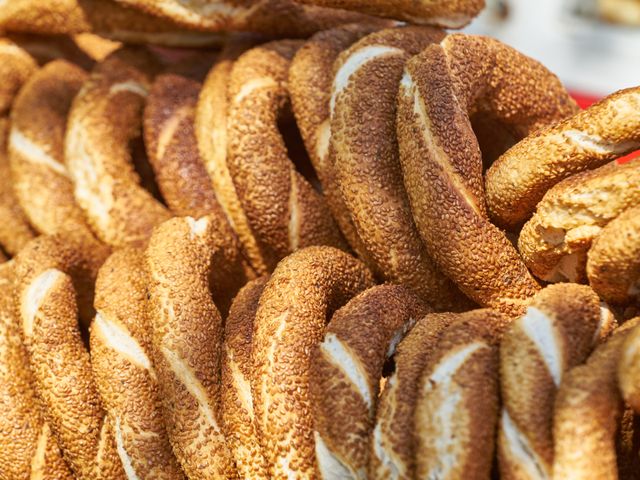
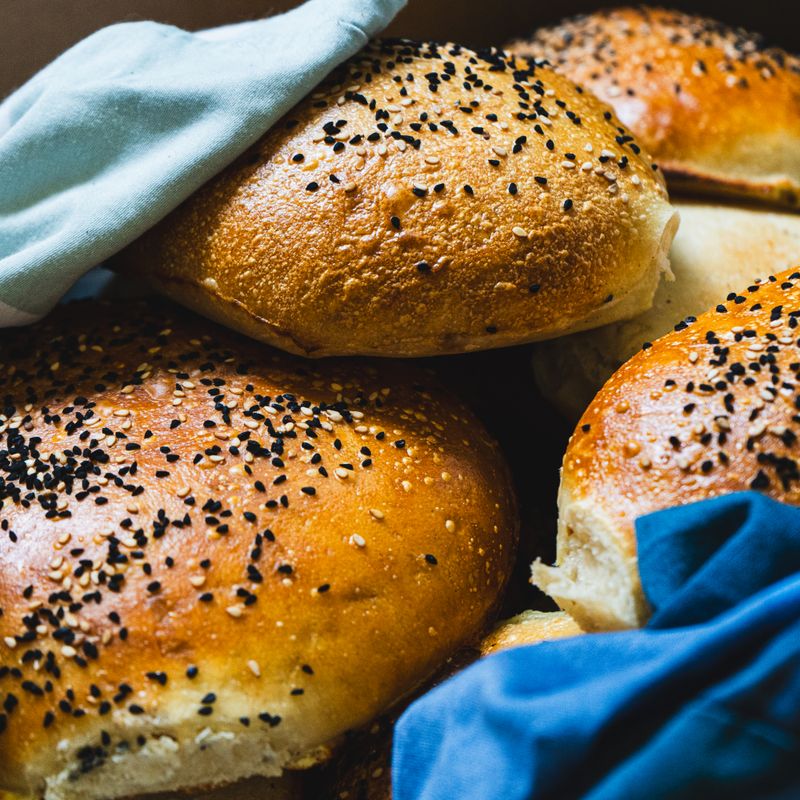
Crispy-exterior, chewy-crumb Greek sesame seed rings with a hint of orange zest and mahlepi spice. These iconic breakfast buns have a glossy, deeply browned crust topped with toasted white sesame seeds. Perfect warm from the oven or cooled, they're a staple from street vendors to home tables across Greece. The dough is enriched with olive oil and perfumed with traditional Greek spices, creating an irresistible balance of crunch and softness.
- Prep
- 30 min
- Cook
- 20 min
- Wait
- 2 hr 15 min
- Total
- 3 hr 5 min
- Makes
- 12 buns
Steps
Before you start
- Preheat oven to 425°F (220°C) about 15 minutes before baking.
- Make sure your yeast is active and fresh (check expiration date).
- Have a large bowl of ice water ready for the final glaze.
- Line two baking sheets with parchment paper.
Bloom the yeast
- Pour the warm water into a small bowl.
- Sprinkle the instant yeast over it and stir gently.
- Let it sit for 5 minutes until it becomes foamy and smells yeasty.
- This confirms the yeast is active.
+ Show details− Hide details
Ready when: Mixture is foamy and smells strongly of yeast
Tip: If the yeast doesn't foam, it's dead—use fresh yeast and start over.
Mix the dough
- In a large bowl, whisk together the flour, salt, sugar, orange zest, and mahlepi (if using).
- Make a well in the center.
- Pour the bloomed yeast mixture and olive oil into the well.
- Using a stand mixer with a dough hook (or mixing by hand), combine until a shaggy dough forms, then knead for 8–10 minutes on medium speed (or 10–12 minutes by hand) until the dough is smooth, slightly sticky, and elastic.
- The dough should pass the windowpane test—a small pinch should stretch thin without tearing.
+ Show details− Hide details
Ready when: Dough is smooth, elastic, and springs back when poked
Tip: Don't over-knead; the dough should be slightly sticky to ensure a tender, open crumb.
First rise
- Shape the dough into a smooth ball.
- Lightly oil the large bowl, place the dough in it, and turn to coat all sides.
- Cover with plastic wrap or a damp kitchen towel.
- Let it rise at warm room temperature (68–75°F / 20–24°C) for 60 minutes, or until nearly doubled in size.
+ Show details− Hide details
Ready when: Dough has increased by roughly 50–75% and is puffy
Tip: Warm water bath or a turned-off oven can speed rising if your kitchen is cool.
Divide and shape
- Turn the dough onto a lightly floured surface.
- Divide it into 12 equal pieces (about 55 g each).
- Roll each piece into a 10-inch (25 cm) rope, then form it into a ring by connecting the ends and pressing firmly to seal.
- Place each ring on the prepared baking sheets, spacing them about 2 inches (5 cm) apart (6 per sheet).
- Cover loosely with plastic wrap.
+ Show details− Hide details
Ready when: All dough pieces are shaped into rings with sealed seams
Tip: Make the rings even in thickness; thin spots will bake too dark while thick spots stay pale.
Second riseOven 425°F / 220°C
- Let the shaped rings rise at warm room temperature for 30–40 minutes until visibly puffy but still holding their shape (they should not completely double).
- Meanwhile, preheat your oven to 425°F (220°C).
+ Show details− Hide details
Ready when: Rings are noticeably puffed and spring back slowly when gently pressed
Tip: Under-proofing yields a denser bun; over-proofing makes them collapse during baking. Stop when they're puffy, not fully doubled.
Prepare the glaze station
- Pour the ice-cold water into a shallow bowl or dish.
- Pour the sesame seeds into another shallow dish.
- Set both next to your oven and baking sheets.
+ Show details− Hide details
Ready when: Both bowls are filled and within reach of the oven
Tip: Cold water creates a better glaze than warm; it helps sesame seeds adhere and creates a glossy finish.
Glaze and seed the buns
- Working quickly, use a pastry brush to wet the top and sides of each ring with ice-cold water (a quick, generous coat).
- Immediately dip the wet ring into the sesame seeds, rotating it to coat all sides, then place it back on the baking sheet.
- Repeat with all rings.
- The water-and-seed coating should be generous and even.
+ Show details− Hide details
Ready when: All rings are heavily coated with sesame seeds and glistening wet
Tip: Don't skip the ice water—it's essential for the seeds to stick and the crust to brown deeply.
Bake the koulouriOven 425°F / 220°C
- Place both baking sheets in the preheated 425°F (220°C) oven.
- Bake for 18–22 minutes, rotating the sheets halfway through (at the 10-minute mark) for even browning.
- The buns are done when the crust is deep golden brown, almost mahogany in color, and the sesame seeds are toasted and fragrant.
- The bottoms should sound hollow when tapped.
+ Show details− Hide details
Ready when: Crust is deep golden-brown, sesame seeds are toasted and fragrant, bottoms sound hollow when tapped
Tip: If the sesame seeds start burning before the crust browns (around 15 minutes), lower the oven to 400°F (200°C) for the remainder.
Cool and serve
- Transfer the baked koulouri to a wire cooling rack.
- Let them cool for at least 10 minutes (they'll crisp further as they cool) before serving.
- They are best enjoyed warm or at room temperature, within a few hours of baking, when the crust is still crisp.
+ Show details− Hide details
Ready when: Buns are warm to the touch and crust is set and crisp
Tip: Avoid stacking them while hot; they'll soften from steam. Space them on the rack for air circulation.
Good to know
Tips
- The ice-cold water glaze is non-negotiable—it's what gives koulouri their signature glossy, deeply browned crust and helps the sesame seeds adhere. Room-temperature or warm water won't work as well.
- Dough temperature matters: aim for a final dough temperature of around 75°F (24°C) after mixing. If your kitchen is cold, use slightly warmer water (up to 115°F / 46°C) when blooming the yeast.
- Mahlepi is a traditional Greek spice (ground cherry kernels) that's increasingly available at specialty shops and online. It imparts a subtle almond-like aroma—use it if you can find it, but the buns are still excellent without it.
- Koulouri freeze beautifully both before and after baking. Unbaked dough rings stay fresh frozen for 3 weeks; baked buns for 1 month. This recipe scales easily—double it for 24 buns and use two pairs of baking sheets.
Make ahead
You can prepare the dough through the end of the first rise (Step 3) up to 8 hours ahead. After the first rise, punch down gently, wrap tightly in plastic, and refrigerate. The next day, remove from the fridge, let it come to room temperature for 30 minutes, then divide, shape, and proceed from Step 4. Alternatively, shape the buns, cover, and freeze them (unbaked) for up to 3 weeks; thaw at room temperature for 1 hour before the second rise, then bake as normal.
Storage & reheating
Room temperature (covered loosely): up to 2 days; crust will soften over time. Refrigerator (in an airtight container): up to 5 days; reheat unwrapped in a 350°F / 175°C oven for 5–7 minutes to re-crisp the crust. Freezer (in a freezer-safe container or bag): up to 1 month; thaw at room temperature for 1–2 hours, then reheat as above.
Substitutions
- mahlepi (cherry kernel spice) → ¼ tsp ground cardamom or ⅛ tsp ground clove. Mahlepi is traditional but hard to find; cardamom gives a warm, floral note that's closer to the original. Omit entirely if unavailable—the buns will still be delicious.
- orange zest → 1 tsp lemon zest or omit. Lemon zest is brighter and more tart; use it if you prefer. The citrus is optional but adds complexity.
- bread flour or all-purpose flour → all-purpose flour (already listed as an option above). Bread flour yields a slightly chewier crumb; all-purpose flour creates a more tender bun. Both work well.
- white sesame seeds → nigella seeds, black sesame seeds, or a mix of both. Black seeds create striking visual contrast and a nuttier flavor. White sesame is most authentic, but the buns are beautiful and delicious either way.