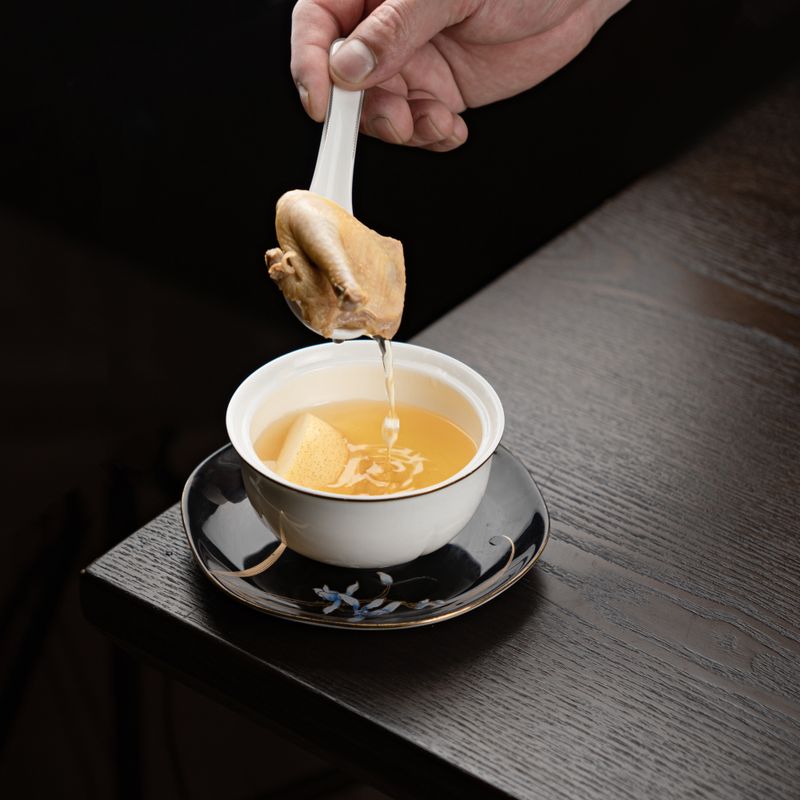
Ginger and Scallion Chicken Broth
A clear, aromatic Asian-style chicken broth infused with fresh ginger, scallions, and a whisper of soy sauce. Perfect as a base for soups, noodle dishes, or served on its own. This broth extracts deep chicken flavor through gentle simmering and benefits from a good carcass—use bones from a roasted chicken, poached chicken, or ask your butcher for backs and necks. Extended simmering ensures food safety whether your carcass is raw or cooked.
- Prep
- 15 min
- Cook
- 1 hr 30 min
- Wait
- 30 min
- Total
- 2 hr 15 min
- Makes
- 8 cups (2 liters) broth
Steps
Before you start
- If your chicken carcass is from the freezer, thaw it in the refrigerator overnight or use it frozen (add 10 minutes to simmering time)
- Gather all vegetables and aromatics before you start—this broth moves quickly once the pot is hot
- Have a fine-mesh strainer or cheesecloth ready for the final straining
- If using raw chicken parts, ensure they are fresh or properly thawed before use
Prep the aromatics
- Smash the ginger with the side of a knife on a cutting board—this cracks the skin and releases its aromatics without losing the peel, which holds many of the flavorful oils.
- Cut it into rough 2-inch pieces.
- Cut the scallions into 3-inch pieces, keeping the white and light green parts together.
- If using dried shiitake, rinse them under cool water.
+ Show details− Hide details
Tip: Don't peel the ginger—the skin is flavorful and the flesh will soften completely during simmering.
Start the broth base
- Place the chicken carcass in a large stockpot (at least 6-quart capacity) and add 10 cups of cold water.
- Bring to a boil over high heat, then immediately lower the heat to maintain a gentle simmer.
- Use a ladle to skim off any gray-white foam and impurities that rise to the surface during the first 2–3 minutes.
- This results in a clearer, cleaner-tasting broth.
- The extended simmering time ensures all bacteria are eliminated whether your carcass is raw or cooked.
+ Show details− Hide details
Ready when: Broth simmers gently with few bubbles breaking the surface; foam is mostly skimmed off
Tip: A gentle simmer, not a rolling boil, extracts clean flavor and keeps the broth clear.
Add the aromatics
- Add the smashed ginger, scallion pieces, and dried shiitake (if using) to the pot.
- Stir gently, then reduce heat to low-medium to maintain a bare simmer—you want just an occasional bubble breaking the surface, not an active simmer.
- The goal is to extract flavor without agitating the broth.
+ Show details− Hide details
Tip: A low, slow simmer (not a vigorous boil) keeps the broth clear and the flavors delicate.
Simmer to extract flavor
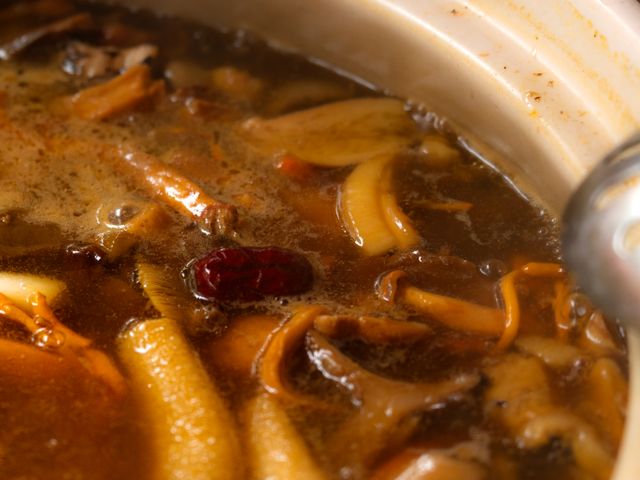
- Allow the broth to simmer gently for 1 hour (90 minutes if using a raw carcass or if you prefer deeper flavor).
- Do not cover the pot—this allows water to evaporate and flavors to concentrate.
- Skim any additional foam or impurities that float to the surface during the first 20 minutes of simmering.
- The broth should smell aromatic and warm, with a subtle chicken and ginger scent.
- The prolonged heat ensures food safety.
+ Show details− Hide details
Ready when: Broth is fragrant, golden, and clear; carcass bones are soft and easily break apart
Tip: Resist the urge to stir frequently—let the broth simmer undisturbed to keep it clear.
Strain and season the broth
- Set a fine-mesh strainer over a clean pot and carefully pour the broth through, allowing solids to collect in the strainer.
- (Alternatively, line a colander with cheesecloth for extra clarity.) Discard the solids—carcass, ginger, scallions, and mushrooms have given all their flavor.
- Add 2 tablespoons of soy sauce and stir well.
- Taste the broth and adjust seasoning with salt and white pepper to your preference.
- The broth should taste savory, slightly sweet from the chicken and ginger, with a subtle scallion note.
+ Show details− Hide details
Ready when: Broth is smooth, clear, and evenly golden; seasonings are balanced
Tip: Strain carefully to keep the broth clear; pour slowly and don't press the solids, which will cloud the broth.
Cool and store (or use immediately)
- If using the broth immediately in a soup or dish, leave it warm and proceed to your recipe.
- If storing, transfer it to a clean container and let it cool to room temperature on the counter (about 30 minutes), then cover and refrigerate for up to 5 days or freeze for up to 3 months.
- When chilled, the broth will gel slightly due to collagen from the bones—this is a sign of a well-made broth.
- Reheat on the stovetop over medium heat, stirring occasionally, until warmed through.
+ Show details− Hide details
Ready when: Broth reaches room temperature and is ready to transfer to storage containers
Tip: Always cool the broth before sealing the container to prevent condensation and bacterial growth.
Good to know
Tips
- A good carcass is essential: use bones from a roasted or poached chicken, or ask your butcher for backs and necks. Raw carcasses yield richer, more gelatinous broth; roasted ones add subtle color and depth.
- Don't skip skimming the first few minutes of simmering—this removes impurities and gives you a clear, refined broth rather than a cloudy one.
- Ginger skin contains most of the flavor and should be left on. Smashing it instead of peeling releases aromatic oils without losing the skin.
- If you prefer a lighter broth, reduce the simmering time to 45–60 minutes. For a richer, more gelatinous broth with deeper flavor, simmer for 2 hours instead.
Make ahead
Make this broth up to 5 days ahead and refrigerate, or freeze for up to 3 months. It's an excellent base to have on hand for quick soups, braises, and grain dishes. Thaw overnight in the refrigerator before using if frozen.
Storage & reheating
**Room temperature**: Cool completely, then store in an airtight container for up to 2 hours (not recommended for longer due to food safety). **Refrigerator**: Store in an airtight container or mason jar for up to 5 days. The broth will gel at the surface due to collagen—this is normal and a sign of quality. **Freezer**: Pour into freezer bags (lay flat for easy stacking) or ice cube trays for portioning; freeze for up to 3 months. **Reheating**: Thaw overnight in the refrigerator if frozen. Warm on the stovetop over medium heat for 5–10 minutes, stirring occasionally, until steaming.
Substitutions
- chicken carcass (from a roasted or poached chicken, or raw backs and necks) → 2 lbs (900 g) chicken backs and necks. Equally flavorful and often easier to source from your butcher. Rinse well before use.
- soy sauce (or tamari for gluten-free) → tamari or coconut aminos (for gluten-free). Use the same amount. Tamari is slightly richer; coconut aminos is milder and slightly sweet.
- dried shiitake mushrooms (optional, but adds depth) → 2–3 dried reishi mushrooms, or omit entirely. Reishi adds earthiness and immune-supporting compounds but is optional. The broth is excellent without any mushrooms.
- white pepper → black pepper or a pinch of cayenne. White pepper is traditional in Asian broths and won't leave visible specks, but black pepper works fine if that's what you have.
More broths
See all →
Find more like this
- Meal
- Dinner
- Main ingredient
- Whole Chicken
- Method
- Stovetop