French Crêpes Dentelles (Lace Pancakes)
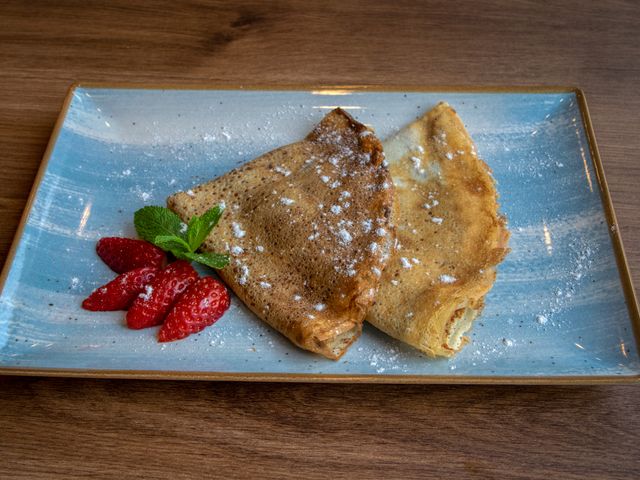
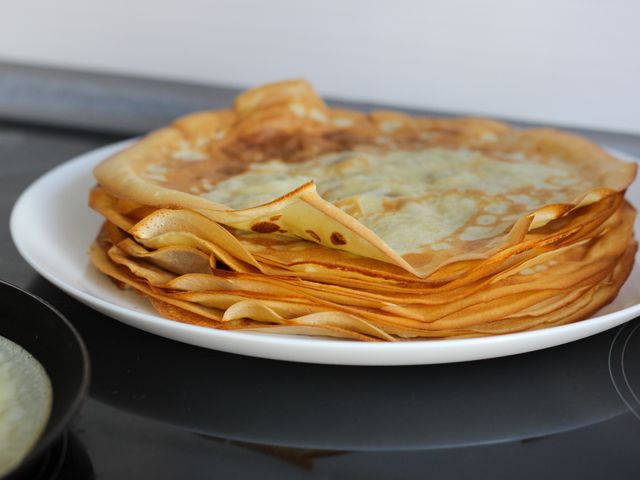
Thin, delicate French crêpes with lacy, caramelized edges and a tender center. These crêpes are made from a simple batter and cooked in a hot skillet until golden and crispy at the edges. Light enough for breakfast, elegant enough for dessert—serve them with jam, Nutella, fresh fruit, whipped cream, or a dusting of powdered sugar.
Steps
Before you start
- Let batter rest at least 15–20 minutes before cooking so the flour fully hydrates and the crêpes cook evenly
- Use a nonstick skillet or well-seasoned crêpes pan; a cold pan will cause thick, doughy crêpes instead of thin lacy ones
- Have all ingredients at room temperature for a smooth, lump-free batter
Combine dry ingredients
- In a medium bowl, whisk together 1 cup (120 g) all-purpose flour, 1⁄4 teaspoon (1.5 g) salt, and 1 tablespoon (12 g) granulated sugar.
- Set aside.
+ Show details− Hide details
Tip: Whisking the dry ingredients together prevents lumps in the batter.
Mix wet ingredients
- In another bowl, lightly beat 2 large room-temperature eggs with a whisk.
- Pour in 1.25 cups (300 ml) room-temperature milk and whisk until combined.
- Add 2 tablespoons (30 g) melted and cooled butter, whisking until smooth.
+ Show details− Hide details
Tip: Room-temperature ingredients blend smoothly; cold eggs or milk can create lumps.
Make the batter
- Pour the wet ingredients into the dry ingredients and whisk gently until just combined.
- A few small lumps are fine—overmixing toughens the crêpes.
- The batter should be smooth and thin, similar to heavy cream.
+ Show details− Hide details
Tip: Stop whisking as soon as the streaks of flour disappear; overmixing develops gluten and makes crêpes tough.
Rest the batter
- Let the batter sit at room temperature for 15–20 minutes.
- This allows the flour to fully hydrate, resulting in tender, evenly cooked crêpes.
- The batter will thicken slightly.
+ Show details− Hide details
Tip: Resting is essential—skipping it results in thick, doughy crêpes instead of thin, delicate ones.
Heat and butter the pan
- Place an 8- to 9-inch (20–23 cm) nonstick crêpes pan or skillet over medium-high heat.
- Once hot, add 1⁄2 teaspoon (2.5 g) of the butter for the pan and let it melt and coat the surface evenly.
- The butter should sizzle gently but not brown.
+ Show details− Hide details
Ready when: Butter melts and coats the pan; a drop of batter sizzles immediately on contact
Tip: A truly hot pan is key for lacy, crispy edges; a cold or lukewarm pan yields pale, thick crêpes.
Cook the first side
- Pour about 1⁄4 cup (60 ml) batter into the center of the hot pan.
- Immediately tilt and swirl the pan in a circular motion to spread the batter thinly and evenly across the bottom.
- If you have bare spots, keep swirling; if too much batter pools at the edges, let it cook off.
- Cook for 60–90 seconds, until the bottom is golden with lacy brown spots and the top is set and dry to the touch.
+ Show details− Hide details
Ready when: Bottom is golden with lacy brown spots; top surface appears dry and matte
Tip: Tilt and swirl immediately—hesitating allows the batter to set unevenly. Practice the first crêpe; it's often imperfect.
Flip and cook the second side
- Using a thin spatula or crêpes spreader, loosen the edges and slide it under the crêpe.
- Flip it over quickly and cook the other side for 20–30 seconds, until it's pale golden or barely colored.
- The second side cooks faster because the pan is already hot.
+ Show details− Hide details
Ready when: Second side is pale golden or just lightly colored; crêpe is set throughout
Tip: The second side should be much lighter than the first; a dark second side means the pan is too hot.
Transfer and cool
- Slide the crêpe onto a serving plate or clean kitchen towel.
- Repeat with the remaining batter, buttering the pan with a pinch of butter (about 1⁄4 teaspoon/1.25 g) every 2–3 crêpes as needed.
- Stack the finished crêpes on the plate; they'll stay warm and soft.
- You should make 8–10 crêpes total.
+ Show details− Hide details
Ready when: All batter is cooked; crêpes are lacy and golden on the first side
Tip: If crêpes tear when flipping, the pan is too hot—reduce heat slightly. If they're pale and thick, the pan isn't hot enough.
Serve warm
- Serve the crêpes warm, folded in quarters or rolled.
- Accompany with jam, Nutella, fresh berries, whipped cream, or a light dusting of powdered sugar.
- They are best eaten immediately, though they can be reheated gently.
+ Show details− Hide details
Tip: Crêpes cool slightly and firm up as they sit; serving them warm preserves their tender texture.
Good to know
Tips
- The first crêpe is often imperfect as the pan comes to temperature—don't be discouraged. Adjust heat up or down slightly if needed, and you'll find your rhythm by the second or third crêpe.
- For the classic lacy dentelle edge, maintain medium-high heat throughout cooking. If the pan is too cool, the batter spreads too slowly and the edges don't caramelize; if too hot, they burn before the center sets.
- Resting the batter is non-negotiable. Skipping this step is the most common reason home cooks end up with thick, doughy crêpes instead of thin, tender ones.
- A thin metal spatula or wooden crêpes spreader is worth the investment—it makes flipping much easier and more confident than a regular spatula.
Make ahead
Batter can be made up to 4 hours ahead and refrigerated, covered. Stir gently before using; it may thicken slightly, so add a splash of milk if it seems too thick. Cooked crêpes can be stacked, cooled, wrapped in plastic wrap, and refrigerated for up to 2 days or frozen for up to 1 month.
Storage & reheating
Room temperature (stacked, loosely wrapped): up to 4 hours. Refrigerator (covered): up to 2 days. Freezer (in an airtight container or wrapped individually): up to 1 month. To reheat, place on a plate, cover loosely with foil, and warm in a 300°F (150°C) oven for 3–5 minutes, or warm gently in a skillet over low heat for 20–30 seconds per side.
Substitutions
- whole milk, at room temperature → Half whole milk and half crème fraîche or sour cream (thinned with a little water). Adds richness and tang. The crème fraîche mixture should total 1.25 cups (300 ml).
- whole milk, at room temperature → Almond milk, oat milk, or other plant-based milk. Use unsweetened varieties. The crêpes will be slightly less tender but still delicious.
- all-purpose flour → Half all-purpose flour and half buckwheat flour. Creates nuttier, savory crêpes (omit or reduce the sugar). Popular in Brittany.
- unsalted butter, melted and cooled → Neutral oil (vegetable or canola). Use the same amount. The crêpes will be slightly less rich but cook evenly. Not recommended if serving with butter-based toppings.