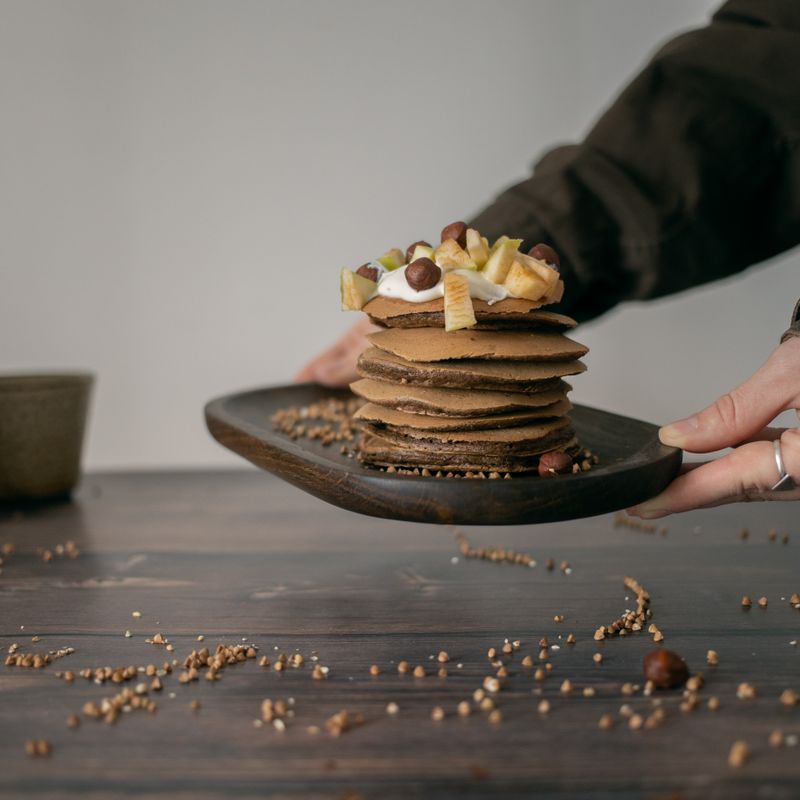
Buckwheat Blueberry Pancakes
Nutty, tender pancakes made with buckwheat flour and studded with fresh blueberries. The buckwheat brings a subtle earthiness and interesting texture that pairs beautifully with the bright fruit. These pancakes are heartier than all-white-flour versions but still light and fluffy, perfect for a wholesome breakfast.
- Prep
- 10 min
- Cook
- 12 min
- Wait
- 5 min
- Total
- 27 min
- Makes
- 12 pancakes (3 per person)
Steps
Before you start
- Have all ingredients at room temperature
- Preheat your griddle or skillet over medium heat for 3 minutes
- Pick through blueberries and pat them dry so they don't sink
- Have toppings ready (butter, maple syrup, yogurt, or jam)
Mix dry ingredients
- In a large bowl, whisk together buckwheat flour, all-purpose flour, baking powder, salt, and sugar.
- Make a well in the center of the mixture and set the bowl aside.
+ Show details− Hide details
Ready when: Dry ingredients are evenly combined with no lumps
Tip: Whisk the dry ingredients thoroughly to distribute the baking powder evenly, which ensures the pancakes rise uniformly.
Combine wet ingredients
- In a medium bowl, whisk together eggs, milk, vanilla, and melted butter until completely combined.
- Do not overmix.
+ Show details− Hide details
Ready when: Mixture is smooth and the butter is fully incorporated
Tip: Keep the butter slightly warm when mixing so it stays smooth and incorporates evenly; cool it to room temperature first if it's too hot.
Make the batter
- Pour the wet ingredients into the well in the dry ingredients.
- Fold and stir gently with a spatula just until the flour disappears.
- The batter should be lumpy with visible streaks of flour—do not overmix.
- Fold in the blueberries gently, being careful not to crush them.
+ Show details− Hide details
Ready when: Dry ingredients are just incorporated; batter is lumpy and no dry streaks remain
Tip: Overmixing buckwheat batter makes pancakes tough and dense. Stop stirring as soon as the flour is moistened, even if there are small lumps.
Rest the batter
- Let the batter rest for 5 minutes at room temperature.
- This allows the buckwheat flour to fully hydrate and the leavening to begin working, resulting in fluffier pancakes.
+ Show details− Hide details
Tip: Don't skip this step—it makes a noticeable difference in the tenderness of the finished pancakes.
Heat the griddle
- Place a 12-inch nonstick skillet or griddle over medium heat.
- Let it heat for 2–3 minutes.
- Test readiness by sprinkling a few drops of water on the surface; they should sizzle gently and evaporate in about 2 seconds.
+ Show details− Hide details
Ready when: Water droplets sizzle and evaporate in 2 seconds
Tip: Medium heat is key for buckwheat pancakes—too hot and they'll burn on the outside before cooking through; too cool and they won't develop a golden crust.
Butter the griddle
- Add about 1 tablespoon of butter to the griddle and let it melt and coat the surface evenly.
- You'll need to add more butter as you cook batches.
+ Show details− Hide details
Ready when: Butter is melted and surface is evenly coated
Tip: Use just enough butter to coat; too much will make the pancakes greasy and cause uneven browning.
Cook first side
- Pour ¼ cup batter onto the griddle for each pancake, spacing them about 2 inches apart.
- You should fit 3–4 pancakes on a 12-inch griddle.
- Cook over medium heat for 2–3 minutes, until the edges look set and dry, small bubbles form across the top, and the bottom is golden brown.
- Do not move the pancakes while cooking.
+ Show details− Hide details
Ready when: Edges are set and look dry; bubbles cover the top surface; bottom is golden brown
Tip: Resist the urge to flip early. Pancakes need bubbles to break through the surface before flipping, or they'll be dense and gummy inside.
Flip and cook second side
- Flip each pancake once using a spatula.
- Cook for another 1–2 minutes on the second side until the bottom is golden brown and the pancake springs back slightly when gently pressed.
- Transfer cooked pancakes to a plate and keep warm.
- Repeat with remaining batter, adding a bit more butter to the griddle between batches.
+ Show details− Hide details
Ready when: Bottom is golden brown; pancake springs back when pressed lightly
Tip: If the second batch browns too quickly or too slowly, adjust your heat slightly. You may need to lower it slightly if the griddle is very hot.
Serve
- Serve the pancakes warm with butter, maple syrup, fresh blueberries, Greek yogurt, or your favorite toppings.
+ Show details− Hide details
Tip: For the best texture, serve immediately while the pancakes are still warm and the exteriors are slightly crisp.
Good to know
Tips
- Pat blueberries completely dry before adding them—wet berries will sink to the bottom and cause the batter to become too wet, leading to dense pancakes.
- Don't overmix the batter. The lumpy texture is essential for fluffy pancakes; stirring too much develops gluten in the flour, making pancakes tough.
- If the first batch of pancakes seems too thick or thin, you can adjust the next batch by adding a tablespoon of milk or flour, but usually the batter is fine—trust the recipe.
- For extra nutrition and flavor, sprinkle a pinch of cinnamon or nutmeg into the dry ingredients, or add ½ teaspoon of lemon zest to brighten the buckwheat.
Make ahead
Batter can be made up to 2 hours ahead and refrigerated in an airtight container. Stir gently before cooking, and add a tablespoon of milk if the batter has thickened.
Storage & reheating
Cooked pancakes keep in an airtight container in the refrigerator for up to 3 days. Reheat in a 300°F oven for 5–8 minutes, or in a toaster oven on medium setting, until warm. Freeze cooked pancakes in a single layer on a baking sheet for 2 hours, then transfer to a freezer bag and freeze for up to 3 months. Toast from frozen in a toaster oven.
Substitutions
- fresh blueberries → raspberries, blackberries, diced apple, or banana slices. Use the same weight. Softer berries like raspberries may break more easily when stirring; fold them in very gently.
- whole milk → buttermilk (use the same amount). Buttermilk adds tanginess and slight richness. The pancakes will be slightly less tender with buttermilk, so reduce baking powder to 1½ teaspoons.
- buckwheat flour → additional all-purpose flour (use 1½ cups all-purpose total, omit buckwheat). Pancakes will be milder and less earthy, but still delicious. Add 1 tablespoon of honey or maple syrup to the wet ingredients for depth.
- unsalted butter, melted → neutral oil like vegetable or canola oil. Use the same amount. Pancakes will be less rich but will have a crisper exterior.
More pancakes & waffles
See all →

Find more like this
- Meal
- Breakfast
- Diet
- VegetarianHalal
- Method
- Stovetop