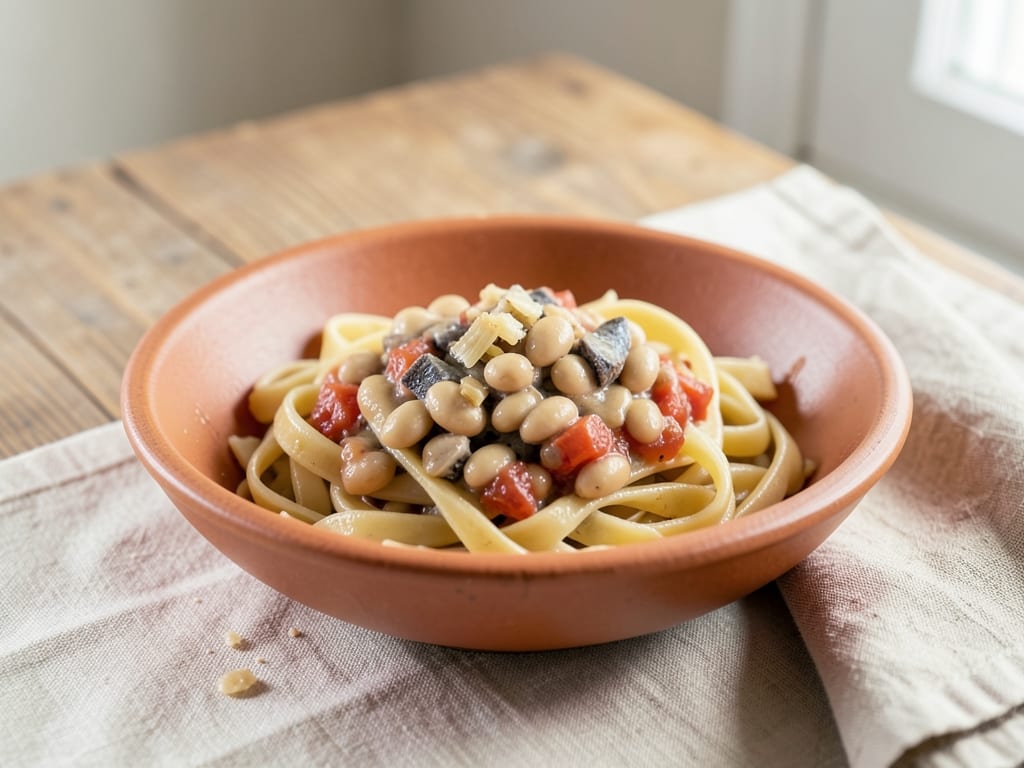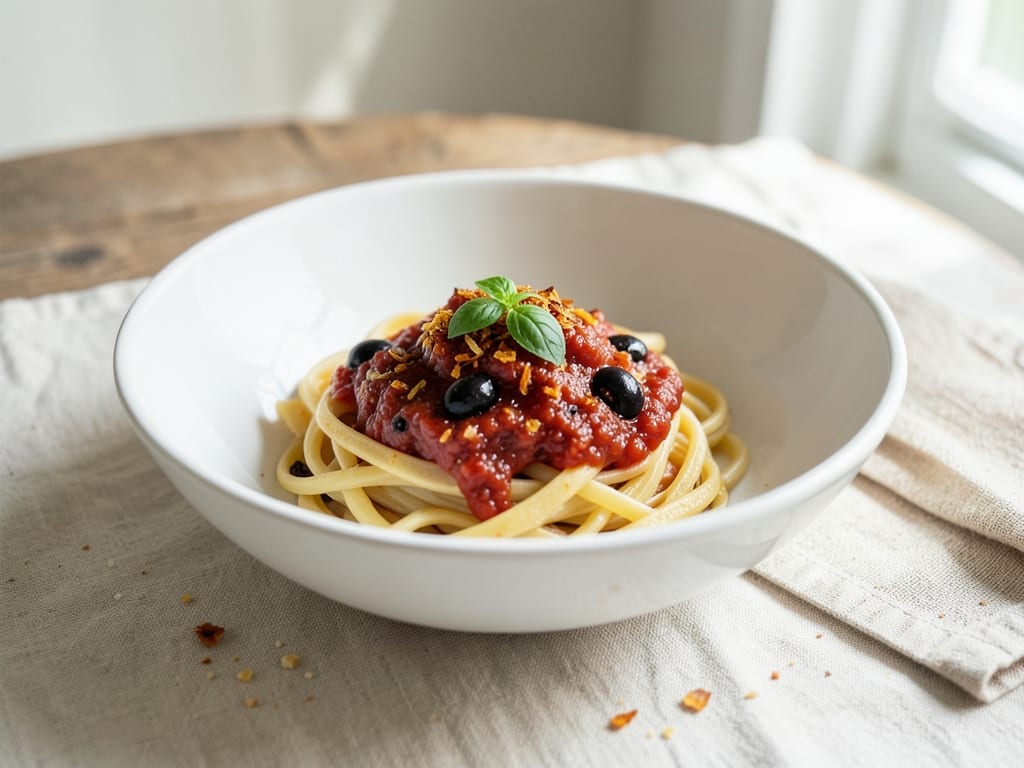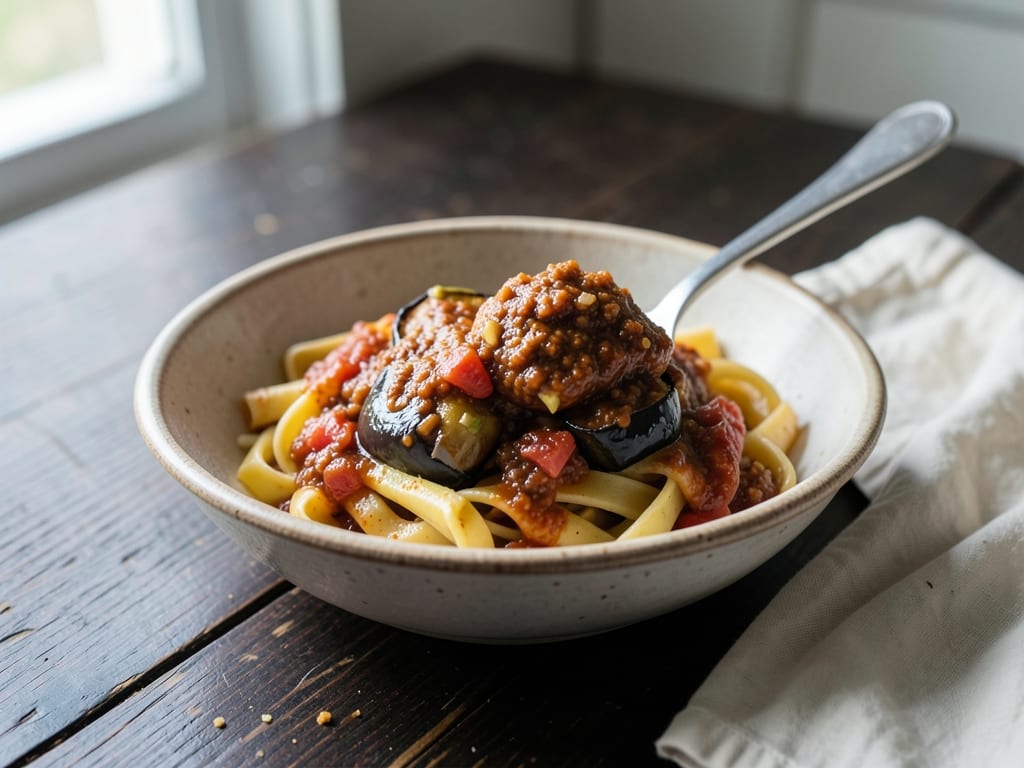
Eggplant and Harissa Ragù
A North African-inspired vegetarian pasta sauce featuring braised eggplant, warm harissa spice, and fragrant tomatoes. The long, slow simmer melts the eggplant into the sauce while the harissa blooms into a complex, rounded heat. Serve over any pasta shape, or spoon over couscous for a Mediterranean-North African fusion.
- Prep
- 15 min
- Cook
- 21 min
- Wait
- 35 min
- Total
- 1 hr 11 min
- Makes
- About 4 cups sauce (serves 4 over pasta, 6 if combined with grains)
Steps
Before you start
- Cut eggplant into uniform ¾-inch cubes so it cooks evenly and doesn't break down too quickly
- Have all aromatics chopped and ready (mise en place makes the cooking flow smoothly)
- Check your harissa paste—some brands are quite spicy; taste a small spoonful first if you're unfamiliar with the brand
Heat oil and sauté onions
- Pour 3 tbsp olive oil into a large heavy-bottomed pot or 5-quart Dutch oven and place over medium heat.
- Once the oil shimmers (about 1 minute), add the diced onion.
- Cook, stirring occasionally, for 4 minutes until the onion becomes soft and translucent at the edges.
- The onion should smell sweet and aromatic.
+ Show details− Hide details
Ready when: Onion is soft and translucent at the edges
Tip: Watch the onions carefully—they should soften without browning, or they'll become bitter.
Add garlic and cumin
- Add the minced garlic and 1 tsp ground cumin.
- Stir continuously for 1–2 minutes until the garlic becomes fragrant but not brown.
- The cumin will bloom in the oil, releasing its warm, earthy aroma.
- This aromatics step is crucial for building the North African flavor base.
+ Show details− Hide details
Ready when: Garlic is fragrant and cumin has bloomed
Tip: Don't let the garlic brown or it will turn bitter and ruin the sauce.
Brown eggplant cubes
- Increase the heat to medium-high and add the eggplant cubes.
- Spread them out in a single layer as much as possible and let them cook undisturbed for 3–4 minutes.
- Stir and cook for another 3–4 minutes, turning the pieces to brown them on multiple sides.
- The eggplant should take on a light golden color.
- This initial browning adds depth and prevents a mushy, one-dimensional sauce.
+ Show details− Hide details
Ready when: Eggplant cubes are lightly golden on multiple sides
Tip: Let the eggplant sit undisturbed for the first 3–4 minutes to develop golden color; this adds depth to the finished sauce.
Stir in harissa paste
- Add 2 tbsp harissa paste and stir well, coating all the eggplant pieces evenly.
- Cook for 1 minute, allowing the harissa to warm and distribute throughout.
- You'll smell the distinctive warm, spicy aroma of the harissa as it blooms.
- The paste will soften and integrate into the oil.
+ Show details− Hide details
Ready when: Harissa is evenly distributed and warm throughout
Tip: Harissa brands vary significantly in spice level. Taste a small spoonful first to gauge the heat, and adjust the amount accordingly.
Add tomatoes and braise
- Pour in 1 can (28 oz / 800 ml) crushed tomatoes and ¾ cup (180 ml) vegetable broth or water.
- Stir well to combine.
- Add a generous pinch of salt and black pepper.
- Increase heat to medium to bring the mixture to a gentle simmer.
- Once you see bubbles breaking the surface regularly, reduce heat to low so the surface barely bubbles—this is a gentle simmer, not a rolling boil.
- Partially cover the pot and simmer for 35 minutes, stirring occasionally to prevent sticking on the bottom.
- The eggplant will become very tender and the sauce will reduce and deepen in color.
+ Show details− Hide details
Ready when: Eggplant is very tender and breaks apart easily, sauce has thickened and darkened
Tip: Stir occasionally to prevent the sauce from sticking to the bottom of the pot, but allow the liquid to reduce and the sauce to deepen in color.
Taste and finish
- Remove the pot from heat.
- Taste a spoonful of the sauce.
- The eggplant should fall apart easily when pressed against the side of the pot, and the sauce should have thickened noticeably and taken on a deeper, richer color.
- If the sauce is still too thin, return the pot to medium heat and simmer uncovered for another 5–10 minutes.
- Stir in 1 tbsp fresh lemon juice if using.
- The acidity will brighten the spices and balance the richness.
- Add more salt and pepper to taste.
+ Show details− Hide details
Ready when: Eggplant breaks apart easily, sauce has thickened and deepened in color
Tip: The lemon juice brightens the spices and balances the richness—add it even if you don't usually like lemon in savory dishes.
Serve over pasta
- Ladle the ragù into bowls and serve immediately over cooked pasta (penne, rigatoni, fusilli, or any shape you prefer).
- Garnish generously with fresh cilantro if desired.
- A final drizzle of olive oil and a grind of fresh black pepper add brightness and richness.
Good to know
Tips
- Cut eggplant into uniform ¾-inch cubes so all pieces cook evenly. Smaller cubes will break down more into the sauce; larger pieces stay firmer. This is a matter of preference.
- Harissa paste varies widely in spice level and brand character—some are smoky, some fruity, some purely hot. Start conservatively and add more after tasting if you want extra heat.
- This sauce is even better the next day or two as flavors meld and deepen. Plan ahead and make it 1–2 days before serving for the best flavor.
- Serve over any pasta shape, or spoon over couscous, rice, or creamy polenta for a more grain-forward, Mediterranean-North African fusion meal.
Make ahead
This ragù actually improves with time. Make it up to 2 days ahead and store in the refrigerator in an airtight container. The flavors will meld and deepen overnight. Reheat gently on the stovetop over low-medium heat, stirring occasionally, and add a splash of water or broth if the sauce has thickened too much during storage.
Storage & reheating
Refrigerator: up to 3 days in an airtight container. Reheat gently on the stovetop over low heat, stirring occasionally, adding a splash of broth if needed. Freezer: up to 2 months in a freezer-safe container or bag. Thaw overnight in the refrigerator and reheat gently as above. Room temperature: not recommended for more than 2 hours.
Substitutions
- canned crushed tomatoes → 4–5 fresh medium tomatoes (about 2 lbs / 900 g), cored and crushed by hand or roughly chopped. Fresh tomatoes work beautifully and add brightness, but they're higher in water content—the sauce will be thinner initially, so simmer for 10 minutes longer to reduce and concentrate.
- harissa paste → 1 tsp cayenne pepper mixed with 1 tbsp tomato paste and 1 tbsp olive oil. This creates heat and depth but won't have the exact complex spice profile of harissa. Start with this mixture and taste before adding more, as cayenne is often spicier than harissa.
- vegetable broth or water → Water or chicken broth. Water works fine and keeps the sauce vegetarian; chicken broth adds richness and body but changes the vegetarian character slightly.
- fresh cilantro, roughly chopped → Fresh parsley or fresh mint. Parsley is more mild and neutral; mint adds a cooling freshness that's still delicious with the warm harissa spices.