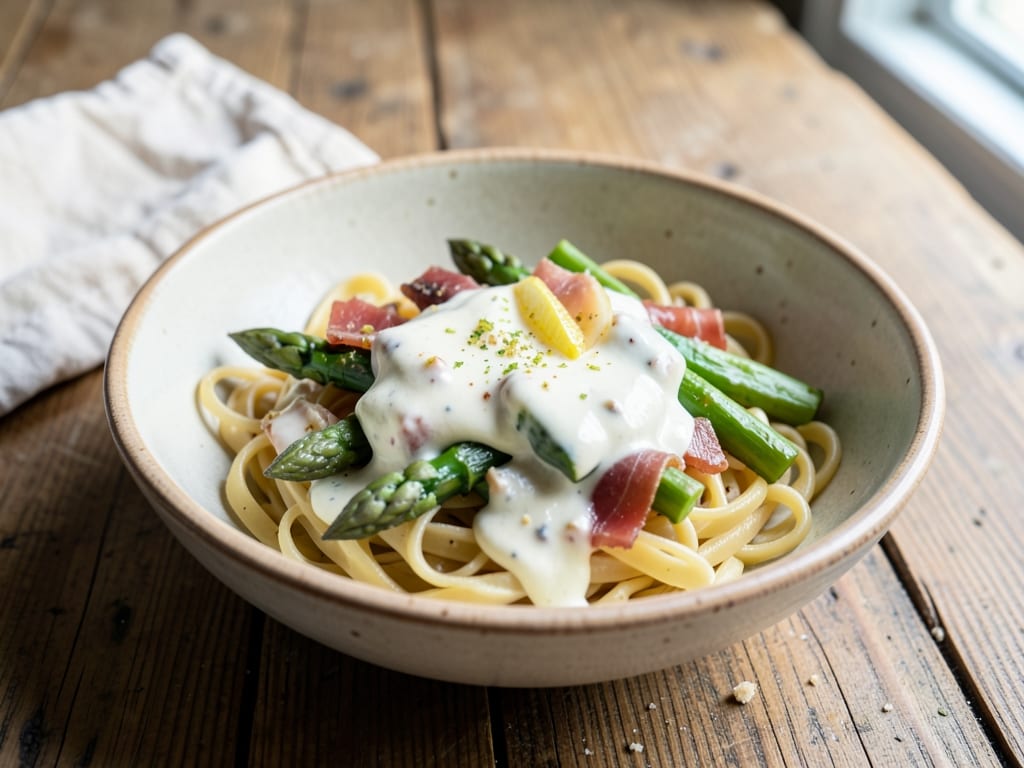
Creamy Asparagus and Prosciutto Sauce
A silky Italian cream sauce with tender asparagus, crispy prosciutto, and a bright lemon finish. This spring pasta sauce comes together quickly (about 30 minutes) by rendering the prosciutto fat first, then simmering tender-crisp asparagus in a light cream sauce enriched with butter and Parmigiano-Reggiano.
- Prep
- 8 min
- Cook
- 11 min
- Wait
- 6 min
- Total
- 25 min
- Makes
- About 2 cups sauce, serves 4 over pasta
Steps
Before you start
- Read through the recipe—it's quick and flows best if you prep before cooking
- Trim the asparagus, mince the garlic, and juice and zest the lemon before you start cooking
- Have salt and pepper at hand for seasoning
- Have your pasta water boiling or fresh pasta ready; this sauce cooks quickly
Prepare the ingredients
- Trim the asparagus by snapping off the woody ends at the natural breaking point (usually the bottom 1–2 inches / 2.5–5 cm).
- Rinse and cut the tender parts into 1-inch (2.5 cm) pieces.
- Mince the garlic cloves.
- Juice the lemon into a small bowl (you'll need about 3 tablespoons / 45 ml) and finely zest it into another small bowl (about 2 teaspoons / 3 g).
- Slice the prosciutto into thin strips if it isn't already.
+ Show details− Hide details
Ready when: ingredients are prepped and measured
Tip: Snapping asparagus at its natural breaking point ensures you remove only the tough, woody ends and keep all the tender, delicious spears.
Render the prosciutto
- Place the prosciutto strips in a 12-inch (30 cm) skillet over medium heat.
- Cook, stirring occasionally, for 3–4 minutes.
- You're looking for the prosciutto to become crispy at the edges and golden, and the fat to render out into the pan, creating a rich, porky aroma.
- Transfer the prosciutto to a small plate using a slotted spoon, leaving all the rendered fat in the pan.
+ Show details− Hide details
Ready when: prosciutto is crispy at the edges and golden; fat has rendered into the pan
Tip: Don't discard the rendered prosciutto fat—it's liquid gold for flavor.
Cook garlic and asparagus
- Add 2 tablespoons (30 g) of the butter to the pan with the prosciutto fat.
- Once melted and foamy, add the minced garlic and cook for about 30 seconds until fragrant.
- Immediately add all the asparagus pieces and stir for about 1 minute to coat them thoroughly in the fat and heat.
+ Show details− Hide details
Ready when: garlic is fragrant and asparagus is coated in fat
Tip: Garlic burns easily on its own, so add the asparagus quickly after the garlic to prevent browning.
Simmer asparagus
- Let the asparagus simmer over medium heat, stirring occasionally, for 5–7 minutes.
- You're looking for the pieces to turn a bright, vibrant green and become tender but still with a slight resistance when you pierce them with a knife or fork.
- The center should be just cooked through, not mushy.
- This keeps the asparagus elegant and prevents it from falling apart when you toss it with the pasta.
+ Show details− Hide details
Ready when: asparagus is bright green and tender-crisp, pierced easily but still with slight resistance
Tip: Overcooked asparagus becomes mushy and dull; these first 5–7 minutes are crucial for keeping the sauce elegant.
Build the cream sauce
- Pour the heavy cream and lemon juice into the pan with the asparagus, stirring gently to combine everything.
- Bring the mixture to a gentle simmer over medium-high heat, about 2–3 minutes.
- You'll notice the sauce beginning to thicken slightly as it heats and the cream starts to bubble gently around the edges.
- Taste the sauce and season it with salt and freshly ground black pepper.
- Remember that the prosciutto and cheese will add saltiness, so taste before adding too much.
+ Show details− Hide details
Ready when: cream is warm and bubbling gently at the edges; sauce has thickened slightly
Tip: Don't let the cream boil hard, or it may break and look curdled instead of silky.
Finish the sauce
- Remove the pan from the heat.
- Crumble or stir in the reserved prosciutto.
- Add the lemon zest and the remaining 1 tablespoon (15 g) of butter, stirring until the butter is completely melted and the sauce looks silky and glossy.
- If using Parmigiano-Reggiano, stir in about 2 tablespoons (20 g) now.
- Taste and adjust seasoning if needed.
+ Show details− Hide details
Ready when: butter is melted, sauce is silky and glossy, all ingredients are combined
Tip: Finishing off the heat with butter creates a silky, emulsified sauce that's less likely to break.
Good to know
Tips
- Fresh asparagus is essential; look for bright green, firm spears without wilting or soft spots.
- Don't prep the asparagus more than a few hours in advance or it will dry out and lose its snap.
- Taste the sauce before finishing with lemon zest—you might want more or less brightness depending on the cream's richness and how thick the sauce has become.
- This sauce is excellent with both fresh egg pasta (which cooks in 2–3 minutes) and dried pasta; adjust your timing accordingly.
Storage & reheating
Leftovers can be stored in an airtight container in the refrigerator for up to 2 days. Reheat gently in a 300°F (150°C) oven for about 10 minutes, or in a pan over low heat with a splash of cream to restore the silky texture. The sauce can be frozen for up to 1 month, though the cream's texture may change slightly.
Substitutions
- fresh asparagus → green beans, snap peas, or fresh spinach. Reduce cooking time for spinach to 1–2 minutes.
- prosciutto → bacon, pancetta, or other cured meat. Adjust the salt in the seasoning step accordingly.
- heavy cream → crème fraîche or sour cream. Add at the end off-heat to prevent curdling.
- fresh lemon → dry white wine. Use about 1/4 cup (60 ml) added with the cream for a slightly less bright flavor.