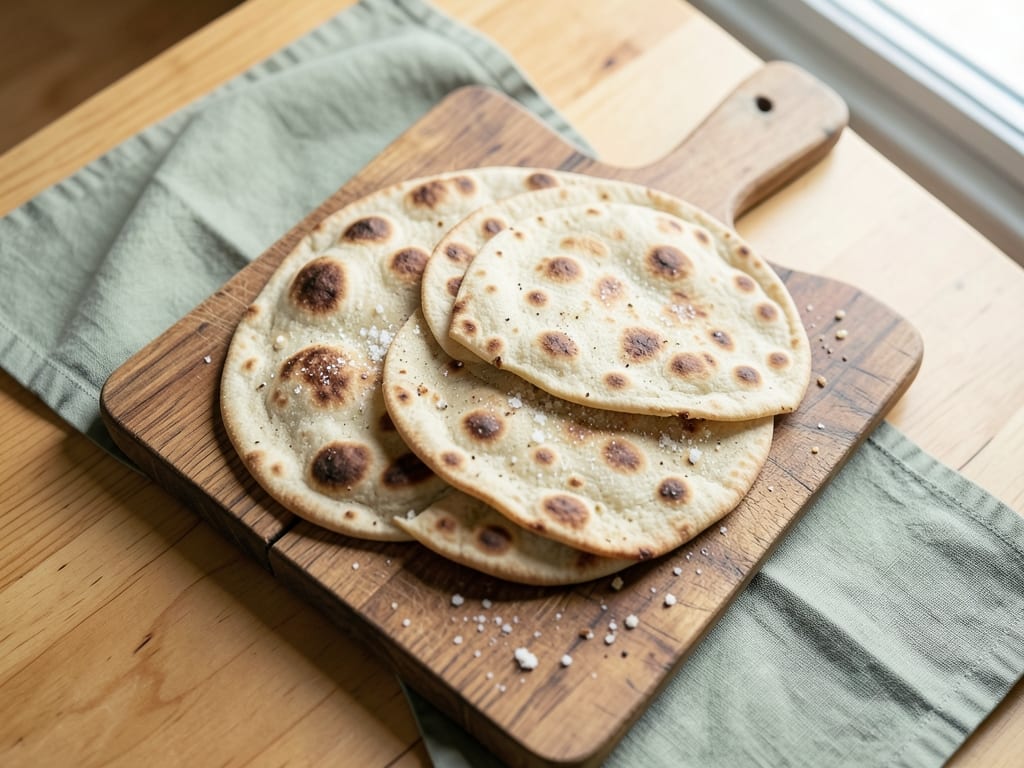
Cuban Torta de Gazpacho Style Flatbread
A thin, crisp-edged Cuban-style flatbread made with lard, a little yeast and plenty of salt. It bakes up sturdy enough to tear and scoop into soups, stews and gazpacho-style dishes, or to eat with butter.
- Prep
- 35 min
- Cook
- 16 min
- Wait
- 1 hr 25 min
- Total
- 2 hr 16 min
- Makes
- 6 flatbreads, about 8 inches (20 cm) each
Steps
Before you start
- Measure the flour by weight if you can. A scale is much more reliable than cups for a stiff dough like this.
- Warm the water to about 105°F (40°C), comfortably warm to the touch but not hot. Hot water will kill the yeast.
- Soft lard works best. Take it out of the fridge 20 minutes ahead so it rubs into the flour easily.
- You will preheat the oven during the dough's rest, so read step 4 before you start.
Mix dry ingredients
- In a large bowl, whisk the flour, instant yeast and salt for 20 seconds so the yeast and salt are evenly spread.
- Add the soft lard pieces and rub them into the flour with your fingertips for about 2 minutes.
+ Show details− Hide details
Ready when: The mixture looks like coarse, sandy crumbs with no large lumps of lard.
Tip: Don't let the lard melt from the heat of your hands. Work quickly and use only your fingertips.
Add water, form dough
- Pour in the warm water.
- Stir with a wooden spoon or your hand until a shaggy dough forms and no dry flour remains.
- If there are dry patches, sprinkle on 1 teaspoon of water at a time and work it in.
+ Show details− Hide details
Ready when: The dough holds together as a rough ball and the bowl is mostly clean.
Tip: This is a fairly stiff dough, so it will feel drier than bread dough. That is correct.
Knead until smooth
- Turn the dough onto a lightly floured counter.
- Knead firmly for 8 minutes, pushing it away with the heel of your hand, folding it back and turning it a quarter turn each time.
+ Show details− Hide details
Ready when: The dough is smooth, elastic and springs back slowly when you press it with a finger.
Tip: Add flour only a pinch at a time. Too much will make the flatbreads tough.
First rise
- Shape the dough into a ball and place it in a clean, lightly oiled or floured bowl.
- Cover with a towel or plastic wrap.
- Let it rest in a warm spot (75–80°F / 24–27°C) for 60 minutes.
+ Show details− Hide details
Ready when: The dough is puffy and about 1½ times larger. A fingertip dent springs back slowly.
Tip: It will not double. The small amount of yeast is meant to give flavor and a little lift, not a fluffy crumb.
Preheat and divideOven 475°F / 245°C
- About 30 minutes before you want to bake, place two baking sheets (or stones) on separate oven racks, one in the upper third and one in the lower third.
- Preheat the oven to 475°F (245°C).
- Meanwhile, turn the dough onto a floured counter and cut it into 6 equal pieces of about 85 g each.
- Roll each into a ball, cover with a towel and rest for 15 minutes.
+ Show details− Hide details
Ready when: The balls are soft and slightly flattened, and the oven has reached 475°F (245°C).
Tip: Hot baking sheets give the bottoms their crisp, browned finish. Don't skip the full preheat.
Roll and dock
- Cut six pieces of parchment about 10 inches (25 cm) square.
- On a lightly floured counter, roll one ball into a round about 8 inches (20 cm) across and 1/16 inch (2 mm) thick.
- Lift and turn it as you roll so it doesn't stick.
- Prick it all over with a fork at ½-inch (1 cm) intervals.
- Set it on a parchment square.
- Repeat with the remaining dough, keeping the unrolled balls covered.
+ Show details− Hide details
Ready when: The dough is thin enough to see the counter's color faintly through it, and the whole surface is pricked.
Tip: If the dough shrinks back, cover it for 5 minutes and try again. Thicker spots stay doughy while thin ones burn.
Bake first batchOven 475°F / 245°C
- Carefully slide 3 parchment squares with the rounds onto each preheated sheet (use a cutting board or the back of a baking sheet as a peel).
- Bake at 475°F (245°C) for 7–9 minutes, swapping the sheets' positions halfway, until the flatbreads are golden with darker brown blisters.
+ Show details− Hide details
Ready when: Golden brown across the top with deeper brown spots. The flatbreads feel firm and crisp at the edges and look dry.
Tip: The parchment may darken. That is normal at this temperature. Watch the last 2 minutes because thin dough browns fast.
Bake second batchOven 475°F / 245°C
- Move the finished flatbreads to a wire rack.
- Reheat the sheets in the oven for 2 minutes, then repeat with the remaining 3 rounds, baking 7–9 minutes until golden with brown blisters.
+ Show details− Hide details
Ready when: Golden with brown blisters and firm, dry edges, matching the first batch.
Tip: Don't put the second batch on a cold sheet or it will bake pale and tough.
Cool and serve
- Cool the flatbreads on the wire rack for 10 minutes.
- They will crisp further as they cool.
- Serve whole to tear and dip, or break into pieces for soups and stews.
+ Show details− Hide details
Ready when: The flatbread snaps cleanly at the edge and feels dry and firm, with a slight chew in the center.
Tip: Stacking warm flatbreads traps steam and softens them. Keep them in a single layer until cool.
Good to know
Tips
- Roll as thinly as you can. Thin dough is the key to a crisp flatbread, and uneven thickness bakes unevenly.
- For a more bubbly, softer result, roll slightly thicker, about 1/8 inch (3 mm), and bake an extra minute or two.
- A very hot oven and preheated baking sheets are what give this flatbread its browned, blistered surface.
- For extra flavor, brush the hot flatbreads lightly with melted lard or olive oil and sprinkle with flaky salt.
Make ahead
"The dough can be made through step 3, then wrapped and refrigerated for up to 24 hours. Bring it to room temperature for 30 minutes before dividing. Baked flatbreads can be made up to 2 days ahead and re-crisped in the oven."
Storage & reheating
"Room temperature: keep in a paper bag or loosely covered container for up to 2 days. Freezer: wrap tightly and freeze for up to 2 months. Reheat at 350°F (175°C) on a baking sheet for 4–5 minutes to re-crisp. They will also soften if stored in an airtight container with moisture, so keep them dry. Refrigeration is not recommended."
Substitutions
- lard → vegetable shortening or olive oil (3 tbsp / 40 ml). Shortening gives a very similar texture. Olive oil makes a slightly softer, more flavorful flatbread.
- all-purpose flour → bread flour (300 g). Gives a chewier flatbread. Add 1–2 tablespoons more water if the dough feels very stiff.
- instant yeast → active dry yeast (1 tsp / 3 g). Dissolve it in the warm water and let it sit 5 minutes until foamy before adding.
- fine sea salt → kosher salt (1½ tsp / 9 g Diamond Crystal). Use more by volume because the flakes are lighter. Use the same weight for table or fine salt.
More flatbreads
See all →
Find more like this
- Meal
- Lunch
- Cuisine
- Caribbean
- Method
- Oven
- Quick & Easy
- 5 Ingredients or LessEasyMake Ahead