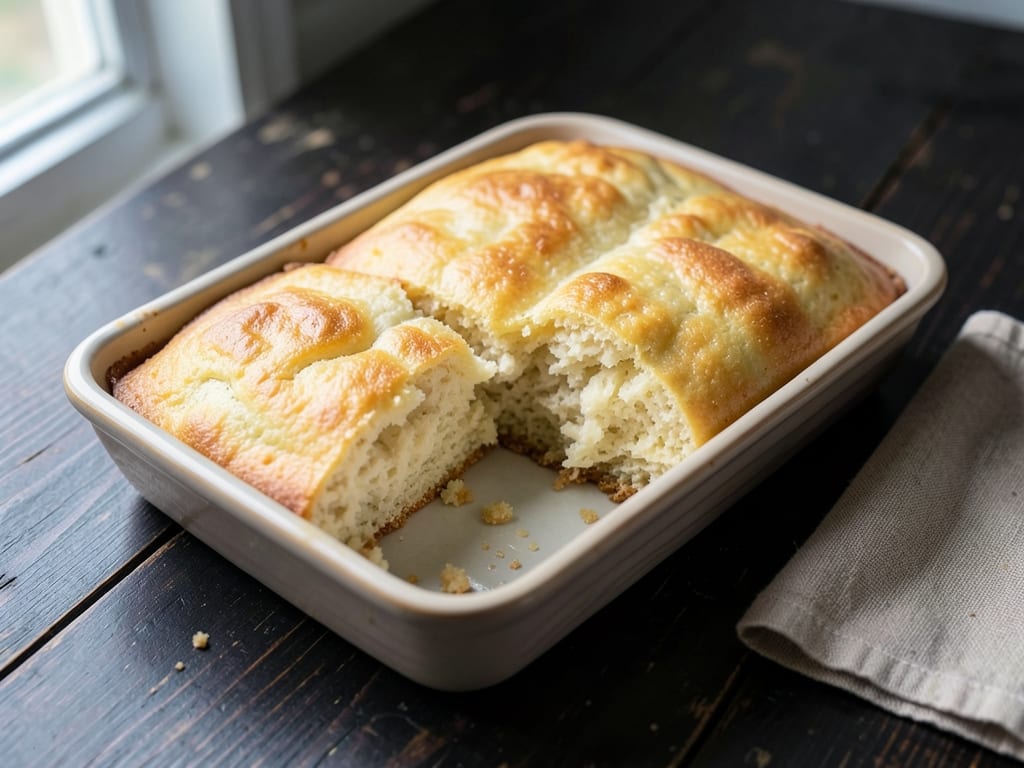
Trinidadian Fried Bake (Dough for Bake and Shark)
Soft, golden, puffy shallow-fried bakes with a tender, slightly crisp shell and a fluffy, airy middle. They're the classic base for Trinidadian bake and shark, and just as good split open and filled with saltfish, cheese, or fried fish.
- Prep
- 27 min
- Cook
- 20 min
- Wait
- 40 min
- Total
- 1 hr 27 min
- Makes
- 8 fried bakes (4-inch / 10 cm), enough for 8 sandwiches
Steps
Before you start
- Cut the butter into small cubes and keep it cold until you need it.
- Use warm tap water, about 100°F (38°C). It should feel comfortably warm on your wrist, not hot.
- Plan for a 30-minute dough rest and a 10-minute ball rest. The dough needs both to roll out easily and puff well.
- Set a wire rack over a tray, or line a plate with paper towels, for draining the bakes before you start frying.
- Keep frying temperature steady at 350°F (175°C). Use a thermometer if you have one.
Mix the dry ingredients
- In a large bowl, whisk together the flour, baking powder, sugar, and salt for 30 seconds so the baking powder is evenly spread through the flour.
+ Show details− Hide details
Ready when: The mixture looks uniform with no clumps of baking powder.
Tip: Uneven baking powder can leave bitter spots, so whisk well.
Rub in the butter
- Add the cold butter cubes.
- Pinch and rub them into the flour with your fingertips for about 2 minutes, until the butter is broken into small flakes and the mixture looks sandy with a few pea-sized pieces.
+ Show details− Hide details
Ready when: The flour looks like coarse, slightly damp sand when squeezed in your fist.
Tip: Work quickly so the butter stays cold and doesn't melt into paste.
Add water and knead
- Make a well in the center and pour in ¾ cup (180 ml) of the warm water.
- Stir with your hand, then add the remaining water gradually until the dough comes together as a shaggy mass.
- Turn onto a lightly floured surface and knead for 5 minutes.
- The dough should feel soft and slightly tacky but not stick to your hands.
- If it feels stiff or crumbly, knead in 1–2 tablespoons more water.
- If sticky, dust with a little flour.
+ Show details− Hide details
Ready when: The dough is smooth, soft, and springs back slowly when pressed with a finger.
Tip: Don't over-flour while kneading. Too much makes the bakes dense and dry.
Rest the dough
- Shape the dough into a ball, place in the bowl, and cover with a damp towel.
- Let it rest at room temperature for 30 minutes.
+ Show details− Hide details
Ready when: The dough feels softer and stretches without snapping back.
Divide into balls
- Divide the dough into 8 equal pieces, about 80 g (2¾ oz) each.
- Roll each piece between your palms into a smooth ball, tucking the seams underneath.
- Place them on a floured surface and cover with the damp towel.
+ Show details− Hide details
Ready when: Each ball is smooth and round with no cracks.
Rest the balls
- Leave the covered balls to rest for 10 minutes.
+ Show details− Hide details
Ready when: A ball flattens slightly when pressed and doesn't spring back fully.
Roll out the rounds
- On a lightly floured surface, roll each ball into a round about 4½ inches (11 cm) across and ¼ inch (6 mm) thick.
- Roll from the center outward, turning as you go, and dust lightly with flour only if sticking.
- Stack the rounds with a sheet of parchment or keep them covered with the towel.
+ Show details− Hide details
Ready when: Rounds are even in thickness, about ¼ inch (6 mm), with no tears.
Tip: Keep the thickness even, or the bakes will puff lopsided.
Heat the oilOven 350°F / 175°C
- Pour the oil into the 12-inch skillet to a depth of about ½ inch (1.25 cm).
- Heat over medium heat for about 4 minutes until it reaches 350°F (175°C).
- Test by dropping in a pinch of dough: it should sizzle steadily and float within a few seconds.
+ Show details− Hide details
Ready when: Thermometer reads 350°F (175°C), and a pinch of dough bubbles right away without browning instantly.
Tip: If the oil is too cool the bakes soak up grease and turn heavy. If too hot they brown before the insides cook.
Fry the bakesOven 350°F / 175°C
- Carefully lay 2 rounds in the hot oil, away from you.
- Within 20–30 seconds they should begin to puff.
- Fry 1½–2 minutes until the underside is deep golden, then flip with tongs or a spatula and fry another 1½–2 minutes.
- Spoon a little hot oil over the top while frying to help them puff.
- Adjust the heat between medium and medium-low to keep the oil near 350°F (175°C).
- Repeat with the remaining rounds in batches of 2.
+ Show details− Hide details
Ready when: Each bake is puffed, golden brown on both sides, and sounds hollow when tapped.
Tip: Don't crowd the pan. More than 2 at once drops the oil temperature and makes flat, greasy bakes.
Drain and serve
- Lift each bake with a slotted spoon, letting excess oil drip off, and transfer to the wire rack or paper towels.
- Let them cool for 2–3 minutes, then split open along the edge and fill with fried shark, fish, or your favorite filling while still warm.
+ Show details− Hide details
Ready when: Bakes are no longer dripping oil and feel light when held.
Tip: Use a rack rather than stacking bakes on paper, so steam doesn't make them soggy.
Good to know
Tips
- Use fresh baking powder. Old baking powder is the most common reason bakes don't puff.
- Keep the oil at 350°F (175°C). Check the temperature between batches and wait a minute if it drops.
- Don't roll thinner than ¼ inch (6 mm), or the bakes won't have room to puff and open into a fluffy center.
- Cover rolled rounds and unused dough balls so they don't dry out and form a crust.
Make ahead
Make the dough through step 3, wrap tightly, and refrigerate up to 24 hours. Let it sit at room temperature for 30 minutes, then continue from step 5. Fried bakes are best fresh, but can be fried a few hours ahead and reheated.
Storage & reheating
Room temperature: keep cooled bakes in a loosely covered container up to 4 hours. Fridge: up to 3 days in an airtight container. Freezer: up to 2 months, separated by parchment in a freezer bag. Reheat in a 350°F (175°C) oven for 6–8 minutes (from frozen, 10–12 minutes), until warmed through and slightly crisp.
Substitutions
- unsalted butter → vegetable shortening or cold coconut oil. Use the same weight (28 g). The texture stays tender; coconut oil adds a faint coconut flavor.
- warm water → warm whole milk. Makes a slightly richer, softer bake that browns a bit faster, so watch the heat.
- granulated sugar → light brown sugar. Use the same amount for a slightly deeper color and flavor.
- neutral vegetable oil (canola, sunflower or vegetable) → peanut oil or corn oil. Any neutral oil with a high smoke point works equally well.
More flatbreads
See all →
Find more like this
- Meal
- Lunch
- Cuisine
- Caribbean
- Diet
- VegetarianHalal
- Method
- Stovetop
- Quick & Easy
- 5 Ingredients or LessEasy