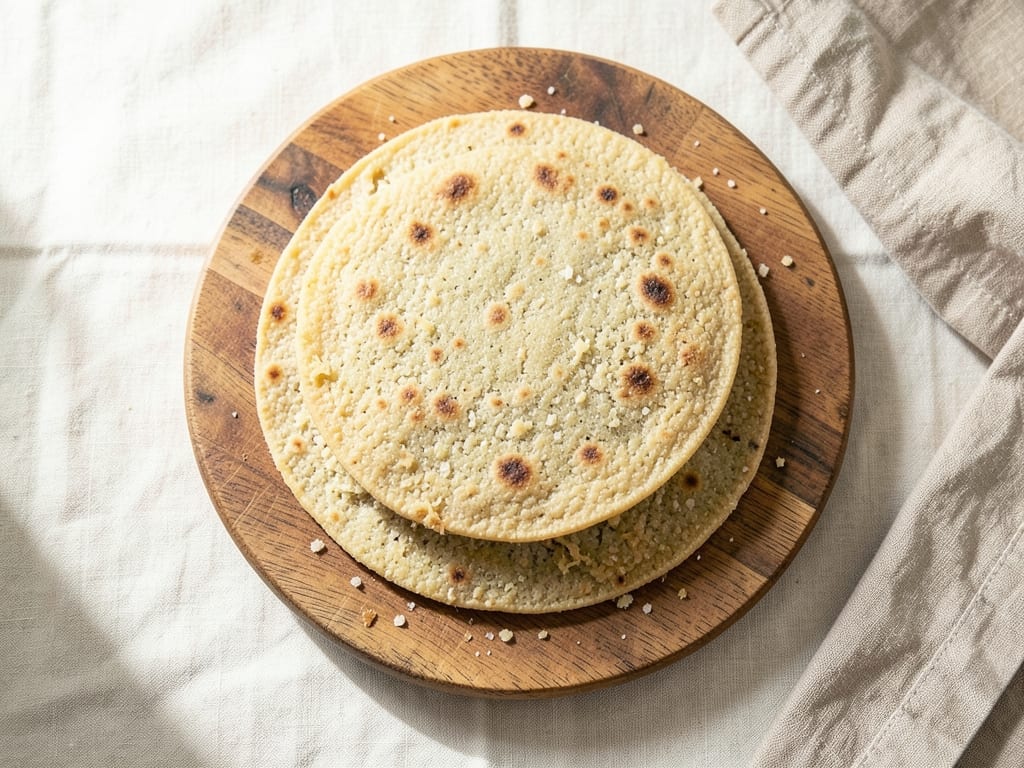
Cassava Casabe Flatbread
A crisp, gluten-free Caribbean flatbread made from just grated yuca, salt and a little water. The squeezed pulp is pressed into thin rounds, toasted on a dry griddle, then dried in a low oven until it snaps like a cracker.
- Prep
- 36 min
- Cook
- 1 hr 3 min
- Wait
- 15 min
- Total
- 1 hr 54 min
- Makes
- 4 rounds, 8 inches (20 cm) each, cut into 32 wedges
Steps
Before you start
- Use the fresh or frozen yuca (cassava) sold in grocery stores. Do not use wild or 'bitter' cassava, which needs special long processing to remove natural toxins.
- Squeeze the pulp as dry as you can and cook the rounds fully. Both steps matter for safety and for a crisp result.
- Have a large piece of clean cotton dish towel, or a double layer of cheesecloth, ready for squeezing. Expect it to be stained by the starch.
- Choose a flat, heavy 10-inch (25 cm) cast-iron or nonstick skillet or griddle. A warped pan makes uneven rounds.
- Read the timing: the rounds cook one at a time, so plan about 35 minutes at the stove.
Peel and cut yuca
- Cut the yuca roots crosswise into 3-inch (7.5 cm) lengths.
- Stand each piece on its end and slice off the thick waxy brown skin and the pink-tinged layer beneath it, until only white flesh remains.
- Quarter each piece lengthwise and cut out the tough, fibrous core.
- Cut the flesh into 2-inch (5 cm) chunks and rinse under cold water.
- Discard any chunk with gray or black streaks or a sour smell.
+ Show details− Hide details
Ready when: All chunks are uniformly white and firm with no fibrous core or brown skin left.
Tip: Wear thin gloves if you have sensitive skin. Raw yuca can be slippery and slightly irritating.
Grate the yuca
- Fit the food processor with the grating disk and feed in the chunks to shred them.
- Switch to the blade, add the 60 ml (¼ cup) cold water, and pulse 15 to 20 times, scraping the bowl once, until the pulp looks like wet, fine crumbs about the size of couscous.
- Work in two batches if your bowl is small.
- If using a box grater, grate on the finest holes and stir in the water afterwards.
+ Show details− Hide details
Ready when: The pulp is wet, fine and crumbly, with no chunks larger than a grain of rice.
Tip: Do not run the processor until it becomes a smooth purée. That turns gluey and will not dry into crisp crumbs.
Squeeze out the liquid
- Spread the towel over a large bowl and put about one-third of the pulp in the center.
- Gather the corners, twist the top tight, and squeeze hard, leaning your weight into it, for 1 to 2 minutes, until the liquid slows to a trickle.
- Open the towel, break up the pulp, re-twist and squeeze again.
- Repeat with the remaining pulp.
- Pour off and discard the cloudy juice.
+ Show details− Hide details
Ready when: A pinch of pulp feels damp but no liquid drips when you squeeze it in your fist. You should have about 500 g (1 lb 2 oz) of pulp.
Tip: Squeezing is the most important step. Pulp that is still wet will steam, stick to the pan and give a gummy flatbread.
Season and sift
- Put the squeezed pulp in a bowl and sprinkle with the 1 tsp (6 g) salt.
- Mix with your fingertips, rubbing out clumps.
- Push the pulp through the coarse sieve in handfuls, pressing with your palm, into a clean wide bowl.
- Fluff the sifted pulp lightly with a fork.
- Do not pack it down.
+ Show details− Hide details
Ready when: The pulp is light, evenly salted, and looks like damp, fluffy flour with no lumps.
Tip: Sifted pulp spreads into an even layer. Lumps leave thick, undercooked spots.
Heat the griddleOven 250°F / 120°C
- Place the dry skillet or griddle over medium heat for 5 minutes.
- Do not add oil.
- Meanwhile, set the oven rack in the center and preheat the oven to 250°F (120°C) so it is ready for the drying step.
+ Show details− Hide details
Ready when: A pinch of pulp dropped on the pan sits quietly and slowly begins to set, with no smoke or hard sizzle.
Tip: If the pan is too hot, the outside browns before the center sets and the bread stays soft.
Press and toast rounds
- Scatter about 125 g (a loosely packed 1½ cups) of pulp into the pan and spread it with the back of a spoon into an even 8-inch (20 cm) circle about ¼ inch (6 mm) thick.
- Press firmly all over with the flat spatula for 10 seconds to bind it.
- Cook 4 to 5 minutes until the top looks dry and the underside is set and pale gold.
- Slide the spatula under the whole round, flip it in one motion, and cook 3 to 4 minutes more.
- Move to the wire rack and repeat to make 4 rounds in total.
+ Show details− Hide details
Ready when: The round holds together when lifted, is pale gold with light brown flecks on both sides, and the edges feel firm and dry.
Tip: If a round cracks when flipping, patch it with a pinch of pulp and press. Let it cook 1 minute more before moving it.
Dry in the ovenOven 250°F / 120°C
- Leave the rounds in a single layer on the wire rack set in the baking sheet.
- If they do not all fit, dry them in two batches.
- Bake at 250°F (120°C) for 20 minutes, flipping once at 10 minutes, to drive out the remaining moisture.
+ Show details− Hide details
Ready when: The rounds feel stiff and dry and the edges lift without bending. They will crisp fully as they cool.
Tip: Do not raise the oven temperature. Higher heat darkens the surface and leaves the center soft.
Cool and break
- Turn off the oven and let the rounds cool on the rack for 15 minutes.
- Break each into 8 wedges with your hands or cut with a sharp knife.
+ Show details− Hide details
Ready when: A wedge snaps cleanly with a sound like a cracker and shows no soft or doughy center.
Tip: If a wedge bends instead of snapping, return it to a 250°F (120°C) oven for 5 to 10 minutes.
Good to know
Tips
- Press the pulp evenly. Thin patches burn while thick patches stay soft, so aim for a uniform ¼ inch (6 mm) layer.
- Serve casabe with garlic butter, mojo, avocado, or alongside soup and stewed fish. It can also be softened briefly in broth or coconut milk.
- For softer, chewier casabe, skip the oven drying step and eat the rounds warm from the griddle. Store those in the fridge for up to 2 days.
- Sprinkle a few sesame seeds or a little coconut on the pulp before pressing, if you like extra flavor.
Make ahead
The squeezed, salted and sifted pulp keeps covered in the fridge for up to 12 hours, but cook it the same day for the best texture. Fully cooked casabe can be made up to a week ahead.
Storage & reheating
Cool completely, then store in an airtight container at room temperature for up to 1 week. Do not refrigerate, as it absorbs moisture. Freeze in a zip-top bag for up to 2 months. To re-crisp softened casabe, bake on a rack at 250°F (120°C) for 5 to 8 minutes, then cool for 5 minutes.
Substitutions
- fresh yuca (cassava) roots → Frozen grated or cut yuca, thawed. Thaw completely and drain, then squeeze and cook as written. Frozen grated yuca may be wetter, so squeeze extra well.
- fine sea salt → Fine table salt. Use ¾ tsp (4.5 g) because table salt is denser.
- cold water → Coconut water. Adds a faint sweetness. It is squeezed out mostly, so the flavor change is slight.
More flatbreads
See all →
Find more like this
- Meal
- Lunch
- Cuisine
- Caribbean
- Quick & Easy
- 5 Ingredients or Less