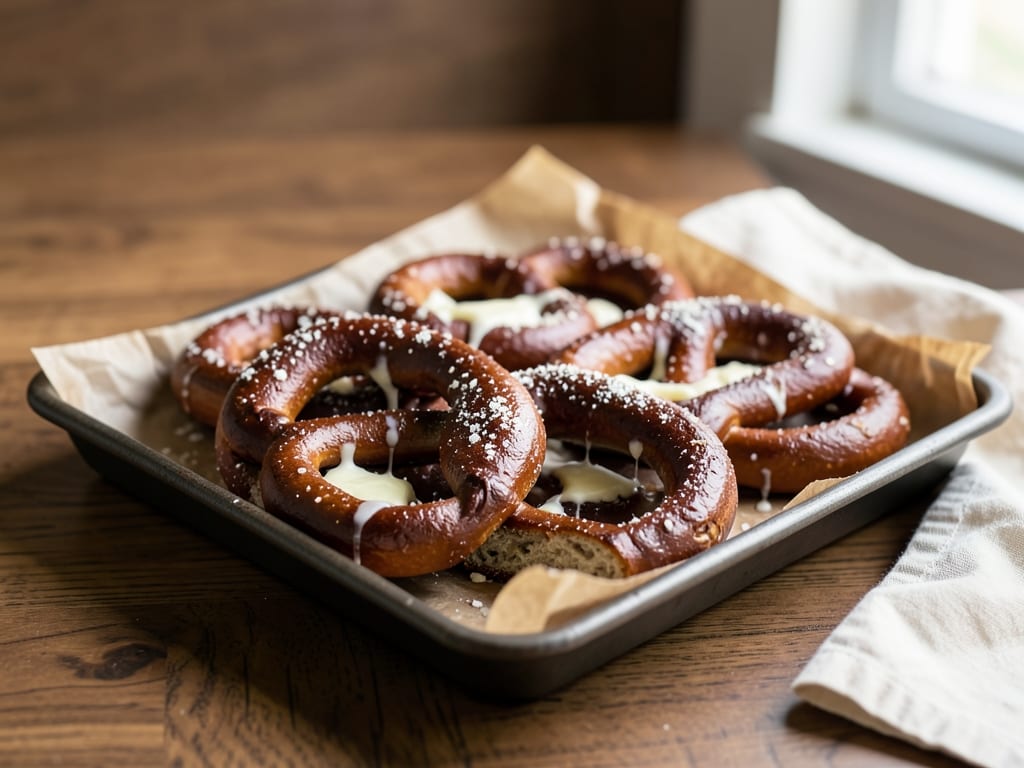
Classic Soft Pretzels
Chewy, deep mahogany German-style pretzels with a glossy, burnished crust, a soft pillowy middle and a crunch of coarse salt. A quick baking-soda bath gives them their classic flavor and color.
- Prep
- 49 min
- Cook
- 24 min
- Wait
- 1 hr 28 min
- Total
- 2 hr 41 min
- Makes
- 8 large pretzels
Steps
Before you start
- Read the timing: about 1 hour of the 2 hours 40 minutes is the dough rising, so plan accordingly.
- Use a pot at least 6 quarts (5.7 L) and 4 inches (10 cm) deep for the baking-soda bath; the soda foams up when added to hot water.
- Set out two rimmed baking sheets and line them with parchment paper. Do not use wax paper or foil, which sticks to the wet pretzels.
- Measure flour by weight if you can. Spooning and leveling cups gives about 125 g per cup; scooping packs in too much and makes a dry, tough dough.
Proof the yeast
- Pour the 1⅓ cups (315 ml) warm water into the bowl of a stand mixer.
- Stir in the sugar and sprinkle the yeast over the top.
- Let it sit for about 8 minutes.
+ Show details− Hide details
Ready when: The surface looks creamy and foamy, with a yeasty smell
Tip: If nothing foams after 10 minutes, the yeast is dead or the water was too hot or cold; start again with fresh yeast.
Mix the dough
- Add the bread flour, fine salt and 2 tablespoons (28 g) melted butter to the yeast mixture.
- Fit the dough hook and mix on low speed for 2 minutes, stopping to scrape the bowl once, until no dry flour remains and a shaggy dough forms.
+ Show details− Hide details
Ready when: A rough, shaggy mass with no dry flour at the bottom of the bowl
Knead until smooth
- Knead on medium-low speed for 7 minutes.
- By hand, knead on a lightly floured counter for 10 minutes.
- The dough should be smooth, elastic and slightly tacky but not sticking to your fingers.
- If it sticks stubbornly, add 1 tablespoon of flour at a time.
+ Show details− Hide details
Ready when: A small piece stretches thin enough to see light through without tearing (windowpane test), and the dough springs back when poked
Tip: A firm dough makes pretzels that hold their shape in the bath, so don't add much extra flour.
First rise
- Grease a large bowl with 2 teaspoons of the oil.
- Shape the dough into a ball, turn it in the bowl to coat, and cover with plastic wrap or a damp towel.
- Leave in a warm spot (75–80°F / 24–27°C) for 60 minutes.
+ Show details− Hide details
Ready when: Doubled in volume, and a finger pressed in about ½ inch leaves a dent that fills back in slowly
Tip: In a cool kitchen, rise in the oven with only the light on.
Preheat and prep pansOven 450°F / 230°C
- Position two racks in the upper and lower thirds of the oven and heat to 450°F (230°C).
- Line two rimmed baking sheets with parchment paper.
- Brush the parchment lightly with the remaining 1 teaspoon oil so the boiled pretzels release easily.
+ Show details− Hide details
Ready when: Oven reaches 450°F (230°C), checked on an oven thermometer if you have one
Tip: Start the oven before shaping so it is fully hot when the pretzels are ready.
Divide and roll ropes
- Turn the risen dough onto an unfloured counter and divide into 8 equal pieces, about 105 g each (use a scale).
- Cover with a towel.
- Roll one piece into a rope, starting from the center and working outward with flat palms, until it is about 24 inches (60 cm) long and tapered slightly at the ends.
- If the dough keeps springing back, let it rest 3 minutes under the towel and continue.
+ Show details− Hide details
Ready when: Each rope is 24 inches (60 cm), even in thickness in the middle with slightly thinner ends
Tip: Work on a clean, unfloured counter. A little friction helps the dough stretch instead of sliding.
Shape the pretzels
- Lay a rope in a U-shape with the ends pointing away from you.
- Cross the ends over each other twice to make a twist, then fold the twisted ends down over the bottom of the U and press them firmly onto the thick sides at about 4 and 8 o'clock.
- Place on the prepared sheet.
- Repeat, putting 4 pretzels on each sheet, spaced apart.
+ Show details− Hide details
Ready when: Pretzels hold the classic shape with ends firmly pressed down
Tip: Press the ends down firmly or they will pop loose in the bath.
Rest and heat the bath
- Let the shaped pretzels rest uncovered for 10 minutes; this lets a light skin form so they are easy to lift.
- Meanwhile, bring the 10 cups (2.4 L) cold water to a boil in a 6-quart or larger pot over high heat.
- Turn the heat to medium-high, then carefully stir in the baking soda; it will foam up.
+ Show details− Hide details
Ready when: Water is at a steady gentle boil with the baking soda fully dissolved
Tip: Add the baking soda slowly to avoid a boil-over, and don't use aluminum pots, which discolor with baking soda.
Boil the pretzels
- Lower 2 pretzels at a time into the bath, top side down.
- Boil for 30 seconds, flipping gently with a slotted spatula after 15 seconds.
- Lift out, let the water drip off for a moment, and return to the parchment, top side up.
- Repeat with the remaining pretzels.
+ Show details− Hide details
Ready when: Pretzels puff slightly and look a bit glossy and wet
Tip: Boiling longer than 30 seconds gives a metallic taste and a tough, leathery skin.
Salt and bakeOven 450°F / 230°C
- Sprinkle the tops generously with the coarse salt, about 1 teaspoon per pretzel.
- Bake both sheets at 450°F (230°C) for 12–14 minutes, swapping and rotating the sheets halfway through, until deeply browned.
+ Show details− Hide details
Ready when: Deep mahogany brown all over, with a crisp crust that sounds hollow when tapped on the bottom
Tip: Salt right after boiling, while the surface is wet, or it will not stick.
Butter and cool
- Immediately brush the hot pretzels with the 2 tablespoons (28 g) melted butter.
- Transfer to a wire rack and cool for 10 minutes before serving warm.
+ Show details− Hide details
Ready when: Crust is glossy and the pretzels are warm, not piping hot
Good to know
Tips
- Weigh the dough pieces so all pretzels are the same size and bake evenly.
- Water for the yeast should be warm, not hot: above 120°F (49°C) can kill the yeast.
- Don't skip the baking-soda bath; it is what gives the crust its deep color, shine and classic pretzel flavor.
- Serve with grainy mustard or warm cheese sauce for dipping.
Make ahead
After kneading, the dough can rise in the fridge instead: cover the oiled bowl tightly and refrigerate 8–18 hours. Let it sit at room temperature for 30 minutes, then divide, shape, rest, boil and bake as written.
Storage & reheating
Best the day they are baked. Room temperature: store in a paper bag up to 1 day (plastic makes the crust soft). Fridge: not recommended, as it dries them out. Freezer: wrap individually and freeze up to 2 months. Reheat from frozen at 350°F (175°C) for 8–10 minutes, or from room temperature for 4–5 minutes, until hot and the crust is crisp again.
Substitutions
- bread flour → all-purpose flour. Use the same weight (500 g). The pretzels will be a little less chewy and the dough slightly softer; hold back 2–3 tablespoons of the water if the dough seems sticky.
- instant yeast (or active dry yeast) → active dry yeast. Use the same amount; proof it in the warm water and sugar for 10 minutes until foamy.
- coarse pretzel salt or flaky sea salt → flaky sea salt. Use about the same amount. Kosher salt works but is slightly less crunchy; avoid fine table salt, which dissolves and tastes too salty.
- unsalted butter → olive oil. Brush the same amount over the hot pretzels for a dairy-free finish.
More rolls & buns
See all →

Find more like this
- Meal
- Snack
- Diet
- VegetarianHalal