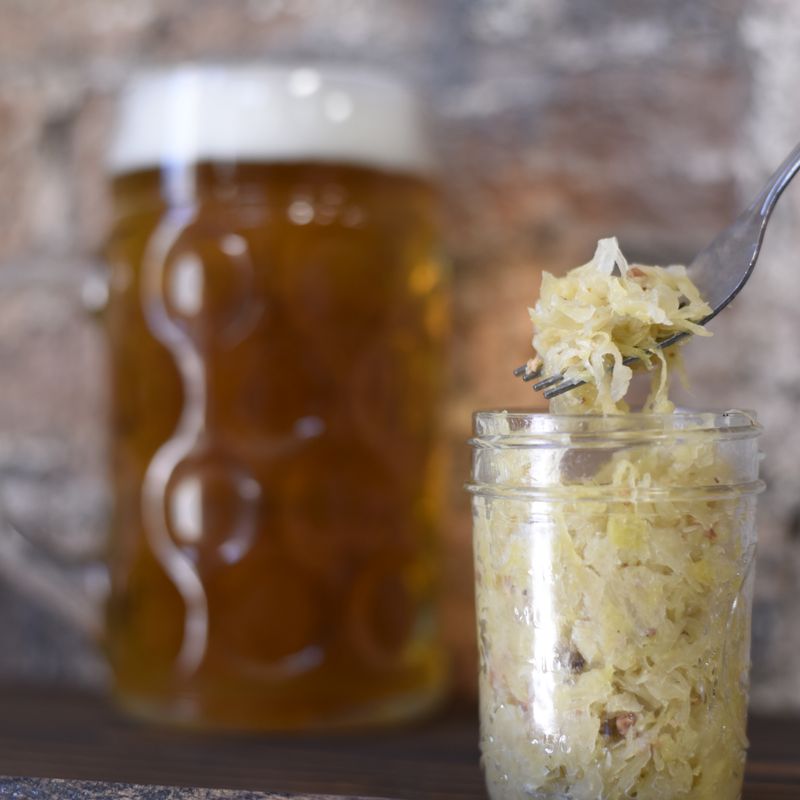
Classic Caraway Sauerkraut
Crisp, tangy, naturally fermented German-style sauerkraut made with just cabbage, salt and caraway. A precise 2% salt ratio keeps the ferment safe, crunchy and reliably sour.
- Prep
- 42 min
- Cook
- —
- Wait
- 7 days
- Total
- 7 days
- Makes
- About 1½ quarts (1.4 L), roughly 16 servings of ¼ cup
Steps
Before you start
- Plan on at least 7 days of fermenting at 65–72°F (18–22°C); 10–14 days gives deeper flavor. Warmer rooms ferment faster and taste less complex.
- Use a digital kitchen scale. Salt at 2% of the cabbage's trimmed weight is what makes the ferment safe and crisp, and volume measures vary by salt brand.
- Use non-iodized salt with no anti-caking additives (kosher or pickling salt). Iodized salt can cloud the brine and slow fermentation.
- Wash the jar, weight and your hands with hot soapy water and rinse well. Everything must be clean, but not sterilized.
Clean your equipment
- Wash the jar, fermentation weight, bowl, spoon and your hands with hot soapy water and rinse thoroughly.
- Set the jar upright on a rimmed plate.
- Remove the 2 tough outer cabbage leaves and discard; rinse the head and pull off 1 more clean, intact leaf and set it aside for covering the kraut later.
+ Show details− Hide details
Ready when: Everything looks and feels free of soap residue.
Tip: Skip antibacterial sprays; they can leave residue that hinders the good bacteria.
Core and shred cabbage
- Quarter the head through the stem and cut the dense white core out of each quarter at an angle.
- Slice each quarter crosswise into thin ribbons about ⅛ inch (3 mm) thick.
- Place the shreds in the large bowl and weigh them; you want about 1,400 g.
- Adjust the salt to 2% of your actual weight if it differs (for example, 1,200 g needs 24 g).
+ Show details− Hide details
Ready when: Shreds are thin and fairly uniform, with no thick chunks of core.
Tip: Thinner shreds release brine faster and ferment more evenly.
Salt the cabbage
- Sprinkle 28 g kosher salt evenly over the shredded cabbage and toss with your hands for about 30 seconds.
- Let it sit for 15 minutes so the salt starts drawing out water.
+ Show details− Hide details
Ready when: Cabbage looks slightly wilted and damp, with liquid beginning to pool at the bottom of the bowl.
Massage until brine forms
- Squeeze, knead and crush the cabbage firmly with clean hands for 5–8 minutes.
- It will shrink in volume, turn glossy and translucent, and release a lot of liquid.
+ Show details− Hide details
Ready when: A handful squeezed over the bowl drips steady liquid, and a pool of brine sits at the bottom of the bowl.
Tip: If it seems dry, rest it another 10 minutes and massage again; older cabbage needs more time.
Mix in caraway
- Sprinkle 2 tsp caraway seeds over the cabbage and toss until evenly distributed.
+ Show details− Hide details
Ready when: Seeds are scattered throughout with no clumps.
Pack the jar tightly
- Transfer the cabbage to the jar a handful at a time, pressing down hard with your fist or a tamper after each addition to remove air pockets and bring the brine up.
- Pour in all the brine from the bowl.
- Leave at least 2 inches (5 cm) of headspace at the top, since the kraut will bubble up.
+ Show details− Hide details
Ready when: Brine rises above the cabbage by at least ½ inch (1 cm) when pressed down.
Tip: If brine doesn't cover the cabbage, stir 5 g salt into 250 ml water and add just enough to submerge it.
Cover and weigh down
- Fold the reserved cabbage leaf and tuck it over the top of the shreds so it keeps loose bits from floating.
- Set the fermentation weight on top so everything stays fully below the brine.
- If you used the top-up brine (water and 5 g salt), add only enough to cover.
- Close with an airlock lid, or a loosely set lid, or cloth and rubber band.
+ Show details− Hide details
Ready when: No cabbage pokes above the brine.
Tip: Anything exposed to air can grow mold; keep it submerged. A tightly sealed lid can build pressure, so loosen it or use an airlock.
Ferment at room temperature
- Place the jar on its plate away from direct sunlight at 65–72°F (18–22°C).
- Each day, press the cabbage down to keep it submerged and release gas; if you use a standard lid, loosen it briefly to burp.
- Expect bubbling and cloudy brine by day 2–3 and a pleasantly sour smell.
- Skim any white film (kahm yeast) if it appears; it is harmless but can taste off.
+ Show details− Hide details
Ready when: After 7 days, brine is cloudy, bubbly and tangy-smelling, and the cabbage is soft-crisp and translucent.
Tip: Discard the batch if you see fuzzy mold in blue, green, pink or black, or if it smells rotten rather than sour.
Taste and decide
- On day 7, use a clean fork to pull out a bit of kraut and taste.
- If you want it more sour, reseal, keep submerged and ferment up to 14 days, tasting every 2 days or so.
+ Show details− Hide details
Ready when: Tastes clearly tangy and salty-sour with crunchy-tender texture.
Tip: Warmer rooms finish sooner; cooler rooms can take 3 weeks.
Chill and store
- Remove the weight and top leaf and discard the leaf.
- Close the jar with a regular lid and refrigerate.
- The flavor mellows and improves over the first week in the fridge.
+ Show details− Hide details
Ready when: Jar is cold and sealed, with kraut covered by brine.
Good to know
Tips
- Always weigh the salt: 2% of the cabbage weight is the safe, crisp sweet spot. Less risks spoilage; more slows fermentation and tastes harsh.
- Keeping the cabbage under the brine is the single most important step for preventing mold.
- Bubbling, a sour smell and cloudy brine are normal signs of healthy fermentation, not spoilage.
- Set the jar on a plate, since brine can overflow during active fermentation.
Make ahead
"Ferment up to 2 weeks ahead, then refrigerate. It keeps improving in flavor for the first few weeks."
Storage & reheating
Refrigerate in the jar, submerged in brine, for up to 6 months. Do not store at room temperature once fermented. Serve cold or at room temperature, or warm gently in a pan (high heat reduces the probiotics). To freeze, drain and freeze in airtight containers for up to 6 months; texture will be softer, so use it for cooking.
Substitutions
- green cabbage → red cabbage. Gives vivid purple kraut; it can take a few extra days to soften. Keep the same weight and salt ratio.
- caraway seeds → juniper berries or dill seeds. Use 6–8 lightly crushed juniper berries or 2 tsp dill seeds for a different traditional flavor, or omit for plain kraut.
- kosher salt (non-iodized, no additives) → fine sea salt or pickling salt. Always go by weight (28 g); fine salts are much denser by volume.
- filtered or boiled-and-cooled water → distilled water. Any chlorine-free water works. Boil and cool tap water first to dissipate chlorine.
More pickles & chutneys
See all →


Find more like this
- Meal
- Dinner
- Main ingredient
- Cabbage
- Quick & Easy
- 5 Ingredients or LessEasyMake AheadBudget