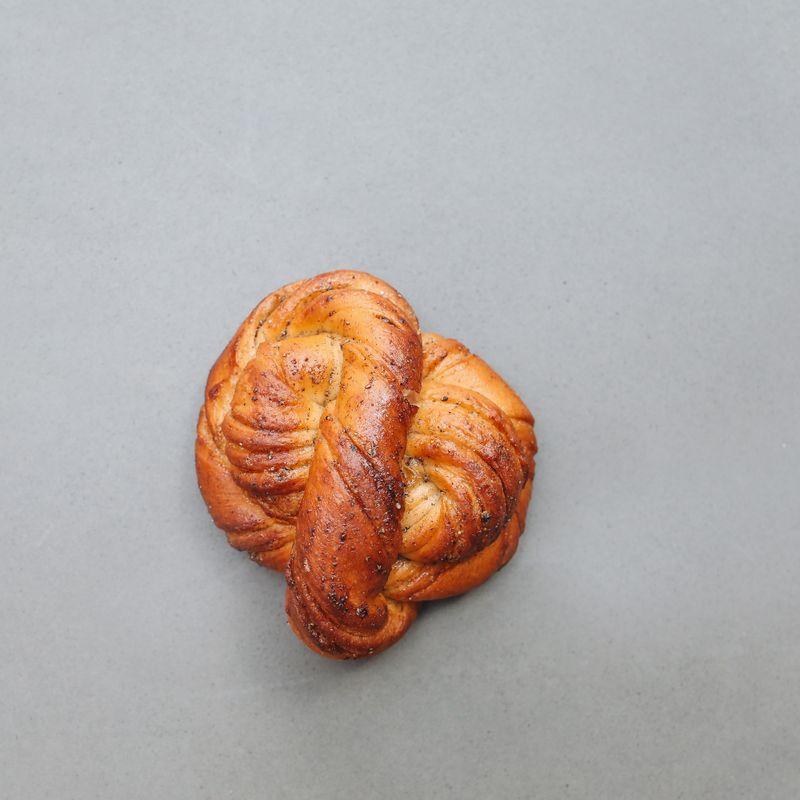
Cardamom Swedish Buns
Classic Scandinavian cardamom buns (kardemommabullar) with a tender, spiced yeast dough wrapped around a sweet butter, brown sugar, and cardamom filling, topped with pearl sugar for delightful crunch. Aromatic, pillowy-soft, and perfect for breakfast, fika (Swedish coffee break), or dessert. Impressive yet approachable for home bakers.
- Prep
- 40 min
- Cook
- 20 min
- Wait
- 2 hr 15 min
- Total
- 3 hr 15 min
- Makes
- 12 buns
Steps
Before you start
- Remove eggs and butter from the refrigerator 1 hour before starting so they reach room temperature
- Warm the milk to exactly 110°F (43°C)—this is crucial for yeast activation; use a thermometer
- Have all ingredients measured and ready (mise en place) before you begin
- Clear a warm, draft-free area for the dough to rise (around 75–80°F / 24–27°C is ideal)
Bloom the yeast
- In a large bowl, combine the warm milk (110°F / 43°C), active dry yeast, and 1 tablespoon of the granulated sugar.
- Stir gently to combine and let sit for 5 minutes until the mixture is foamy and smells strongly of yeast.
- If the mixture doesn't foam, the yeast may be dead—discard and start over with fresh yeast.
+ Show details− Hide details
Ready when: Mixture is foamy and fragrant with a strong yeast aroma
Tip: Milk must be exactly 110°F (43°C)—too hot kills yeast, too cold won't activate it properly
Mix the dough
- To the yeast mixture, add the remaining sugar (about ⅓ cup minus 1 tablespoon), melted butter, 2 of the eggs, all-purpose flour, salt, and 1½ tsp ground cardamom.
- Using a stand mixer fitted with the dough hook (or a wooden spoon and strong arm), mix on medium speed for 2–3 minutes until a shaggy dough forms and most of the flour is incorporated.
+ Show details− Hide details
Ready when: Shaggy dough forms and flour is mostly incorporated
Knead until smooth
- Turn the dough onto a lightly floured surface and knead by hand for 8–10 minutes (or 6–7 minutes in a stand mixer) until smooth, elastic, and only slightly sticky.
- The dough should spring back slowly when poked.
- If too sticky, dust with a little more flour, 1 tablespoon at a time.
+ Show details− Hide details
Ready when: Dough is smooth, elastic, and springs back slowly when poked
Tip: Don't over-knead—stop as soon as the dough becomes smooth and elastic, or it may become tough
First rise and prepare filling
- Shape the dough into a smooth ball and place it in a lightly greased bowl.
- Cover the bowl with plastic wrap or a damp kitchen towel.
- Set the bowl in a warm, draft-free place (around 75–80°F / 24–27°C is ideal) and let the dough rise until doubled in size, about 60–90 minutes.
- Meanwhile, prepare the filling: In a small bowl, mix the softened butter (4 tbsp at room temperature) with the brown sugar and remaining 1 teaspoon ground cardamom until well combined and spreadable.
- Set aside until needed.
+ Show details− Hide details
Ready when: Dough has doubled in size and springs back slowly when poked; filling is uniform and spreadable
Tip: The warmer the environment, the faster the dough rises—in a cool room, it may take 2 hours or more
Roll, fill, and cut
- Punch down the dough and turn it onto a lightly floured surface.
- Using a rolling pin, roll the dough out into a 12×15-inch (30×38 cm) rectangle, about ¼ inch thick.
- Spread the filling evenly over the dough, leaving a ½-inch (1 cm) border along one long edge.
- Starting from the opposite long edge (the one without the border), tightly roll the dough up like a log, then gently press the seam closed.
- Cut the log into 12 equal pieces, each about 1¼ inches (3 cm) thick.
+ Show details− Hide details
Ready when: Dough is rolled to the right size; filling is evenly spread; buns are evenly cut
Tip: If the dough springs back while rolling, let it rest 5–10 minutes then try again—the gluten will relax
Arrange and second rise
- Carefully place each bun, cut-side up, on a parchment-lined 9×13-inch (23×33 cm) baking sheet, spacing them about 1 inch (2.5 cm) apart so they have room to rise.
- Cover the pan loosely with plastic wrap and let the buns rise in a warm place until they are puffy and light to the touch, 30–45 minutes.
- The buns should rise until they nearly touch each other.
+ Show details− Hide details
Ready when: Buns have risen significantly, are light and airy, and nearly touch each other
Tip: If your kitchen is cool, place the pan in a proofing box or inside a closed oven with just the light on
Preheat and prepare toppingOven 400°F / 205°C
- When the buns are almost done rising, preheat the oven to 400°F (200°C).
- In a small bowl, whisk together the remaining 1 egg with 1 tablespoon of water until well combined.
- This is your egg wash.
+ Show details− Hide details
Ready when: Egg wash is smooth and well combined; oven reaches 400°F (200°C)
Top with egg wash and pearl sugar
- Brush each bun lightly with the egg wash, being careful not to flatten them.
- Sprinkle the top of each bun with pearl sugar, about 1 teaspoon per bun.
- The pearl sugar will add a delightful crunch and subtle sweetness to the buns.
+ Show details− Hide details
Ready when: All buns are brushed with egg wash and topped with pearl sugar
Tip: Don't press down while brushing—the buns will deflate if you use too much pressure
Bake until goldenOven 400°F / 205°C
- Place the baking sheet in the preheated 400°F (200°C) oven and bake for 18–22 minutes until the buns are golden brown on top.
- The buns should sound hollow when tapped on the bottom, and the internal temperature should reach about 190°F (88°C) if measured with a thermometer.
+ Show details− Hide details
Ready when: Buns are golden brown; they sound hollow when tapped; internal temperature reaches 190°F (88°C)
Tip: If the buns are browning too quickly, loosely tent the pan with foil in the last few minutes
Cool on rack
- Transfer the buns to a wire rack to cool for at least 15 minutes before serving.
- They will cool slightly and firm up, making them easier to handle.
- Serve warm or at room temperature.
- They are best enjoyed within a few hours of baking but will keep for up to 3 days when stored in an airtight container.
+ Show details− Hide details
Ready when: Buns are warm but no longer piping hot
Good to know
Tips
- Cardamom is essential to Swedish buns—if possible, buy whole cardamom pods and grind them fresh just before use in a spice grinder or mortar and pestle. Pre-ground cardamom loses its aromatic oils quickly.
- For deeper flavor, make the dough the evening before: let it rise in the fridge overnight (8–12 hours), then proceed with shaping and the second rise the next morning. The slow, cool fermentation develops much more complex flavor.
- Don't skip the second rise—it's what makes these buns light and fluffy rather than dense and heavy. They should feel airy and pillowy before baking.
- Egg wash adds shine and helps the pearl sugar adhere, but don't apply it too heavily or you'll flatten the buns. A light brush is all you need.
Make ahead
Prepare dough through the first rise and refrigerate up to 12 hours. Alternatively, shape buns after the second rise, freeze on a baking sheet, then transfer to a freezer bag and store up to 2 months. Thaw frozen buns at room temperature before baking, or bake directly from frozen with an extra 10–15 minutes.
Storage & reheating
Room temperature: up to 2 days in an airtight container. Refrigerator: up to 4 days in an airtight container; reheat in a 300°F (150°C) oven for 10 minutes. Freezer: up to 2 months in an airtight container; thaw at room temperature overnight and reheat as above.
Substitutions
- ground cardamom → ½ tsp each ground cinnamon and ground nutmeg, or ½ tsp cinnamon mixed with ¼ tsp ginger. Cardamom is essential to authentic Swedish buns, but these spice blends create a delicious alternative with a different warm flavor profile
- pearl sugar → sliced almonds, roughly chopped blanched almonds, or conventional sparkling sugar (sanding sugar). Pearl sugar provides a unique crunch and subtle sweetness; other options will give a different texture and appearance but taste equally good
- whole milk (or 2%) → any type of milk (2%, 1%, skim, or unsweetened oat or almond milk). Full-fat milk gives the richest flavor and tender crumb, but any unsweetened milk will work
- active dry yeast → 2 tsp instant yeast (bread machine yeast) or ½ oz (14g) fresh yeast crumbled into the milk. Instant yeast doesn't need blooming—mix it directly with the dry ingredients if you prefer. Fresh yeast should be crumbled into the warm milk
More pastries
See all →




Find more like this
- Meal
- Breakfast
- Diet
- VegetarianHalal
- Method
- Oven
- Quick & Easy
- Make AheadFreezer Friendly