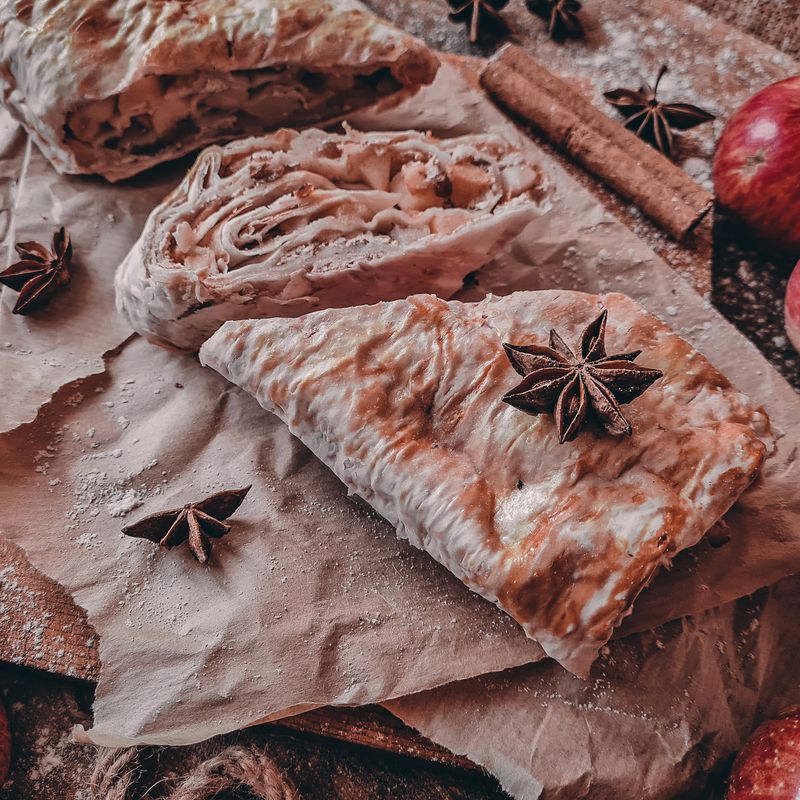
Buckwheat Apple Strudel
A rustic Eastern European rolled pastry featuring a buckwheat and all-purpose flour dough wrapped around a spiced apple and walnut filling. The dough is tender and slightly nutty, while the filling is warm and aromatic—seasoned with cinnamon, nutmeg, and lemon zest. Breadcrumbs line the dough to absorb moisture, preventing a soggy base. The strudel is brushed with melted butter and baked until the crust is deep golden, then finished with a light dusting of powdered sugar.
- Prep
- 40 min
- Cook
- 55 min
- Wait
- 1 hr 20 min
- Total
- 2 hr 55 min
- Makes
- 1 strudel (10–12 slices)
Steps
Before you start
- Preheat oven to 375°F (190°C) about 15 minutes before baking
- Bring egg and butter to room temperature (at least 1 hour ahead)
- Measure and prep all ingredients before mixing the dough
- Line a 9×13-inch (23×33 cm) baking sheet with parchment paper
Make the dough
- In a large mixing bowl, whisk together buckwheat flour, all-purpose flour, and salt.
- Add the softened butter, cut into small pieces, and the room-temperature egg.
- Using your hands or a wooden spoon, mix until the ingredients form a shaggy mass.
- Add the vinegar and ¼ cup (60 ml) water, mixing gently until a soft dough forms.
- If the dough is crumbly and doesn't hold together, add 1 tablespoon of water or milk at a time until it comes together.
- Knead gently in the bowl for 2 minutes to develop structure—the dough should be soft and slightly sticky but not wet.
+ Show details− Hide details
Ready when: Soft dough that holds together but is still slightly sticky; no dry flour visible
Tip: Don't overwork the dough; buckwheat can become tough if kneaded too much. Mix just until combined.
Rest the dough
- Cover the bowl with a damp kitchen towel or plastic wrap.
- Let the dough rest at room temperature for 30 minutes.
- This allows the buckwheat flour to fully hydrate and makes the dough easier to roll out without cracking.
Prepare the apple-walnut filling
- While the dough rests, peel, core, and dice the apples into ½-inch (1.3 cm) pieces.
- Heat a 12-inch (30 cm) skillet over medium heat and add the butter.
- Once the butter foams and the foam subsides, add the diced apples, sugar, cinnamon, nutmeg, lemon zest, and salt.
- Stir well to combine.
- Cook, stirring occasionally, for 12–15 minutes until the apples are tender and have released their liquid; you should see the pan beginning to dry slightly as the liquid reduces.
- Stir in the chopped walnuts in the last minute of cooking.
- Transfer the filling to a bowl and let cool to room temperature, about 10–15 minutes, stirring occasionally.
+ Show details− Hide details
Ready when: Apples are tender with distinct pieces, liquid is mostly reduced, and walnuts are fully incorporated
Tip: Don't overcook the apples until they turn to mush; they'll continue to soften as they cool. You want distinct apple pieces for texture.
Roll out the doughOven 375°F / 190°C
- Preheat the oven to 375°F (190°C).
- Lightly dust a clean countertop with buckwheat flour.
- Transfer the rested dough to the floured surface and gently flatten it with your hands into a rough rectangle.
- Using a rolling pin, roll the dough into a 12×16-inch (30×41 cm) rectangle, about ¼-inch (6 mm) thick.
- If the dough tears, pinch it back together.
- Transfer the rolled dough to the parchment-lined baking sheet, centering it and letting the edges hang over slightly.
+ Show details− Hide details
Ready when: Dough is rolled to ¼-inch thickness and fits on the baking sheet
Tip: Work quickly and gently with buckwheat dough; it's more fragile than wheat dough and won't stretch as much. If it springs back, let it rest for 1 minute and try again.
Layer the breadcrumbs and filling
- Sprinkle the breadcrumbs evenly over the dough, leaving a ½-inch (1.3 cm) border on all edges.
- This absorbs moisture from the apples and prevents a soggy bottom crust.
- Spoon the cooled apple-walnut filling over the breadcrumbs, spreading it in an even layer while maintaining the same ½-inch border all around.
- The filling should be about 1 to 1.5 inches (2.5–4 cm) thick.
+ Show details− Hide details
Ready when: Even layer of breadcrumbs and filling with visible border on all sides
Roll and seal the strudel
- Starting from one of the long sides of the rectangle (the 16-inch side), grasp the edge of the parchment paper and use it to help roll the dough tightly around the filling, like rolling up a jelly roll.
- Once completely rolled, position the strudel seam-side down on the baking sheet.
- Gently press the seam to seal it, and tuck the ends underneath to create a neat, tidy package.
+ Show details− Hide details
Ready when: Strudel is tightly rolled with sealed seams and tucked ends
Tip: Using the parchment paper makes rolling much easier. Take your time; a tight roll prevents the filling from leaking out during baking.
Brush with butter
- Using a pastry brush, brush the entire surface of the strudel—top and sides—with the melted butter, using about 3–4 tablespoons.
- This creates a golden, crispy crust and adds rich flavor.
+ Show details− Hide details
Ready when: Strudel is evenly coated with a thin layer of butter
Tip: If the butter solidifies as you work, gently reheat it.
Bake the strudelOven 375°F / 190°C
- Place the baking sheet in the preheated 375°F (190°C) oven and bake for 35–40 minutes, until the strudel is deep golden brown on the top and sides and the butter is bubbling around the edges.
- The kitchen will smell wonderfully aromatic.
- If the top is browning too quickly before the interior is baked (usually after 25–30 minutes), loosely tent with aluminum foil to slow the browning.
+ Show details− Hide details
Ready when: Deep golden brown crust on top and sides, butter bubbling at edges, strong apple-cinnamon aroma
Tip: Tent with foil if browning too quickly; the filling needs time to heat through.
Cool and finish
- Remove the baking sheet from the oven and let the strudel rest on the sheet for 10 minutes.
- This allows it to set slightly, making it easier to move without breaking apart.
- Transfer the strudel to a wire cooling rack and let it cool completely, about 30–40 minutes.
- Once cool, dust the top generously with powdered sugar.
- Slice with a sharp serrated knife, using a gentle sawing motion to avoid cracking the crust.
+ Show details− Hide details
Ready when: Strudel is completely cool and dusted with powdered sugar
Tip: Cool completely before slicing for clean cuts. A serrated bread knife works better than a chef's knife for strudel.
Good to know
Tips
- Buckwheat dough is more delicate than wheat dough and won't stretch as much. Handle it gently, and if it tears, simply pinch the tears closed—they'll seal as it bakes and are unnoticeable.
- The breadcrumb layer is crucial for a non-soggy bottom. It acts as a moisture barrier between the wet apple filling and the crust, absorbing excess liquid as it bakes.
- For a glossier, more professional finish, brush the strudel a second time with melted butter after the first 15–20 minutes of baking. This creates a rich, burnished crust.
- Slicing is easier and cleaner with the strudel at room temperature. A serrated bread knife (like a serrated tomato knife) works better than a chef's knife because it saws through the crispy crust without shattering it.
Make ahead
The dough can be made up to 1 day ahead and refrigerated, wrapped tightly in plastic wrap. The apple-walnut filling can be made up to 2 days ahead and refrigerated in an airtight container. Assemble and bake the strudel the same day you plan to serve it for best crust texture, though it can be assembled, wrapped in plastic, and refrigerated for up to 4 hours before baking.
Storage & reheating
Room temperature (loosely wrapped in foil or under a cake dome): up to 2 days. The crust will soften slightly but remain pleasant. Refrigerator (covered): up to 4 days; reheat gently in a 300°F (150°C) oven for 10–15 minutes to restore crispness. Freezer (wrapped tightly in plastic wrap, then foil): up to 3 months. Thaw overnight in the refrigerator and reheat in a 300°F (150°C) oven for 15–20 minutes to restore crispness.
Substitutions
- buckwheat flour → ¾ cup all-purpose flour mixed with ¾ cup buckwheat flour. If pure buckwheat is unavailable, use this 50-50 blend. The dough will be slightly lighter and less nutty, but still delicious. If making this substitution, reduce the all-purpose flour in the base dough to 2 tablespoons.
- walnuts → Pecans or toasted sliced almonds. Both add a different but equally pleasant nutty flavor. Use the same weight as walnuts. Pecans are slightly sweeter; almonds add a delicate crunch.
- tart apples (such as Granny Smith) → A mix of tart and sweet apples (half Granny Smith, half Honeycrisp or Gala). This creates a more complex flavor with less tartness. Reduce the sugar by 1–2 tablespoons if using sweeter apples to avoid excess sweetness.
- ground cinnamon → Apple pie spice or a blend of cinnamon, cloves, and allspice. Use 1½ teaspoons apple pie spice total, or add ⅛ teaspoon of ground cloves to the cinnamon and nutmeg for warmer spice notes.
More pastries
See all →


Find more like this
- Meal
- Dessert
- Main ingredient
- Apples
- Diet
- VegetarianHalal
- Method
- Oven