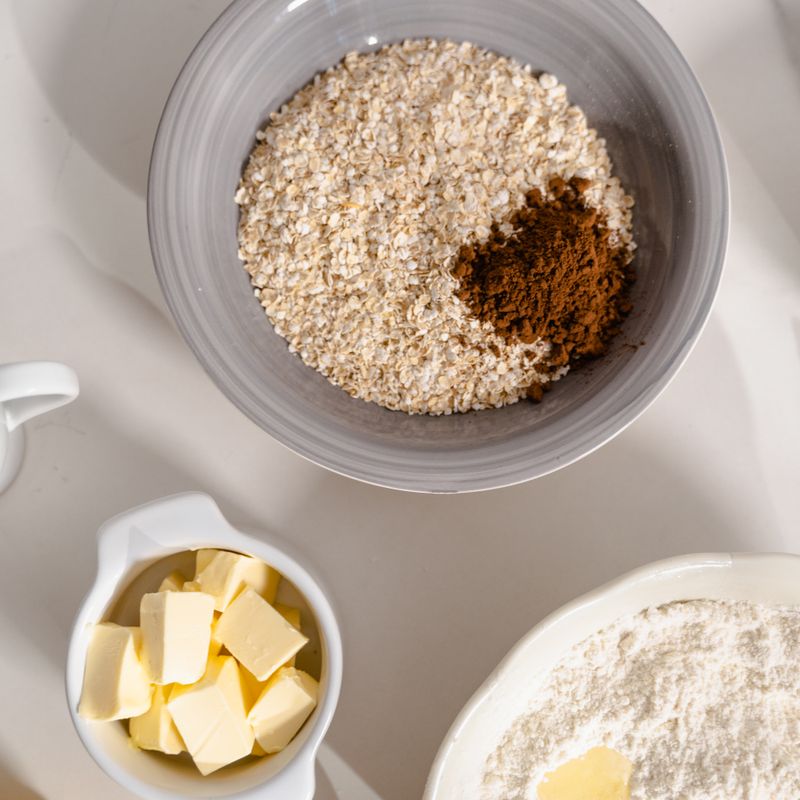
Brown Butter Hazelnut Scones
Tender, flaky scones enriched with nutty brown butter and toasted hazelnuts. The butter is browned slowly to develop deep, caramelized flavor that pairs beautifully with the hazelnuts. A light touch and cold ingredients are the keys to achieving a tender crumb. Serve warm with clotted cream and jam.
Steps
Before you start
- Preheat oven to 400°F (200°C)
- Chill a mixing bowl in the freezer for 10 minutes
- Toast hazelnuts at 350°F (175°C) for 8–10 minutes if not already roasted
- Have a baking sheet lined with parchment paper ready
Brown the butter
- Cut the cold butter into 4–5 pieces and place in a small saucepan over medium heat.
- Stir occasionally as it melts.
- The butter will foam and bubble; watch for the solids at the bottom to turn deep golden brown and smell nutty, about 8–10 minutes total.
- Do not let it burn—it should smell toasted, not charred.
- Pour the brown butter (solids and all) through a fine-mesh strainer into a bowl.
- Let it cool to room temperature, about 10 minutes.
- You should have about ½ cup (120 ml) of brown butter.
+ Show details− Hide details
Ready when: Butter turns deep golden and smells toasted; solids are dark brown
Tip: Watch the butter carefully—the line between golden and burnt is quick. A bit of color variation is fine; worry if it smells bitter or acrid.
Mix dry ingredients
- In your chilled mixing bowl, whisk together the flour, granulated sugar, baking powder, and salt.
- Set aside.
+ Show details− Hide details
Ready when: Mixture is evenly combined with no lumps
Add hazelnuts and combine wet
- Stir the chopped hazelnuts into the dry mixture.
- In a separate small bowl or cup, whisk the cold milk with the cooled brown butter and vanilla extract until combined.
- Pour the wet ingredients into the dry ingredients and gently fold together with a spatula or wooden spoon until just combined.
- The dough will be shaggy and slightly sticky; do not overmix.
- Stop as soon as no dry flour streaks remain.
+ Show details− Hide details
Ready when: Dough just comes together with no visible dry flour
Tip: Overworking the dough develops gluten and makes tough, dense scones. Mix until combined, then stop.
Shape and cut scones
- Turn the shaggy dough out onto a lightly floured work surface.
- Gently press and fold it together a few times (2–3 folds) until it forms a rough disk about ¾ inch thick.
- Do not knead.
- Use a 2½-inch (6 cm) round biscuit cutter or the rim of a drinking glass to cut out scones, pressing straight down without twisting.
- You should get 8 scones.
- Arrange them on the prepared baking sheet about 1½ inches (4 cm) apart.
- If using coarse sugar, lightly brush the tops with a tiny bit of milk and sprinkle with coarse sugar.
+ Show details− Hide details
Ready when: Scones are cut and arranged on baking sheet
Tip: Avoid twisting the cutter; pressing straight down creates even layers and rise. Twisting seals the edges and prevents height.
Bake sconesOven 400°F / 205°C
- Bake at 400°F (200°C) for 14–16 minutes, until the tops are golden brown and the edges are set.
- The centers may still feel slightly soft when pressed, which is correct for tender scones.
- Do not overbake.
+ Show details− Hide details
Ready when: Tops are golden brown; edges are set and pulling away slightly from baking sheet
Tip: If your oven runs hot, rotate the baking sheet halfway through baking for even browning.
Cool and serve
- Transfer the scones to a wire rack and let cool for 2–3 minutes.
- They are best served warm, within 30 minutes of baking, with clotted cream and jam.
+ Show details− Hide details
Ready when: Scones are cool enough to move without breaking
Tip: Scones are most tender and flavorful served warm the same day they are baked.
Good to know
Tips
- Brown butter can be made 1 day ahead and refrigerated; gently warm to room temperature or melt over low heat before using, so it combines smoothly with the milk.
- A marble or granite slab chilled in the freezer is ideal for mixing scone dough—the cold surface keeps the butter from melting too fast, resulting in a more tender crumb.
- Scones are tender when the butter remains in small pieces throughout the dough rather than fully incorporated; do not aim for a smooth, homogeneous batter.
- Serve scones with clotted cream and jam, or a simple spread of good butter and honey. The brown butter nuttiness pairs especially well with berry jam or lemon curd.
Make ahead
The dough can be prepared and cut into scones up to 4 hours ahead; cover loosely with plastic wrap and refrigerate. Bake from cold, adding 1–2 minutes to the baking time. Alternatively, baked scones can be frozen for up to 1 month; thaw at room temperature and warm in a 300°F (150°C) oven for 5 minutes.
Storage & reheating
Store cooled scones in an airtight container at room temperature for up to 2 days. They are best eaten within a few hours of baking. To reheat, wrap in foil and warm in a 300°F (150°C) oven for 5–8 minutes. Freeze in an airtight container for up to 1 month; thaw at room temperature before reheating.
Substitutions
- toasted hazelnuts, roughly chopped → toasted almonds or walnuts, roughly chopped. Use the same amount by weight. Toast for 8–10 minutes at 350°F (175°C) if not already roasted. The flavor will be slightly different but equally delicious.
- whole milk, cold → buttermilk or plain Greek yogurt thinned with water. Use the same volume. The scones will be slightly more tender and tangy. If using Greek yogurt, whisk it with water to reach 180 ml (¾ cup) total volume.
- vanilla extract → Omit or replace with ¼ tsp almond extract. Almond extract complements the hazelnuts beautifully. Omitting vanilla is also fine and will let the brown butter and hazelnuts shine.
- all-purpose flour → all-purpose flour mixed with ¼ cup (30 g) whole wheat flour. Replace ¼ cup (30 g) of the all-purpose flour with whole wheat flour for a nutty, slightly denser crumb. The flavor pairing with brown butter is excellent.
More scones & biscuits
See all →



Find more like this
- Meal
- Breakfast
- Diet
- VegetarianHalal