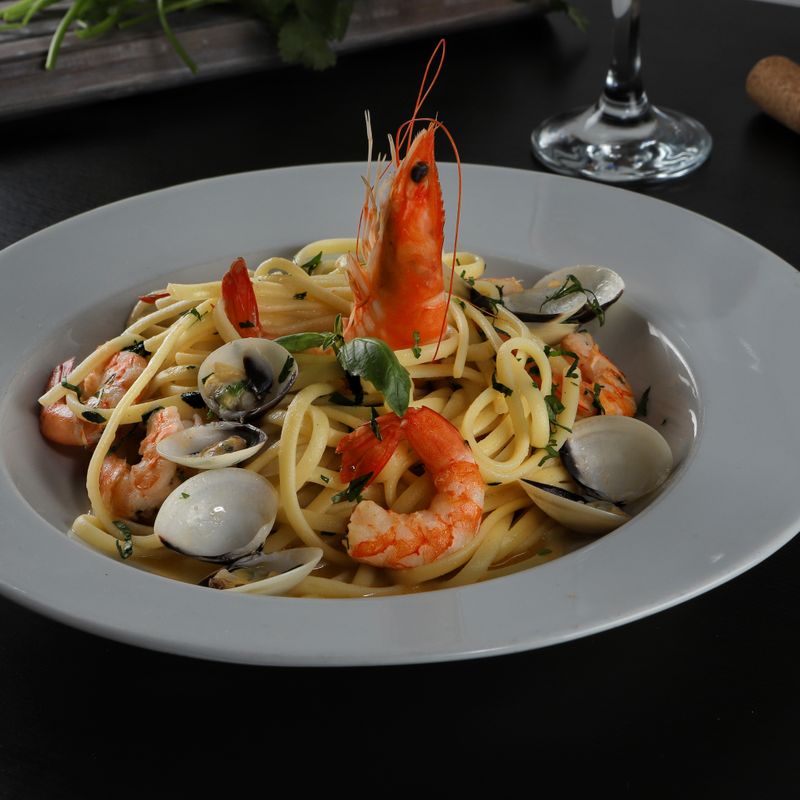
Baked Seafood Pasta with White Wine and Garlic
A refined but straightforward baked pasta featuring sautéed shrimp, scallops, and mussels in a delicate white wine and garlic sauce. Tossed with fresh pasta and bright parsley, the whole dish is transferred to a baking dish, topped with a golden, butter-enriched breadcrumb crust, and finished in a hot oven. It's comfort food with elegance—perfect for a weeknight that feels a bit special.
- Prep
- 20 min
- Cook
- 50 min
- Wait
- 5 min
- Total
- 1 hr 15 min
- Makes
- Serves 4 as a main course
Steps
Before you start
- Preheat your oven to 400°F (200°C).
- Thaw any frozen seafood and pat it dry with paper towels; moisture prevents good searing.
- Prepare a mise en place: mince garlic and shallots, chop fresh parsley, grate Parmesan, measure wine and stock, and keep all ingredients within reach.
Cook pasta until al dente
- Bring a large pot of generously salted water to a rolling boil over high heat.
- Add the pasta and cook according to package directions until it has a slight firmness to the bite—usually 9–12 minutes, depending on the shape and brand.
- Don't rinse the pasta once drained; a light starch coating helps it absorb the sauce later.
- Drain in a colander and set aside.
+ Show details− Hide details
Ready when: Pasta is tender but still firm to the bite when you taste a piece
Tip: Don't overcook the pasta—it will continue cooking in the oven, so aim for al dente or even slightly firmer than you'd normally serve.
Prepare and season the seafood
- Pat the thawed mixed seafood completely dry using paper towels to remove excess moisture.
- This is crucial for achieving a good sear rather than steam.
- Sprinkle lightly with salt and a pinch of black pepper.
+ Show details− Hide details
Ready when: Seafood is dry to the touch
Tip: Moisture is the enemy of browning; don't skip the drying step, which takes only a minute but makes a big difference.
Sauté aromatics in olive oil
- Heat 4 tbsp (60 ml) olive oil in a large skillet over medium heat.
- Once the oil shimmers, add the minced shallots and cook for 2 minutes, stirring, until just softened.
- Add the minced garlic and cook for 1–2 more minutes, stirring constantly, until very fragrant.
- Do not allow the garlic to brown, or it will taste bitter.
+ Show details− Hide details
Ready when: Shallots are translucent, garlic is fragrant and light golden but not browned
Tip: Use medium heat and watch closely; burned garlic ruins the dish, so stir constantly in this step.
Sear the seafood until nearly cooked
- Increase heat to medium-high.
- Add the dried seafood to the skillet in a single layer.
- Let it sit undisturbed for 3–4 minutes so shrimp and scallops can develop a light golden crust.
- Then stir and cook for another 2–3 minutes, until shrimp are mostly opaque throughout and scallops are just cooked through.
- If using mussels, they should be mostly closed by now.
- Resist the urge to fully cook them—they'll finish in the oven.
+ Show details− Hide details
Ready when: Shrimp are opaque and firm, scallops are just cooked through (no translucent center), mussels mostly closed
Tip: Stop short of full doneness; the residual heat in the oven will finish the cooking, so the seafood won't become tough.
Deglaze with white wine and stock
- Pour in 1 cup (240 ml) dry white wine, scraping the bottom of the skillet with a wooden spoon to lift up all the browned, flavorful bits.
- Simmer for 3–4 minutes, stirring occasionally, to cook off some of the raw alcohol taste and allow the wine to reduce slightly.
- Add the 1/2 cup (120 ml) seafood stock and stir to combine.
+ Show details− Hide details
Ready when: Wine has reduced slightly, the harshest alcohol aroma has dissipated, and the sauce smells appetizing
Tip: Don't skip the deglazing—those caramelized, stuck-on bits are pure umami and build the depth of flavor.
Combine pasta with seafood sauce
- Return the drained cooked pasta to the skillet.
- Add the juice of half a lemon (about 2 tbsp / 30 ml) and half of the fresh parsley (about 2 tbsp / 4 g).
- Toss gently but thoroughly with a wooden spoon or tongs to coat all the pasta evenly in the sauce.
- The pasta should absorb some of the liquid.
- Taste and season with a pinch of salt and black pepper as needed.
+ Show details− Hide details
Ready when: Pasta is coated with sauce and glistens; flavors taste balanced
Tip: Toss gently to avoid breaking apart the delicate seafood; a light hand here keeps everything intact.
Transfer to baking dish
- Pour the entire pasta and seafood mixture into a 9×13-inch (23×33 cm) baking dish, spreading it in a relatively even layer.
- Make sure the sauce is distributed throughout; this helps everything cook evenly and stay moist during baking.
+ Show details− Hide details
Tip: If the mixture seems dry, add a splash of stock or white wine to keep it moist during baking.
Prepare the breadcrumb topping
- In a small bowl, combine 1 cup (100 g) panko breadcrumbs, 1/2 cup (50 g) grated Parmesan, and 2 tbsp (30 g) softened butter.
- Use a fork to mix until the mixture resembles coarse sand with small clumps of butter distributed throughout.
+ Show details− Hide details
Ready when: Breadcrumb mixture resembles coarse sand with visible butter clumps
Tip: The butter helps the breadcrumbs brown evenly and add richness; don't skip it or overmix.
Top with breadcrumbs and bakeOven 400°F / 205°C
- Sprinkle the breadcrumb mixture evenly over the pasta in the baking dish, breaking up any large clumps so the topping is uniform.
- Bake in the preheated 400°F (200°C) oven for 15–20 minutes, until the breadcrumb topping is deep golden brown and the pasta mixture bubbles gently around the edges.
- If the breadcrumbs are browning too quickly before the edges bubble, loosely tent the dish with foil and continue baking.
+ Show details− Hide details
Ready when: Breadcrumb topping is deep golden brown (not pale), sauce bubbles at the edges, and a faint aroma of roasted breadcrumbs fills the kitchen
Tip: If browning too fast, tent with foil; if not browning enough toward the end, remove foil for the final 2–3 minutes.
Rest and garnish with fresh parsley
- Remove the baking dish from the oven and let it rest undisturbed for 5 minutes.
- During this time, residual heat settles and flavors meld.
- Scatter the remaining fresh parsley (about 2 tbsp / 4 g) over the top of the dish just before serving.
- Serve directly from the baking dish or transfer to individual plates.
+ Show details− Hide details
Tip: The fresh parsley added at the end is essential—it provides bright color, fresh aroma, and a contrast to the rich, cooked flavors.
Good to know
Tips
- Choose a white wine you'd actually drink. Sauvignon Blanc, Pinot Grigio, Albariño, or unoaked Chardonnay all work beautifully; avoid cheap 'cooking wine,' which adds unpleasant flavors.
- Seafood overcooks quickly and becomes rubbery. Keep a close eye on the searing step; remove it from heat slightly underdone, knowing the oven will finish the job.
- The pasta water starch is your friend—don't rinse the pasta after draining, as that light coating helps it grip the sauce and thicken the final dish.
- Fresh parsley at the end is not optional. It brightens the rich, wine-forward flavors and makes the dish feel vibrant and alive.
Make ahead
You can assemble the pasta-and-seafood mixture and prepare the breadcrumb topping separately up to 2 hours ahead. Keep the pasta mixture in the baking dish, covered with plastic wrap, in the refrigerator. Store the topping in a separate airtight container. Combine just before baking and add 3–5 minutes to the baking time if the dish starts cold from the fridge.
Storage & reheating
Room temperature: Best served fresh, but can rest at room temperature for up to 1 hour. Refrigerator: Store in an airtight container for up to 3–4 days. To reheat, place in a 350°F (175°C) oven, cover loosely with foil, and bake for 15–20 minutes until warmed through, or reheat gently in a skillet over medium heat, stirring often. Freezer: Not recommended, as the texture of seafood deteriorates significantly after freezing and thawing.
Substitutions
- mixed seafood (large shrimp, sea scallops, mussels, or frozen blend) → Use 1 lb (450 g) large shrimp alone, or a 1:1 mix of shrimp and sea scallops (omitting mussels), or frozen seafood blend. Different seafood cooks at slightly different rates; if using just shrimp, reduce sear time by 1–2 minutes. Frozen blends should be thawed before use.
- dry white wine (sauvignon blanc, pinot grigio, or albariño) → Dry vermouth, or 1.5 cups (360 ml) seafood or chicken stock combined with 2 tbsp white wine vinegar or fresh lemon juice. Vermouth has herbal notes that work well here. If using stock only, add acid (lemon or vinegar) to brighten the dish.
- panko breadcrumbs → Italian-seasoned breadcrumbs, or regular panko mixed with 2 tbsp grated Parmesan and 1 tsp dried Italian seasoning. Panko gives the crispest texture, but Italian-seasoned breadcrumbs add flavor if you're in a pinch.
- seafood or fish stock → Chicken or vegetable stock, or increase white wine to 1.5 cups (360 ml) and omit the stock entirely. Chicken stock is milder and works fine; vegetable stock is lighter. Using only wine makes a more concentrated, wine-forward sauce.
More baked pasta
See all →


Find more like this
- Meal
- Dinner
- Cuisine
- Italian
- Diet
- Sugar-Free