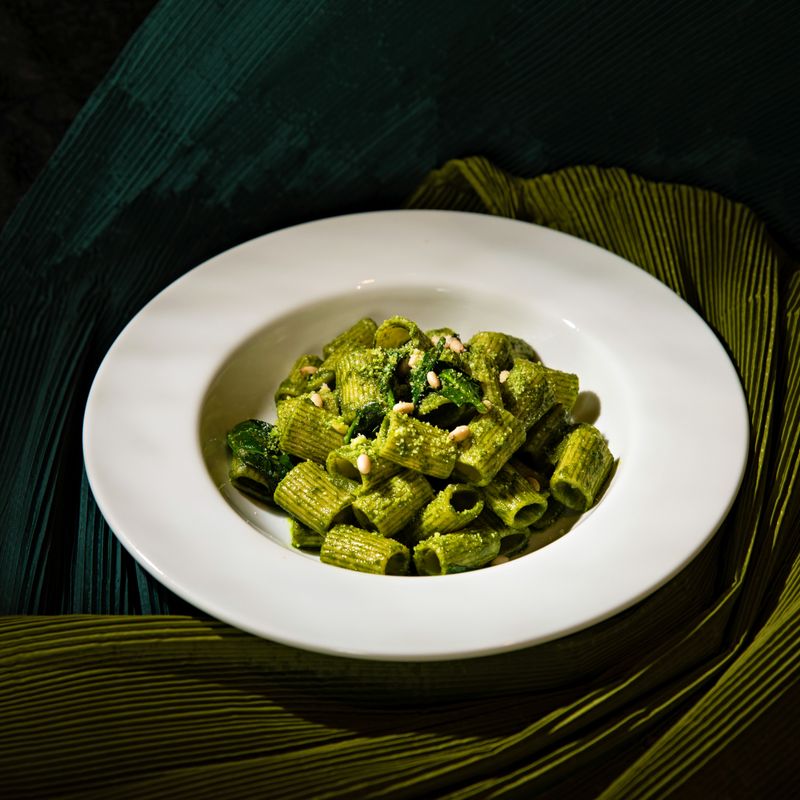
Baked Pesto Chicken Rigatoni with Sun-Dried Tomatoes
A comforting baked pasta dish where al dente rigatoni is tossed with shredded cooked chicken and a creamy basil pesto sauce enriched with sun-dried tomatoes and chicken broth, then topped with melted mozzarella and parmesan cheese and baked until bubbly and golden. Quick to assemble and freezer-friendly, it's perfect for weeknight dinners and makes excellent leftovers.
- Prep
- 15 min
- Cook
- 15 min
- Wait
- 25 min
- Total
- 55 min
- Makes
- Serves 6 (about 8 oz/225 g per serving)
Steps
Before you start
- If using raw chicken, cook 1.5 lbs (700 g) boneless skinless chicken breasts by boiling, baking, or poaching until the internal temperature reaches 165°F (74°C), then cool and shred. Alternatively, use a store-bought rotisserie chicken or leftover cooked chicken.
- Measure and mince all ingredients before you start cooking (mise en place) so the assembly goes smoothly.
- Preheat your oven to 375°F (190°C) about 15 minutes before assembling the dish.
- Have your 9×13-inch (23×33 cm) baking dish ready and lightly oiled or sprayed with cooking spray.
Preheat oven and prepare dishOven 375°F / 190°C
- Position the oven rack to the center and preheat the oven to 375°F (190°C).
- While preheating, lightly coat the bottom and sides of the 9×13-inch (23×33 cm) baking dish with olive oil or cooking spray so the pasta doesn't stick during baking.
- Set the dish aside until you're ready to use it.
+ Show details− Hide details
Ready when: Oven has fully preheated (indicated by a beep or light)
Tip: Start the oven early so it's ready while you're preparing the other components.
Cook the pasta
- Bring a large pot of water (at least 5 quarts/4.7 liters) to a rolling boil over high heat.
- Once boiling, add 3 tablespoons (50 g) salt and stir until dissolved.
- Add the rigatoni and stir well to prevent sticking.
- Cook according to package directions, but remove it 1–2 minutes before the package time suggests—the pasta should be just tender with a slight bite (al dente), not fully soft, because it will continue to soften in the oven and the sauce.
- Drain thoroughly in a colander; do not rinse the pasta, as some starch helps the sauce cling to it.
+ Show details− Hide details
Ready when: Pasta is tender but still has a slight bite when you bite into a piece; it should not be mushy or fully soft
Tip: Underdone pasta is better than overdone in this dish—the pasta will soften more in the sauce and oven. Taste a piece to check.
Make the pesto cream sauce
- While the pasta cooks, heat 2 tablespoons (30 ml) olive oil in a large skillet (10-inch/25 cm) over medium heat.
- Once shimmering (don't let it smoke), add the 3 minced garlic cloves and sauté for about 1 minute, stirring occasionally, until very fragrant and the garlic turns pale golden (do not brown, or it will taste bitter).
- Add the basil pesto, sun-dried tomatoes, heavy cream, and chicken broth.
- Stir well with a wooden spoon until everything is combined and smooth with no lumps of pesto.
- Let the mixture simmer gently for 2–3 minutes, stirring occasionally, until it's well blended and has thickened slightly—it should coat the back of a spoon.
- Taste a small spoonful and set the skillet aside off the heat.
+ Show details− Hide details
Ready when: Sauce is smooth and well-blended with no visible lumps of pesto; it coats the back of a spoon and is slightly thickened but still pourable
Tip: Keep the heat at medium or below to prevent the cream from breaking or separating. Never let it boil vigorously.
Add chicken and season
- Add the 3 cups (420 g) of cooled shredded cooked chicken to the pesto sauce and stir gently with a wooden spoon until the chicken is evenly coated with sauce.
- Taste a spoonful of the mixture and season with additional salt (start with ½ teaspoon/2.5 g) and freshly ground black pepper (start with ¼ teaspoon/0.5 g) to your preference.
- Remember that the parmesan cheese on top will also add saltiness, so go easy.
- Stir once more to make sure the chicken is well distributed and everything is combined.
+ Show details− Hide details
Ready when: Chicken is evenly coated with sauce; no dry spots or lumps of pesto are visible; the mixture tastes well-seasoned
Tip: Taste as you season—salt cannot be removed once added. It's better to undersalt slightly now since the parmesan and pesto are both salty.
Combine pasta and sauce
- Transfer the drained rigatoni to a large mixing bowl.
- Pour the entire chicken-pesto sauce over the pasta.
- Using a large rubber spatula or wooden spoon, gently fold and stir from the bottom to the top, turning the bowl as you go, until every piece of pasta is well coated with sauce.
- Make several sweeps with the spatula to ensure no dry pasta remains.
- This should take 2–3 minutes of gentle, patient mixing.
- Be careful not to be too aggressive, or you'll break the pasta into small pieces.
+ Show details− Hide details
Ready when: All pasta is evenly coated with sauce; no white, dry pasta is visible; the mixture looks creamy and uniform throughout
Tip: Use a rubber spatula or wooden spoon rather than a metal spoon to avoid breaking or bruising the delicate cooked pasta.
Assemble in baking dish and top
- Pour the entire pasta mixture into the prepared 9×13-inch (23×33 cm) baking dish, spreading it in an even layer.
- Use a rubber spatula to press it down gently so it settles evenly and fills the dish with no large gaps.
- Sprinkle the 1.5 cups (150 g) of shredded mozzarella cheese evenly over the top, then sprinkle the ½ cup (50 g) of finely grated parmesan cheese on top of that in an even layer.
- Cover the dish loosely with aluminum foil or parchment paper—the foil should tent above the pasta without touching the cheese if possible, leaving some room for steam to circulate.
+ Show details− Hide details
Ready when: Pasta is evenly spread in the dish; cheeses are distributed in an even layer; foil is loosely tenting above without pressing on the cheese
Tip: Don't pack the pasta down hard—just settle it gently so it fills the dish evenly without gaps. Leaving air space under the foil helps the cheese cook evenly.
Bake until bubbly and goldenOven 375°F / 190°C
- Place the covered baking dish in the preheated 375°F (190°C) oven on the center rack.
- Bake covered for 15 minutes.
- After 15 minutes, carefully remove the foil (watch out for steam rising) and bake for another 10–12 minutes uncovered, until the cheese is fully melted, bubbly around the edges, and the top has turned light golden brown (some darker golden-brown spots are perfectly fine—aim for an even light golden color).
- The pasta should be hot all the way through.
- Remove from the oven and let the dish rest, undisturbed, for 5 minutes before serving.
- This allows it to cool slightly so you don't burn your mouth and helps the dish set so it holds together when plated.
- Just before serving, tear fresh basil leaves over the top if desired.
+ Show details− Hide details
Ready when: Cheese is fully melted and bubbly, the top is light golden brown, steam is visible when foil is removed, and the pasta is hot when you press a spoon against it
Tip: If the cheese is browning too quickly before the interior is hot, tent loosely with foil again. If it's not browning enough by the end, you can broil for 1–2 minutes (watch carefully to avoid burning). Don't skip the resting step—it makes a difference in texture and temperature.
Good to know
Tips
- Use fresh, high-quality basil pesto if possible—it makes a significant difference in flavor. Jarred pesto works, but homemade or high-end brands give noticeably better results.
- Don't overcook the pasta. Undercooked is better than overcooked in this recipe, since the pasta continues to soften in the sauce and oven. It should have a slight bite (al dente), not be mushy or tender all the way through.
- For a true make-ahead dinner, assemble the dish the night before, cover, and refrigerate. The flavors deepen overnight, and everything comes together beautifully. Add about 5 minutes to the baking time if baking from cold.
- If the cheese is browning too quickly before the pasta heats through, cover with foil again. If it's not browning enough by the end, broil for 1–2 minutes at the end, watching carefully to avoid burning.
Make ahead
This dish can be assembled up to 1 day ahead. Cover the unbaked casserole tightly with plastic wrap and refrigerate. When ready to bake, remove from the fridge and bake covered at 375°F (190°C) for 20 minutes, then uncovered for 12–15 minutes until bubbly and golden (add about 5 extra minutes since it's cold). You can also freeze the unbaked assembled dish for up to 3 months in a freezer-safe container. Bake directly from frozen at 375°F (190°C) covered for 25 minutes, then uncovered for 15–18 minutes until bubbly and golden.
Storage & reheating
Refrigerate leftovers in an airtight container for up to 3 days. Reheat covered in a 350°F (175°C) oven for 15–20 minutes until warmed through, or reheat individual portions in the microwave (place on a microwave-safe plate, cover loosely, and heat on 50% power for 2–3 minutes, stirring halfway through). Freeze cooled leftovers in an airtight freezer-safe container for up to 2 months. Thaw overnight in the refrigerator before reheating, or reheat directly from frozen at 350°F (175°C) covered for 30–35 minutes.
Substitutions
- basil pesto → Sun-dried tomato pesto, arugula pesto, or homemade basil pesto. Different pestos will change the flavor profile but work equally well. Homemade pesto may be thinner; reduce the chicken broth by ¼ cup to compensate and achieve a thicker sauce.
- sun-dried tomatoes packed in oil → Roasted red peppers (jarred or fresh) or fresh cherry tomatoes. Roasted red peppers add sweetness and use ½ cup drained. Fresh tomatoes make the sauce slightly looser; use 1 cup halved cherry tomatoes and reduce the broth by ¼ cup to keep the sauce creamy.
- heavy cream → Half-and-half, or a mixture of ½ cup heavy cream + ½ cup chicken broth. This makes a lighter, less rich sauce, but the dish will still be creamy and delicious. Good for a lighter version or if you're low on cream.
- mozzarella cheese → Fontina, provolone, white cheddar, or a mix of cheeses, shredded. Fontina is creamy and mild; provolone is slightly smoky; white cheddar adds tang. Each brings its own character to the dish.
More baked pasta
See all →


Find more like this
- Meal
- Dinner
- Cuisine
- Italian
- Main ingredient
- Leftover ChickenTomatoesPasta
- Diet
- HalalSugar-Free
- Quick & Easy
- EasyFreezer Friendly