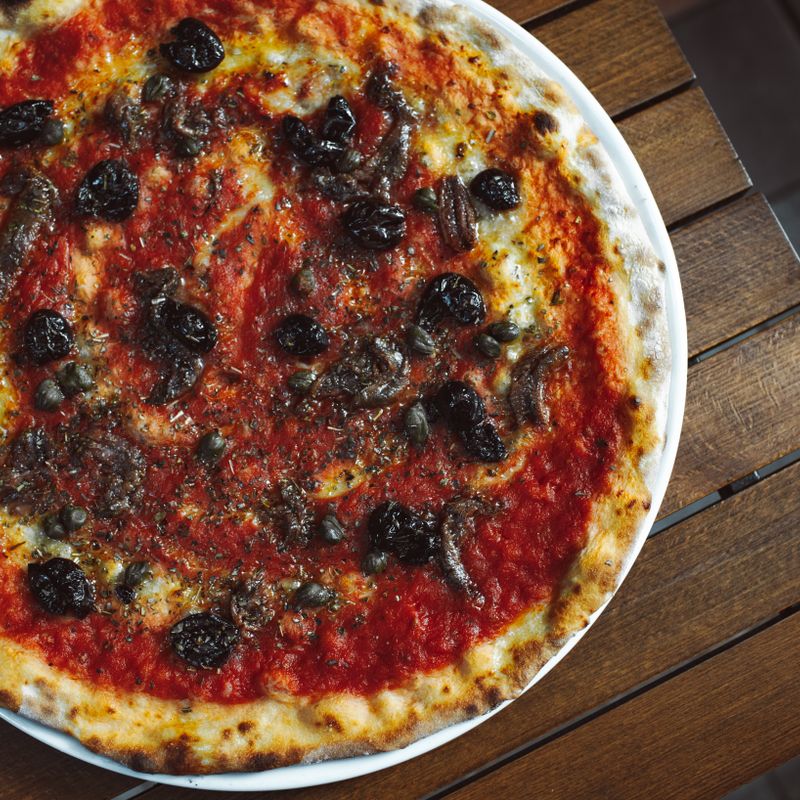
Spicy Baked Arrabbiata with Anchovies
A rustic Italian-inspired baked pasta with a fiery tomato sauce enriched by salty anchovies that dissolve into an umami-deep base. The pasta bakes until the top is golden and crispy while the sauce below remains saucy and fragrant with garlic and red pepper flakes. Simple ingredients, profound flavor—this is comfort food with unexpected depth.
- Prep
- 10 min
- Cook
- 25 min
- Wait
- 25 min
- Total
- 1 hr
- Makes
- Serves 4 as a main course
Steps
Before you start
- Preheat your oven to 400°F (200°C) at least 10 minutes before you plan to bake.
- Read through the recipe to understand the sequence and timing.
- Mince the garlic and measure out the red pepper flakes before you start cooking (mise en place).
- Have your 9×13-inch (23×33 cm) baking dish clean and ready.
Cook the pasta
- Bring a large pot of salted water to a boil over high heat (about 6 quarts / 5.7 L of water).
- Once the water is at a rolling boil, add the pasta and cook, stirring occasionally with a wooden spoon, until just al dente—usually 9–11 minutes depending on the pasta shape and brand; check the package directions.
- About 1 minute before the pasta is done, carefully scoop out and reserve ½ cup (120 ml) of the starchy cooking water in a small bowl or measuring cup.
- Then drain the pasta in a colander but do not rinse it.
+ Show details− Hide details
Ready when: Pasta is tender but still firm to the bite when you taste a piece; water is at a rolling boil
Tip: Reserve the pasta water before draining—the starch in this water helps the sauce cling to the pasta and creates a creamier texture in the finished baked dish.
Toast anchovies and garlic
- Place a large skillet over medium heat and add 3 tablespoons (45 ml) of olive oil.
- Let it warm for about 30 seconds until shimmering but not smoking.
- Add the anchovy fillets and use the back of a wooden spoon to break them apart, stirring constantly for about 1 minute.
- The fillets will soften and begin to dissolve directly into the oil, creating a rich, salty foundation without any fishiness.
- Add the minced garlic and red pepper flakes, stirring constantly, and cook for another minute until the garlic is very fragrant and just beginning to soften but definitely not brown.
+ Show details− Hide details
Ready when: Anchovies are completely dissolved into the oil; garlic is fragrant and just softened
Tip: Keep the heat at medium—if it's too hot, the garlic will brown quickly and taste bitter. The whole step should smell deeply savory and rich, never burnt.
Simmer tomatoes and season
- Pour the entire can of crushed tomatoes with its juice into the skillet, scraping the bottom with the wooden spoon to loosen any flavorful browned bits.
- Stir well and bring to a gentle simmer over medium heat.
- Let it bubble softly for 3 minutes, stirring occasionally, so the flavors meld together.
- Then stir in the reserved pasta water to dilute the sauce slightly—it should look less thick than straight tomato sauce, more like a loose, pourable consistency.
- Remove from heat.
- Taste the sauce carefully and season very conservatively with salt and black pepper, starting with just a pinch of salt and a single turn of the pepper mill.
- Remember that the anchovies are quite salty, and you'll be topping the dish with salty Parmesan cheese, so underseasoning now is much safer than overseasoning.
- You can always adjust the seasoning after tasting the finished dish.
+ Show details− Hide details
Ready when: Sauce is bubbling gently; it looks thinner and more pourable after adding pasta water
Tip: Taste before seasoning aggressively. Anchovies and Parmesan cheese both contribute significant saltiness—you can always add more salt later, but you cannot remove salt once added.
Toss pasta with sauce
- Pour the drained pasta into the skillet with the sauce.
- Using tongs or two wooden spoons, gently but thoroughly toss for about 1–2 minutes, lifting and turning the pasta continuously until every piece is evenly coated with the sauce.
- Some sauce should be visible pooled at the bottom of the skillet—the mixture should be saucy, not soupy, but also not dry.
- If it looks too thick to your eye, add a splash more pasta water (1–2 tablespoons / 15–30 ml) and toss again.
+ Show details− Hide details
Ready when: Pasta is evenly coated and sauce clings to each piece; sauce pools slightly at the bottom
Tip: Do not drain the pasta sauce into a colander—keep all the liquid in the skillet. The sauce will continue to be absorbed by the pasta during baking, so you want it to be slightly loose now.
Transfer and top with ParmesanOven 400°F / 205°C
- If you haven't already, preheat the oven to 400°F (200°C).
- Carefully pour the entire pasta and sauce mixture into a 9×13-inch (23×33 cm) baking dish, scraping the skillet with a spatula to get every bit of flavorful sauce.
- Spread the mixture evenly in the dish—there should be sauce visible pooling on top and around the sides.
- Sprinkle the grated Parmesan cheese evenly across the entire surface in a thin, light layer; don't press it down or create thick clumps.
- Finish by drizzling the remaining 1 tablespoon (15 ml) of olive oil over the top in a thin, even stream.
+ Show details− Hide details
Ready when: Parmesan is evenly distributed; pasta mixture is spread in the dish
Tip: Distribute the cheese evenly in a light, loose layer—tightly packed cheese won't brown as evenly and can taste dense. You want the cheese to melt and develop a light golden color on top.
Bake until golden and bubblyOven 400°F / 205°C
- Place the baking dish in the preheated 400°F (200°C) oven and bake uncovered for 18–20 minutes.
- Watch for the top to become golden brown with some deeper caramelized spots, and the sauce to bubble gently around the edges of the dish.
- The Parmesan should be melted and beginning to turn a light golden color.
- If after 18 minutes the sauce is bubbling nicely but the top isn't browning much, you can move the baking dish to the upper third of the oven for the last 2–3 minutes, or briefly turn on the broiler (watching closely for 1–2 minutes) to encourage browning.
+ Show details− Hide details
Ready when: Top is golden brown with some darker caramelized spots; sauce bubbles at the edges
Tip: If the cheese on top is browning too fast (getting very dark brown) while the sauce is still not bubbling, tent the dish loosely with aluminum foil and reduce the oven temperature to 375°F (190°C) for the remaining time.
Rest and serve
- Remove the baking dish from the oven and let it rest on the counter for 5 minutes undisturbed.
- During this time, the pasta continues to absorb the remaining liquid and the dish sets slightly, making it easier to serve without being soupy.
- Divide the pasta among shallow bowls or plates.
- If using fresh parsley, tear or finely chop it and scatter a small handful (about ½ teaspoon per serving) over each portion just before serving for a fresh, herbaceous note.
+ Show details− Hide details
Ready when: Sauce has set slightly; pasta has absorbed excess liquid
Tip: Do not skip the resting period—if you serve immediately, the dish will be too soupy and the pasta won't absorb the sauce optimally. These 5 minutes are crucial for the right texture.
Good to know
Tips
- For an extra-luxurious touch, grate a tiny whisper of fresh nutmeg (just a turn on the microplane) into the sauce as it simmers. This is a classic Italian technique that adds subtle warmth and complexity without being detectable as nutmeg.
- Don't let the anchovies intimidate you. When cooked into a sauce, they do not taste 'fishy'—instead, they dissolve and contribute a complex, salty, umami-rich depth that makes people ask 'What makes this taste so good?' without realizing it's anchovies.
- If your Parmesan is pre-shredded, it may clump and not brown as evenly as freshly grated. For the best result, grate a wedge of Parmesan on the large holes of a box grater just before using.
- This dish actually tastes even better the next day after the flavors have fully melded and the pasta has fully absorbed the sauce. Make it ahead without hesitation, and enjoy it cold or reheated.
Make ahead
You can assemble the pasta and sauce mixture in the baking dish up to 4 hours ahead, cover it tightly with plastic wrap or aluminum foil, and refrigerate. When ready to bake, remove from the fridge and let it sit at room temperature for 10 minutes before topping with Parmesan and olive oil, then bake as directed, adding 2–3 minutes to the baking time since the dish will be cooler.
Storage & reheating
Refrigerator: Store leftovers in an airtight container for up to 3 days. Reheat in a 375°F (190°C) oven for 10–15 minutes until warmed through, or in a microwave (stirring halfway) until hot. Freezer: The unbaked assembled dish (before adding Parmesan) freezes well for up to 1 month. Thaw overnight in the fridge, then top and bake as directed, adding 3–4 minutes to the baking time. The baked dish also freezes for up to 2 weeks; thaw and reheat as above.
Substitutions
- anchovy fillets in oil, packed → Omit the anchovies entirely. For a vegetarian version, simply leave them out. The dish will be less umami-rich but still delicious and flavorful. If you want extra depth without anchovies, add a pinch of soy sauce (½ teaspoon) to the sauce or place a small piece of Parmesan rind in the sauce as it simmers.
- red pepper flakes → Reduce to 1 teaspoon or less, or omit entirely. If you prefer a milder, less spicy dish, reduce the amount gradually or leave them out completely. The sauce will be savory and tomato-forward instead of fiery.
- canned crushed tomatoes → Fresh tomatoes (about 2 lbs / 900g), cored, roughly chopped, and cooked down. In summer when tomatoes are ripe and flavorful, use fresh tomatoes instead of canned. Chop them and simmer the sauce for 8–10 minutes instead of 3 so the tomatoes break down and release their juices.
- grated Parmesan cheese → Pecorino Romano or a similar aged, hard cheese. Pecorino Romano will give a sharper, more assertive, slightly saltier flavor. You can also mix half Parmesan and half Pecorino for a balanced flavor between mild and sharp.
More baked pasta
See all →



Find more like this
- Meal
- Dinner
- Cuisine
- Italian
- Diet
- HalalSugar-Free