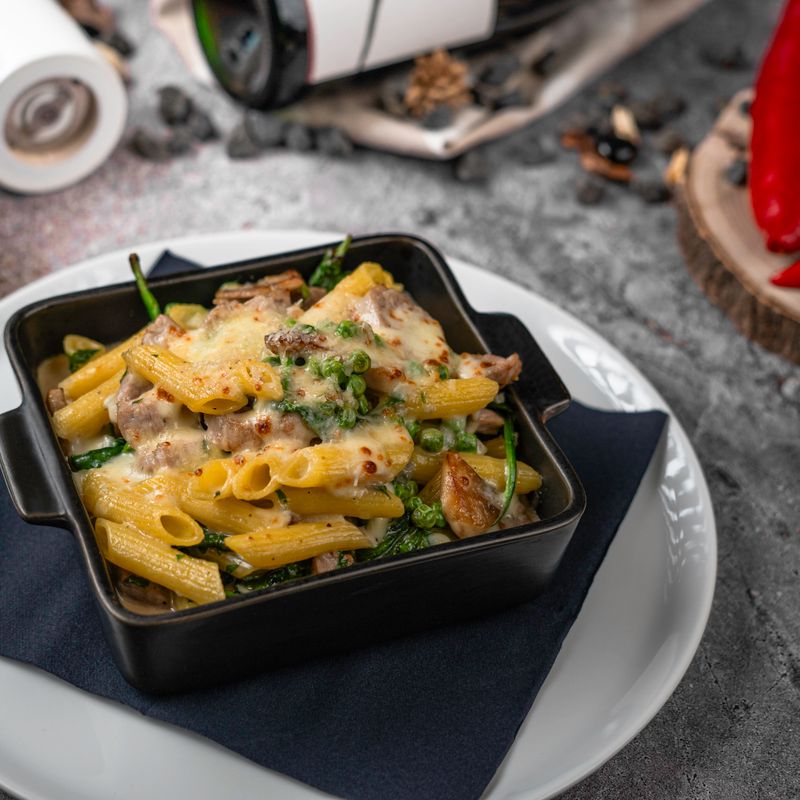
Baked Penne with Wild Mushrooms and Truffle Oil
A luxurious vegetarian pasta bake layering tender penne with caramelized wild mushrooms, fragrant thyme, and a silky Parmesan cream sauce, all enriched with truffle oil and finished under the broiler until the top turns golden. The key is patient browning of the mushrooms to develop their deep, earthy flavor—worth every minute. Elegant enough for company yet simple enough for a special weeknight dinner.
- Prep
- 15 min
- Cook
- 55 min
- Wait
- 5 min
- Total
- 1 hr 15 min
- Makes
- 4 servings (one 9×13-inch baking dish)
Steps
Before you start
- Preheat your oven to 400°F (200°C) about 10 minutes before you plan to start cooking.
- Bring the heavy cream out of the fridge so it's ready to use—cold cream poured into a hot pan helps the sauce emulsify properly.
- Grate the Parmesan cheese fresh if possible; pre-grated versions contain anti-caking agents that can make the sauce grainy rather than smooth.
- Gather all your prepped ingredients within arm's reach of the stove before you start sautéing—this is crucial for managing multiple steps without stress.
Preheat and cook pastaOven 400°F / 205°C
- Preheat your oven to 400°F (200°C).
- Bring a large pot of generously salted water to a boil over high heat—add about 1 teaspoon of salt per gallon.
- Once boiling, add the penne and cook according to package directions until al dente (usually 9–10 minutes).
- The pasta should have a slight resistance when bitten—it will continue to soften in the oven, so do not cook it fully.
- Drain the pasta in a colander and set aside without rinsing it; the residual starch helps the sauce cling.
+ Show details− Hide details
Ready when: Pasta is tender with slight resistance in the center when bitten
Tip: Don't overcook the pasta—it should still have a slight bite, as it will continue to soften in the oven. Under-cooked is better than over-cooked here.
Clean and slice mushrooms
- While the water is heating, gently clean the mushrooms by wiping them with a damp paper towel (do not soak them as they will absorb excess water like a sponge).
- Trim the stem ends and discard any dark or discolored bits.
- Slice the mushrooms into even ¼-inch (6 mm) thickness so they cook evenly and release moisture in a controlled way during sautéing.
+ Show details− Hide details
Ready when: Mushrooms are cleaned, uniform slices ready for sautéing
Tip: Never wash mushrooms under running water—they're highly absorbent. A quick wipe with a damp towel is all they need. Uniform slicing ensures they cook at the same rate.
Sauté first batch of mushrooms
- Heat a large skillet (12-inch or 30 cm) over medium-high heat.
- Add 1.5 tablespoons (21g) of butter and 1 tablespoon (15 ml) of truffle oil.
- When the butter is foaming and the oil is hot (about 1 minute), add half of the sliced mushrooms in a single layer.
- Resist the urge to stir—let them sit undisturbed for 3–4 minutes.
- This allows them to develop a deep golden-brown crust through the Maillard reaction.
- After 3–4 minutes, stir and cook for another 2–3 minutes until all the pieces are golden and any released liquid has mostly evaporated.
- Season with a small pinch of salt and pepper.
- Transfer the cooked mushrooms to a clean bowl and set aside.
+ Show details− Hide details
Ready when: Mushrooms are deep golden brown and any released liquid has mostly evaporated
Tip: The initial rest without stirring is crucial—this is where deep mushroom flavor develops. Moisture is the enemy of browning; if you stir too early, the mushrooms release water and steam instead of caramelize.
Sauté second batch of mushrooms
- Repeat the process with the remaining half of the mushrooms, using another 1.5 tablespoons (21g) of butter and 1 tablespoon (15 ml) of truffle oil.
- Again, let them sit undisturbed for 3–4 minutes, then stir and cook for 2–3 more minutes until golden.
- Season with salt and pepper, then transfer to the bowl with the first batch.
+ Show details− Hide details
Ready when: Second batch is golden brown with released moisture evaporated
Tip: Cooking in two batches prevents overcrowding, which would cause the mushrooms to steam rather than brown. Never skip this step or cram them all into the pan at once.
Sauté aromatics and herbs
- In the same skillet, reduce heat to medium.
- Add the minced shallot and cook for 2 minutes, stirring occasionally, until softened and just beginning to caramelize.
- Add the minced garlic and the fresh thyme sprigs, cooking for another 1–2 minutes until the aroma becomes very pronounced but the garlic is not yet brown (garlic burns easily and will taste acrid if overdone).
- Return all the cooked mushrooms to the skillet and gently stir to combine everything evenly.
+ Show details− Hide details
Ready when: Garlic is fragrant and golden, shallot is soft and translucent, mushrooms are folded in
Tip: Watch the garlic carefully—you want it golden and fragrant, not brown. If it starts to brown, immediately pour in the cream (next step) to stop the cooking.
Create cream sauce
- Pour the cold heavy cream into the skillet, stirring gently, and bring it to a gentle simmer over medium heat (about 2–3 minutes).
- Once simmering, stir in 1 cup (100g) of the grated Parmesan cheese, stirring until it's fully melted and incorporated into the cream.
- Add the remaining 1.5 tablespoons (22 ml) of truffle oil, a small pinch (about 1/16 teaspoon or 0.3g) of ground nutmeg, and then taste the sauce carefully.
- Add a pinch of salt and black pepper to taste.
- The sauce should taste slightly over-seasoned at this point because the pasta will dilute it when combined.
- Continue simmering gently for 1–2 more minutes until smooth and silky.
+ Show details− Hide details
Ready when: Parmesan is fully melted, sauce is smooth and coats the back of a spoon, nutmeg is incorporated
Tip: Keep the heat at medium—a rolling boil can break the cream. If the sauce looks grainy or separates, reduce heat and whisk gently. Cold cream helps stabilize the sauce, so don't skip chilling it first.
Combine pasta and sauce
- Add the cooked, drained penne to the mushroom-cream mixture in the skillet.
- Using two wooden spoons or pasta tongs, gently fold and toss the pasta for about 1–2 minutes, ensuring every piece is evenly coated in the creamy sauce.
- Be gentle to avoid breaking the pasta strands.
- If the sauce seems too thick, add a splash of pasta water (about 2 tablespoons / 30 ml) to loosen it slightly.
- Transfer the entire mixture to a lightly buttered 9×13-inch (23×33 cm) baking dish, spreading it in an even layer.
+ Show details− Hide details
Ready when: Pasta is evenly coated with creamy sauce, no dry pasta visible
Tip: Toss gently—aggressive stirring will break the pasta and result in a mushy texture. The pasta doesn't need cooking anymore; it just needs to be coated and heated through in the oven.
Bake until goldenOven 400°F / 205°C
- Sprinkle the remaining ¼ cup (25g) of grated Parmesan cheese evenly over the top of the penne.
- Place the baking dish in your preheated 400°F (200°C) oven and bake uncovered for 20–25 minutes.
- The top should turn golden brown and you should see the cream sauce bubbling up around the edges.
- Peek after 18 minutes; if the top is already deep golden, you can remove it.
- If it's still pale, give it another few minutes.
+ Show details− Hide details
Ready when: Top is golden brown and cream is bubbling around the edges
Tip: If the top is browning too quickly but the sauce isn't bubbling yet, loosely tent with foil and continue baking; this prevents over-browning while the interior heats.
Rest and finish
- Remove the baking dish from the oven and let it rest, undisturbed, for 5 minutes.
- This allows the sauce to set slightly, which makes serving neater and the pasta more cohesive.
- Just before serving, drizzle the warm dish generously with high-quality truffle oil (about 1.5 teaspoons or 7.5 ml)—use the best truffle oil you have, as it's now the final flavor accent.
- If you'd like, garnish with fresh chopped parsley for color and a bright herbal note.
- Serve immediately while still warm and fragrant.
+ Show details− Hide details
Ready when: Sauce has set enough to hold its shape on a spoon, truffle aroma is pronounced
Tip: Add the finishing truffle oil just before serving—the delicate aromatic compounds in truffle oil dissipate with heat, so drizzling it onto the hot but resting dish preserves the truffle flavor. Don't bake it.
Good to know
Tips
- The foundation of this dish is properly caramelized mushrooms. Resist the urge to stir immediately and don't crowd the pan. The Maillard reaction—which creates deep, complex flavor—happens only with dry, high heat and patience. Two batches takes longer, but results in dramatically better flavor.
- Use fresh, fine-grated Parmesan for the smoothest sauce. Pre-grated versions contain anti-caking agents (usually cellulose) that turn the sauce grainy or stringy when heated. A box grater or microplane takes 3 minutes and makes a huge difference.
- Quality truffle oil is essential to the final result. Good truffle oil should smell unmistakably earthy and truffle-like; cheap versions smell musty and artificial. Store it in a cool, dark place and use it within a year of opening. Add it at the end to preserve its delicate flavor.
- For a lighter version, use only 1 cup (240 ml) heavy cream and add ½ cup (120 ml) reserved pasta water to the sauce instead. This lightens the dish while keeping it creamy, and the pasta starch helps bind the sauce naturally.
Make ahead
The mushroom-cream mixture can be prepared up to 8 hours ahead and refrigerated in an airtight container. When ready to proceed, gently reheat it in a large skillet over medium heat (3–4 minutes), stirring occasionally, while simultaneously cooking fresh pasta. Then combine and transfer to the baking dish, and bake as directed (the baking time may be reduced by 3–5 minutes since the mixture will be warm).
Storage & reheating
Room temperature: Cover loosely and hold for up to 2 hours (not recommended for longer storage due to the dairy content). Refrigerator: Transfer to an airtight container and store for up to 3 days. Reheat gently in a 325°F (160°C) oven, covered with foil, for 15–20 minutes until warmed through, or in a large skillet over medium heat with a splash of heavy cream or pasta water to restore creaminess. Freezer: Not recommended. The cream-based sauce and pasta do not freeze well; they become grainy and mushy upon thawing and lose their silky texture.
Substitutions
- Truffle oil → Extra virgin olive oil or roasted walnut oil. Use 3 tablespoons (45 ml) of a high-quality extra virgin olive oil in place of truffle oil for a lighter, more herbaceous dish, or walnut oil for nuttiness. The earthy truffle aroma will be gone, but the dish remains rich and delicious. Finish with a drizzle of aged balsamic vinegar for depth.
- Parmigiano-Reggiano cheese → Gruyère or Emmental cheese. These hard cheeses melt smoothly and add a creamy, slightly sweet note with good texture. Use the same amount (1.25 cups / 125g), finely grated. The flavor will be more caramel-like and less sharp than Parmesan.
- Heavy cream → Half-and-half or crème fraîche. These will produce a slightly thinner, more tangy sauce. Use 1.75 cups (420 ml) of half-and-half or 1.5 cups (360 ml) of crème fraîche for similar body. Crème fraîche adds a pleasant tang; half-and-half will be mild and light.
- Mixed wild mushrooms (cremini, shiitake, oyster) → A mix of cremini, portobello, and white button mushrooms. While less earthy and complex than true wild varieties, this supermarket mix still develops excellent caramelized flavor with proper browning. Use the same total weight (1.5 lbs / 680g) and follow the same sautéing technique for the best result.
More baked pasta
See all →


Find more like this
- Meal
- Dinner
- Cuisine
- Italian
- Diet
- HalalSugar-Free