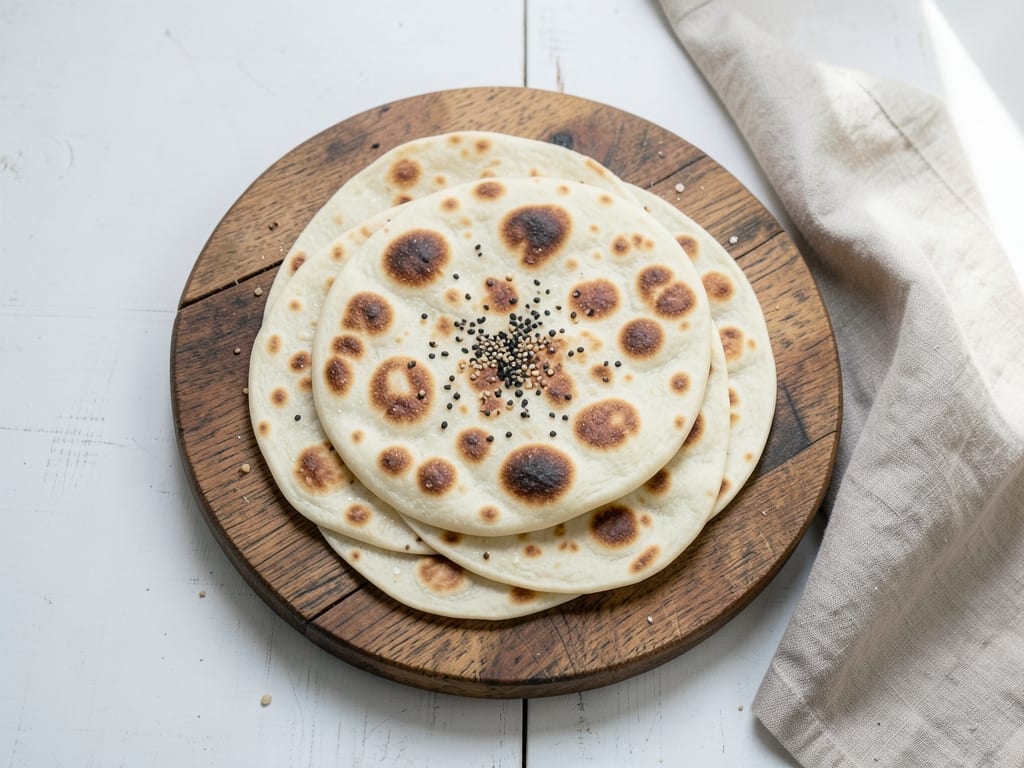
Armenian Lavash Dough and Thin Baked Lavash
A simple four-ingredient yeasted dough rolled paper-thin and baked at high heat until blistered and golden. The result is a soft, pliable Armenian flatbread that is perfect for wraps, dipping, and serving alongside grilled meats and cheese.
- Prep
- 30 min
- Cook
- 15 min
- Wait
- 1 hr 20 min
- Total
- 2 hr 5 min
- Makes
- 6 large lavash (about 12 × 9 inches / 30 × 23 cm each)
Steps
Before you start
- Plan on about 2 hours 5 minutes: 1 hour for the first rise and 15 minutes of resting before rolling.
- Place a large rimless baking sheet or baking steel on the oven rack and start preheating the oven at the beginning of the rest period so the surface is very hot when the first lavash goes in.
- Clear a large work surface and have a rolling pin (a thin dowel-style pin works best), a bench scraper, and a clean kitchen towel ready.
- Weigh the flour and water with a kitchen scale if possible. Accurate hydration is the key to dough that rolls thin without tearing.
Mix the dough
- In a large bowl, whisk the 500 g (4 cups) flour, instant yeast, and salt together.
- Pour in the 300 ml (1¼ cups) lukewarm water.
- Stir with a wooden spoon or your hand until no dry flour remains and a shaggy, fairly stiff dough forms.
+ Show details− Hide details
Ready when: No dry flour is left in the bowl and the dough holds together in a rough ball.
Tip: Water that is hotter than about 110°F (43°C) can damage the yeast, so keep it lukewarm.
Knead until smooth
- Turn the dough onto a lightly floured surface (use a little of the dusting flour only if it sticks badly).
- Knead for 8 to 10 minutes, pushing with the heel of your hand, folding, and turning, until the dough is smooth, elastic, and slightly tacky.
- It should be firmer than bread dough.
+ Show details− Hide details
Ready when: The dough is smooth and springs back slowly when pressed with a finger.
Tip: Keep the dough fairly firm. A stiffer dough rolls thinner without shrinking back.
First rise
- Shape the dough into a ball and place it in a clean, lightly floured bowl.
- Cover with plastic wrap or a damp towel and leave in a warm spot (75–80°F / 24–27°C) for 1 hour.
+ Show details− Hide details
Ready when: The dough has roughly doubled and a fingertip poke leaves a dent that springs back slowly.
Divide and restOven 500°F / 260°C
- Turn the dough onto a lightly floured surface and gently press out the large bubbles.
- Cut into 6 equal pieces of about 135 g (4¾ oz) each and shape each into a smooth ball.
- Cover with a towel and rest for 15 minutes.
- During this rest, set the oven rack in the lower third, put the baking sheet or baking steel on it, and preheat to 500°F (260°C).
+ Show details− Hide details
Ready when: The balls feel soft and spread slightly when pressed.
Tip: Keep unused dough balls covered so they don't form a dry skin.
Roll very thin
- Dust the work surface lightly.
- Flatten one ball, then roll it out into a rough oval about 12 × 9 inches (30 × 23 cm) and 1/16 inch (1–2 mm) thick, turning and flipping often.
- If the dough springs back, cover it for 2 minutes and try again.
- Brush off excess flour and, if using, sprinkle with a pinch of sesame seeds and press lightly with the pin.
+ Show details− Hide details
Ready when: The dough is thin enough to see the work surface faintly through it, with no holes.
Tip: Use as little flour as possible. Too much flour burns on the hot surface and makes the bread dry.
Bake the first lavashOven 500°F / 260°C
- Carefully lift the rolled dough, stretching it slightly over your forearm or a peel, and lay it on the hot baking sheet.
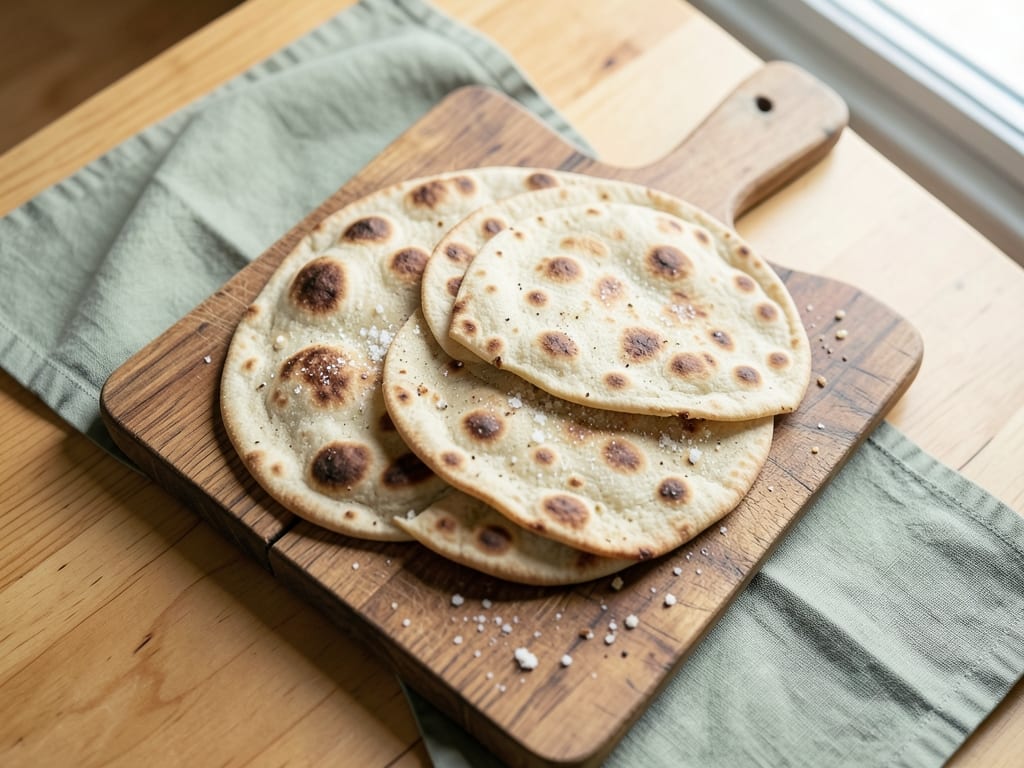
- Bake at 500°F (260°C) for 2 to 3 minutes, until it puffs in places and has golden-brown blisters.
- Flip with a spatula and bake another 30 seconds to 1 minute if the underside is still pale.
+ Show details− Hide details
Ready when: The bread is flecked with golden-brown spots and still flexible, not crisp.
Tip: Watch closely. Thin dough goes from golden to burnt in under a minute, and over-baked lavash turns into a cracker.
Roll and bake the restOven 500°F / 260°C
- While each lavash bakes, roll out the next dough ball.
- Bake the remaining 5 breads one at a time in the same way, 2 to 3 minutes each, letting the baking surface stay in the oven between batches so it stays hot.
+ Show details− Hide details
Ready when: Each bread has golden-brown blisters and bends without cracking.
Tip: If a bread starts to crisp at the edges, remove it earlier and stack it under a towel to soften.
Steam and cool
- As each lavash comes out, stack it on a clean kitchen towel and fold the towel over the pile.
- Let them steam and cool for about 5 minutes, which makes them soft and pliable.
- Serve warm, or cool completely before storing.
+ Show details− Hide details
Ready when: The lavash feels soft and bendable all over.
Tip: Wait until the bread is fully cool before bagging it, or condensation will make it gummy.
Good to know
Tips
- Roll one piece at a time and keep the rest covered. Rolled dough left uncovered dries out quickly.
- A very hot baking surface gives the characteristic puffs and blisters. If your oven only reaches 450°F (230°C), bake 3 to 4 minutes per bread.
- If the dough keeps shrinking back as you roll, cover it and rest it for 5 minutes. The gluten needs to relax.
- For crisp lavash crackers, bake the bread 1–2 minutes longer until deep golden, then cool on a rack and break into pieces.
Make ahead
The dough can be mixed, kneaded, and refrigerated in a covered, lightly floured bowl for up to 24 hours after the first rise. Bring it to room temperature for 30 minutes before dividing and rolling. Baked lavash can be made a day ahead and re-softened (see storage).
Storage & reheating
Room temperature: keep cooled lavash in an airtight bag for up to 2 days. Fridge: up to 5 days in a sealed bag. Freezer: stack with parchment between layers, wrap well, and freeze up to 3 months. To reheat or soften, sprinkle lightly with water and warm in a dry skillet over medium heat for 20–30 seconds per side, or wrap in a damp towel and microwave for 15–20 seconds. Raw dough balls can be frozen up to 1 month; thaw in the fridge overnight.
Substitutions
- all-purpose flour → bread flour. Gives a chewier bread; add 1–2 tablespoons more water if the dough feels too stiff.
- instant yeast → active dry yeast. Use 1¼ tsp (4 g). Dissolve in the lukewarm water for 5 minutes before mixing.
- all-purpose flour → up to 150 g (1¼ cups) whole wheat flour in place of the same weight of all-purpose. Makes a nuttier bread. Add about 1 tablespoon more water and expect a slightly less pliable result.
- sesame seeds → nigella seeds or poppy seeds. Used the same way, pressed lightly into the rolled dough before baking.
More flatbreads
See all →
Find more like this
- Meal
- Dinner
- Method
- Oven
- Quick & Easy
- 5 Ingredients or LessMake Ahead