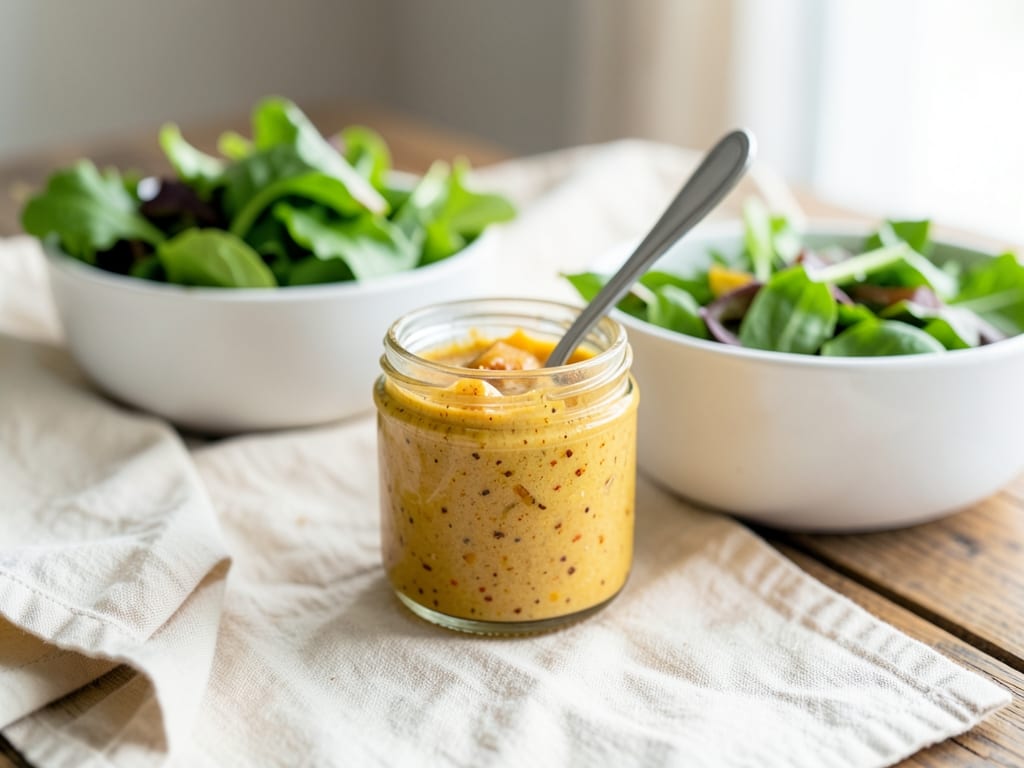
30-Minute Mango Hazelnut Oil
A silky, golden infused oil that marries tropical mango sweetness with toasted hazelnut richness, brightened by white wine vinegar and subtle thyme. This fusion dressing comes together quickly on the stovetop and works beautifully drizzled over warm grains, roasted vegetables, grilled fish, or fresh greens. The gentle heat coaxes flavor from shallots and thyme while mango puree melts into the oil, creating an elegant, emulsified finish.
Steps
Before you start
- Have your mango puree ready (fresh or frozen, thawed)
- Measure out hazelnut oil at room temperature
- Chop shallots finely and pick thyme leaves
- Use a fine-mesh strainer or cheesecloth for the final strain
Bloom shallots and thyme
- Pour the hazelnut oil into a small 2-quart (2 L) saucepan over medium heat.
- Add the thinly sliced shallots and thyme leaves.
- Stir gently with a wooden spoon and let them soften and become fragrant, without allowing the oil to bubble vigorously.
- This step should take about 3 minutes—the shallots will become translucent and release their aroma.
+ Show details− Hide details
Ready when: Shallots are translucent and thyme is fragrant
Tip: Keep the heat at medium—you want gentle infusion, not hot oil that will cook or brown the aromatics.
Add mango puree
- Pour in the mango puree (80 ml / ⅓ cup) slowly while stirring.
- The puree will sink into the warm oil.
- Continue stirring for about 1 minute to distribute it evenly throughout the oil.
- You may see the mixture begin to very gently emulsify at the edges.
+ Show details− Hide details
Ready when: Mango puree is fully incorporated and no raw-looking streaks remain
Tip: Stir constantly to prevent the mango from settling to the bottom or scorching. The puree should blend smoothly into the oil.
Add vinegar and seasoning
- Remove the pan from heat.
- Pour in the white wine vinegar (45 ml / 3 tablespoons), then add the sea salt.
- Stir well to combine.
- At this point, the mixture will become noticeably more emulsified as the vinegar and salt help bind the oil and fruit puree together.
- Season to taste with cracked black pepper.
+ Show details− Hide details
Ready when: Oil is silky and mango puree is fully incorporated; no raw vinegar taste remains
Tip: Adding vinegar off the heat helps preserve the delicate mango flavor and prevents the oil from becoming too hot.
Let cool and settle
- Pour the infused oil into a clean glass jar or bottle.
- Set it aside at room temperature for 10 minutes, undisturbed.
- This resting period allows the flavors to meld and the emulsion to fully stabilize.
- You'll notice the oil taking on a more uniform, silky appearance as it cools slightly.
+ Show details− Hide details
Ready when: Oil is warm to the touch but no longer hot; it appears silky and uniform in color
Tip: Do not cap or strain while the oil is still hot—this can cause condensation and affect the shelf life.
Strain if desired
- If you prefer a smooth oil without visible shallot or thyme pieces, pour the oil through a fine-mesh strainer lined with cheesecloth or a coffee filter into a fresh jar.
- This step is optional—leaving the aromatics in adds visual appeal and flavor depth.
- If straining, gently press the solids with the back of a spoon to extract the maximum flavor, but do not squeeze forcefully.
+ Show details− Hide details
Ready when: Oil is clear or nearly clear; strainer is dry
Tip: Gentle pressing preserves the silky emulsion; aggressive squeezing can break it down and make the oil separate.
Taste and adjust
- Dip a clean spoon into the oil and taste it.
- The flavor should be balanced—sweet mango, nutty hazelnut, bright acidity, and herbaceous thyme.
- If it needs more salt, add another small pinch.
- If it tastes too tart, whisk in an extra teaspoon of mango puree.
- If it needs more herb flavor, add a pinch more fresh thyme leaves and let them infuse for 2 minutes over very low heat.
+ Show details− Hide details
Ready when: Flavors are balanced and pleasing to your taste
Tip: Taste is subjective—adjust vinegar, salt, and aromatics to match your preference and the dish you're dressing.
Good to know
Tips
- Make sure your mango puree has no large fibers or lumps; blend it thoroughly or press it through a fine strainer before starting if needed.
- For a richer emulsion, whisk the oil gently as it cools—this incorporates tiny air bubbles and creates a more luxurious texture.
- This oil separates naturally over time; simply whisk or shake before each use to re-emulsify. This is normal and does not indicate spoilage.
- Serve warm or at room temperature drizzled over roasted root vegetables, grilled chicken, fresh mozzarella, or warm farro salad.
Make ahead
You can prepare this oil up to 5 days ahead and store it tightly sealed in the refrigerator. Warm gently before use so it drizzles smoothly. It's also ideal for last-minute preparation since it takes only 30 minutes from start to finish.
Storage & reheating
Room temperature (sealed, away from heat and light): up to 3 days. Refrigerator (airtight glass jar): up to 1 week. Freezer: not recommended, as the emulsion may break when thawed. Before using chilled oil, warm it gently in a small saucepan over low heat or leave it at room temperature for 30 minutes to restore fluidity and flavor clarity.
Substitutions
- hazelnut oil → Walnut oil or almond oil. Use the same amount. Walnut oil adds earthiness; almond oil is more delicate. Both complement mango beautifully.
- mango puree (fresh or frozen, thawed) → Ripe peach puree or apricot puree. Use the same amount. The oil will be slightly less tropical but equally lush. Strain carefully as stone fruit purees can be thicker.
- white wine vinegar → Rice vinegar or champagne vinegar. Use the same amount. Rice vinegar is milder and more floral; champagne vinegar is delicate and pairs well with fruit.
- fresh thyme sprigs → Fresh basil, mint, or tarragon. Use the same amount of leaves. Each herb brings a different character—basil adds warmth, mint brightness, tarragon a subtle anise note.