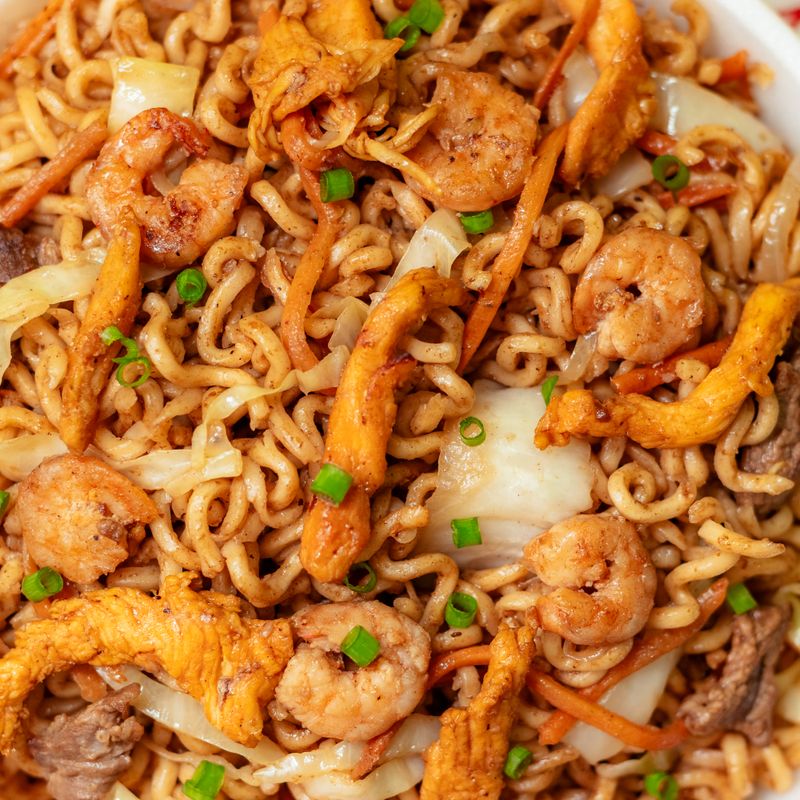
Yakisoba with Pork and Cabbage
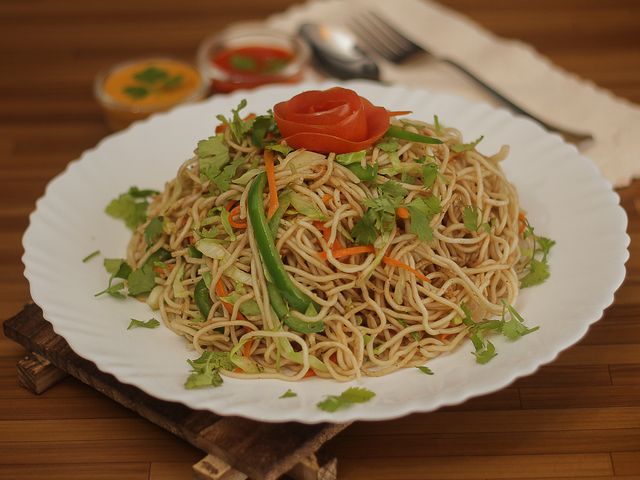
Japanese street-food stir-fried noodles with crisp-edged pork belly, sweet cabbage and carrot, all coated in a tangy, savory homemade yakisoba sauce and finished with bright pickled ginger. It's on the table in about 30 minutes.
- Prep
- 18 min
- Cook
- 14 min
- Total
- 32 min
- Makes
- 4 servings (about 1½ to 2 cups / 325 g each, roughly 1.3 kg total)
Steps
Before you start
- Have everything chopped and the sauce mixed before you turn on the heat. The cooking goes fast, and you won't have time to prep once the pan is hot.
- Use pre-steamed yakisoba noodles sold in vacuum packs in the refrigerated section (about 150 g / 5.3 oz each). If your packs come with seasoning powder, discard it or save it for another use. This recipe uses its own sauce.
- If your pork belly is not already pre-sliced, freeze it for 20 to 30 minutes so it is firm enough to slice thinly (about ⅛ inch / 3 mm).
- This makes about 1.3 kg of food. Use a 14-inch (35 cm) wok or a very large, deep pan. If you only have a 12-inch (30 cm) skillet, cook the vegetables and noodles in two batches (instructions are in the steps).
Mix the sauce
- In a small bowl, stir together the tonkatsu sauce (60 ml), oyster sauce (30 ml), ketchup (15 ml), soy sauce (15 ml) and sugar (1 tsp).
- Stir for about 30 seconds until the sugar dissolves and the sauce looks uniform and glossy.
- Set it next to the stove.
+ Show details− Hide details
Ready when: No sugar granules remain and the sauce is a uniform dark brown.
Loosen the noodles
- Leave the noodles in their packs and pierce each bag a few times with a fork.
- Microwave the packs on a plate for 1 minute.
- Alternatively, empty the noodles into a bowl, pour over hot water for 30 seconds, then drain well.
- Open the packs and gently pull the noodle clumps apart with your fingers.
+ Show details− Hide details
Ready when: The noodles separate into loose strands with no stuck-together blocks.
Tip: Loosening them first prevents tearing and mushy noodles when you stir-fry.
Cut pork and vegetables
- Cut the pork belly into 2-inch (5 cm) pieces.
- Cut the cabbage into 1½-inch (4 cm) squares, slice the onion ¼ inch (6 mm) thick, and cut the carrot into thin 2-inch matchsticks.
- Keep the pork on its own plate, and keep the cabbage separate from the carrot and onion, because they go into the pan at different times.
+ Show details− Hide details
Ready when: Carrot pieces are thin and even so they cook in the same time as the onion.
Tip: Cut the carrot thinner than you think you need to. Thick pieces stay raw in this quick cook.
Render the pork
- Heat the wok or skillet over medium-high heat for 1 minute.
- Add the vegetable oil (1 tsp) and swirl to coat.
- Add the pork belly in a single layer, sprinkle with salt (¼ tsp) and black pepper (¼ tsp), and cook for 4 to 5 minutes, turning occasionally.
- The pork is ready when the fat has turned translucent and melted, the edges are golden brown and lightly crisp, and no pink remains.
- Transfer the pork with a slotted spoon to the paper-towel-lined plate.
+ Show details− Hide details
Ready when: Pork edges are golden and crisp, the fat has rendered into a pool in the pan, and no pink remains.
Tip: Judge by sight, not a thermometer. The thin pieces are too small to probe, and belly needs to cook well past pink to render properly.
Drain the excess fat
- Carefully spoon the rendered fat into a heatproof bowl, leaving only about 1 to 2 tbsp (15 to 30 ml) in the pan.
- Leave the browned bits behind for flavor.
- The pork stays on the plate until the noodles go in.
+ Show details− Hide details
Ready when: The pan has a thin, even film of fat, with no visible pool.
Tip: Don't pour hot fat down the drain. Let it cool in the bowl and throw it away.
Stir-fry carrot and onion
- Add the carrot and onion to the pan.
- Stir-fry constantly for 2 minutes, until the onion turns translucent at the edges and the carrot brightens in color.
+ Show details− Hide details
Ready when: Onion is translucent at the edges; carrot is bright orange and slightly bendy.
Add the cabbage
- Add the cabbage and toss for 2 to 3 minutes.
- The pile will look huge at first, but it shrinks quickly.
- Cook until the leaves turn bright green, soften at the edges and are still slightly crunchy in the thick parts.
- In a 12-inch skillet, work in two batches: cook half of each vegetable at a time (use half the oil and fat), set the first batch aside, then return everything to the pan in the next step.
+ Show details− Hide details
Ready when: Cabbage is bright green, wilted at the edges, and still has some crunch in the ribs.
Tip: If the cabbage won't toss freely, the pan is too full. Cook in batches rather than steaming it.
Fry the noodles
- Add the loosened noodles and the cooked pork on top of the vegetables (in a skillet, do this in two batches, using half of each).
- Drizzle over the water (2 tbsp).
- Using chopsticks or a spatula, lift and toss for about 2 minutes, until the noodles are hot and the steam has loosened them and mixed them through the vegetables and pork.
+ Show details− Hide details
Ready when: Noodles are steaming hot, separate, and evenly mixed with the vegetables and pork.
Tip: Toss by lifting rather than stirring in circles. This keeps the noodles from breaking.
Sauce and toss
- Pour the sauce evenly over the noodles.
- Toss constantly for 1 to 2 minutes, until every strand is coated a deep glossy brown and the sauce smells sweet and tangy.
- Taste a noodle.
- If you'd like it saltier, add a splash of soy sauce.
- Remove from the heat.
+ Show details− Hide details
Ready when: No pale noodles remain, and the sauce is absorbed with only a thin gloss left in the pan.
Tip: Don't keep cooking after the sauce is absorbed. The sugars burn quickly and make the noodles taste bitter.
Plate and top
- Divide the yakisoba among 4 warm plates or bowls (about 325 g each), mounding it high.
- Top each portion with 1½ tsp of pickled ginger, then sprinkle with aonori and bonito flakes if using.
- Serve immediately while the noodles are hot.
+ Show details− Hide details
Tip: Bonito flakes will 'dance' from the steam, which is part of the fun.
Good to know
Tips
- Keep the heat at medium-high and don't overcrowd the pan. Steam is the enemy of good stir-fried noodles.
- Add the sauce only at the end. If it goes in too early, it reduces and sticks, and the noodles turn gummy.
- For extra color and sweetness, add a handful of sliced shiitake mushrooms or scallion whites with the onion.
- Serve with a fried egg on top, plus a squeeze of Japanese mayonnaise, for a classic pan-style twist.
Make ahead
Mix the sauce up to 5 days ahead and refrigerate it in a sealed jar. Cut the vegetables and pork up to 1 day ahead and refrigerate them in separate airtight containers. Cook the noodles right before serving for the best texture.
Storage & reheating
Room temperature: up to 2 hours. Refrigerator: airtight container for up to 3 days. Freezer: not recommended, because the cabbage turns watery and the noodles go soft. To reheat, stir-fry in a skillet over medium heat with 1 to 2 tbsp of water for 3 to 4 minutes until steaming hot throughout, or microwave covered for 1 to 2 minutes, stirring halfway.
Substitutions
- tonkatsu sauce or Worcestershire sauce → Bottled yakisoba sauce. Use about 6 tbsp (90 ml) of bottled yakisoba sauce in place of all five sauce ingredients. Add a little at a time and taste, because brands vary in saltiness.
- thinly sliced pork belly → Thinly sliced pork shoulder or bacon. For pork shoulder, use 1 extra tbsp of oil and skip the fat-draining step. For bacon, use unsmoked if you can, and skip the added salt.
- fresh pre-steamed yakisoba noodles → Dried ramen noodles or fresh Chinese egg noodles. Boil 3 to 4 portions (about 10 oz / 280 g dried) 1 minute less than the package says, then drain, rinse and toss with ½ tsp of oil before stir-frying.
- green cabbage → Napa cabbage or bean sprouts. Napa cooks faster, so add it for only 1 to 2 minutes. Add bean sprouts together with the noodles.
More stir-fried noodles
See all →
Find more like this
- Meal
- Dinner
- Cuisine
- Japanese
- Diet
- Dairy-Free
- Quick & Easy
- Easy