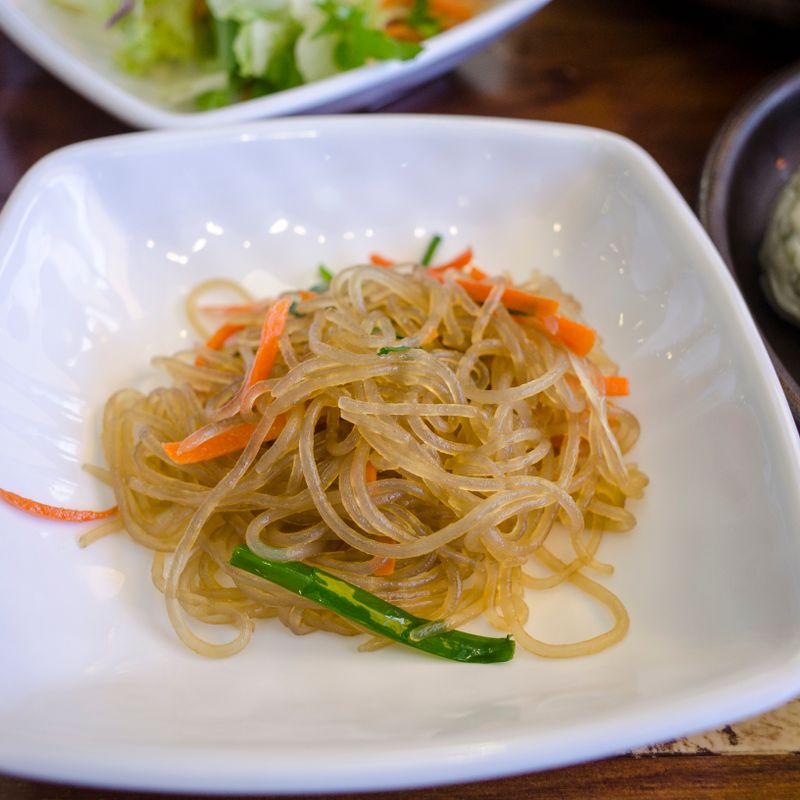
Japchae (Korean Sweet Potato Noodle Stir-Fry)
Chewy, glossy sweet potato starch noodles tossed with tender beef, spinach, carrots, onion and mushrooms in a savory-sweet soy and toasted sesame sauce. Each component is cooked separately so every vegetable keeps its color and texture. It's good warm or at room temperature.
- Prep
- 28 min
- Cook
- 23 min
- Wait
- 17 min
- Total
- 1 hr 8 min
- Makes
- About 8 cups (6 side-dish or 4 main-course servings)
Steps
Before you start
- Use dried Korean sweet potato starch noodles (dangmyeon). Other noodles won't give the same chewy, slippery texture.
- Slice the beef while it is partly frozen (about 20 minutes in the freezer) so you can cut it paper-thin.
- Cut all vegetables into similar thin strips before you turn on the stove. The cooking goes quickly.
- Set up a large mixing bowl to collect the cooked components, and a bowl of ice water for the spinach.
Marinate the beef
- In a small bowl, combine the sliced beef with 1 tbsp soy sauce, 1 tsp sugar, 1 tsp toasted sesame oil and 1 minced garlic clove.
- Mix with your hands until every strip is coated, then leave it at room temperature while you prep the vegetables.
+ Show details− Hide details
Ready when: Beef strips look evenly coated and slightly glossy
Tip: Don't marinate longer than 30 minutes. The soy sauce will start to cure the thin slices and make them salty.
Prep the vegetables
- Cut the carrot into thin 2-inch (5 cm) matchsticks.
- Slice the onion into ¼-inch (6 mm) half-moons.
- Slice the shiitake caps thinly.
- Cut the scallions into 2-inch (5 cm) lengths and halve any thick pieces lengthwise.
- Keep each vegetable in its own pile on the cutting board or in separate bowls.
+ Show details− Hide details
Ready when: All vegetables are cut into similar thin strips
Tip: Uniform strips cook at the same speed and make the finished dish easy to eat with chopsticks.
Mix the sauce
- In a small bowl, stir together 3 tbsp soy sauce, 2 tbsp sugar, 2 tbsp toasted sesame oil, 2 minced garlic cloves, 2 tbsp water and the black pepper.
- Stir for about 30 seconds until the sugar has dissolved and no grains remain at the bottom of the bowl.
+ Show details− Hide details
Ready when: Sugar is fully dissolved and the sauce looks uniform
Blanch the spinach
- Bring a large pot with 3 quarts (3 L) of water to a rolling boil over high heat.
- Prepare a bowl of ice water.
- Add the spinach and cook for 30 seconds, just until bright green and wilted.
- Lift it out with tongs or a spider into the ice water, leaving the pot of water on the heat for the noodles.
- Once cool, squeeze the spinach firmly with your hands to remove as much water as possible, cut it into 3-inch (7 cm) lengths, and toss with ½ tsp sesame oil and ¼ tsp salt.
- Set it aside in the large mixing bowl.
+ Show details− Hide details
Ready when: Spinach is bright green and wilted, and no water drips out when squeezed
Tip: Squeeze hard. Wet spinach will water down the sauce and make the finished noodles soggy.
Boil the noodles
- Return the pot of water to a boil if it has stopped.
- Add the dry noodles and boil for 6–7 minutes, stirring occasionally so they don't stick, until translucent, soft and chewy.
- Bite one to check.
- It should be tender with a pleasant chew and no hard white core.
- Drain in a colander, rinse briefly under cold water, and drain well.
- Using kitchen scissors, cut the noodles a few times into roughly 8-inch (20 cm) lengths.
+ Show details− Hide details
Ready when: Noodles are translucent, slippery and chewy with no hard center
Tip: Don't overcook. They will absorb sauce and soften further when stir-fried.
Cook onion and carrot
- Heat a 12-inch (30 cm) nonstick skillet over medium-high heat for 1 minute.
- Add 1 tbsp neutral oil and the onion with a pinch of salt.
- Stir-fry for 2 minutes until the onion turns translucent.
- Add the carrot with another pinch of salt and cook 2 more minutes until crisp-tender and bright orange.
- Transfer to the large mixing bowl with the spinach.
- Wipe out the skillet if any bits have browned.
+ Show details− Hide details
Ready when: Onion is translucent and carrot is bendable but still has some bite
Tip: Don't crowd the pan. The vegetables should sizzle, not steam.
Cook mushrooms and scallions
- Return the skillet to medium-high heat.
- Add 1 tbsp neutral oil and the shiitake with a pinch of salt.
- Cook, stirring often, for 3 minutes until the mushrooms release liquid and are lightly browned at the edges.
- Add the scallions and stir for 30 seconds until bright green.
- Transfer to the mixing bowl.
+ Show details− Hide details
Ready when: Mushrooms are golden at the edges and the pan is mostly dry
Sear the beef
- Return the skillet to high heat.
- Add the last 1 tbsp neutral oil and spread the marinated beef in a single layer.
- Cook, stirring and breaking apart the strips, for 1½–2 minutes until no pink remains and the edges are lightly browned.
- The beef should reach 145°F (63°C).
- Transfer to the mixing bowl with the vegetables.
+ Show details− Hide details
Ready when: No pink remains and the beef reads 145°F (63°C)
Tip: Cook the beef in two batches if the strips pile up. Crowding steams the meat instead of searing it.
Glaze the noodles
- Reduce the heat to medium-low.
- Add the cut noodles and the sauce to the skillet.
- Toss constantly with tongs for 2–3 minutes until the noodles absorb most of the sauce, turn a glossy dark brown and the liquid in the pan is gone.
+ Show details− Hide details
Ready when: Noodles are glossy and evenly brown, and there is no liquid pooling in the pan
Tip: Keep the heat low. High heat can scorch the sugar before the noodles take up the sauce.
Toss and serve
- Transfer the glazed noodles to the large bowl with the spinach, vegetables and beef.
- Toss gently with tongs or clean hands for about 1 minute so everything is evenly mixed.
- Taste and add a pinch of salt or a splash of soy sauce if needed.
- Sprinkle with the toasted sesame seeds and serve warm or at room temperature.
+ Show details− Hide details
Ready when: Vegetables and beef are evenly distributed through the noodles
Tip: Mixing by hand (with clean or gloved hands) is the traditional method. It distributes the ingredients without breaking the noodles.
Good to know
Tips
- Cooking each vegetable separately keeps its color and texture. Don't skip this even though it takes extra time.
- Always cut the noodles after boiling. Whole noodles are almost impossible to toss and eat.
- Add a bit more sesame oil at the end if the noodles seem dry after resting, since they keep absorbing flavor.
- For a colorful version, add thin strips of red bell pepper with the carrot and a fried egg garnish (cooked until the white is set).
Make ahead
"Cook and season all components up to 1 day ahead and refrigerate them separately. Reheat the noodles in a skillet with 1 tbsp water over medium heat, then toss with the other components. Or make the whole dish and serve it at room temperature."
Storage & reheating
"Room temperature: up to 2 hours. Refrigerator: airtight container up to 4 days. Freezer: not recommended because the noodles turn mushy. Reheat in a skillet over medium heat with 1–2 tbsp water, tossing for 2–3 minutes until hot, or microwave covered for 1–2 minutes with a splash of water."
Substitutions
- beef sirloin or ribeye → extra-firm tofu (pressed, cut into strips) or extra shiitake mushrooms. For a vegetarian version, marinate and sear the tofu the same way, until golden.
- fresh shiitake mushrooms → cremini mushrooms or rehydrated dried shiitake. Squeeze rehydrated mushrooms dry and use 6 medium caps.
- fresh spinach → baby bok choy or Swiss chard leaves. Blanch 45–60 seconds for chard, then squeeze dry.
- soy sauce → tamari. Use for a gluten-free dish. Check that the noodles are 100% sweet potato starch.
More stir-fried noodles
See all →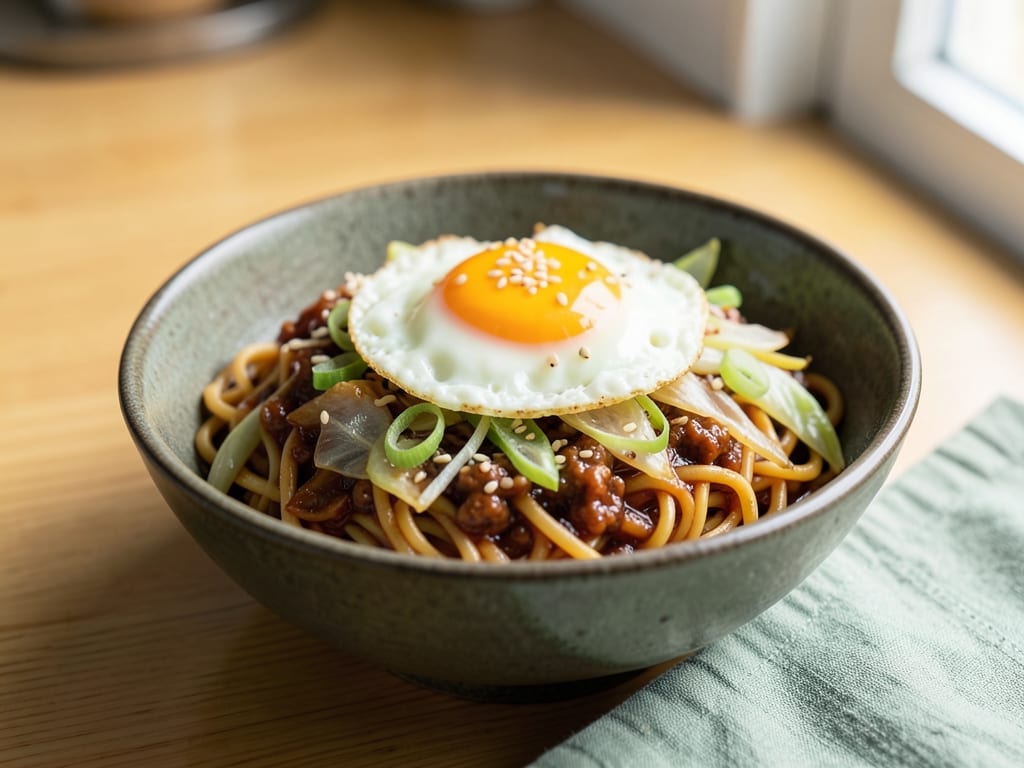
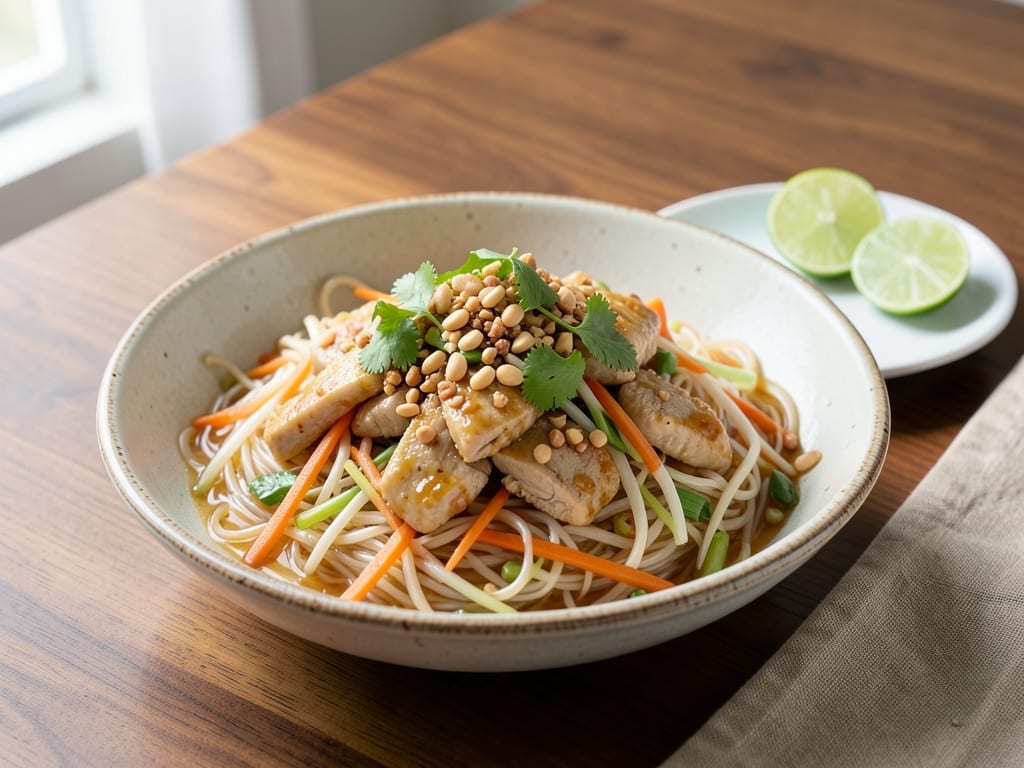
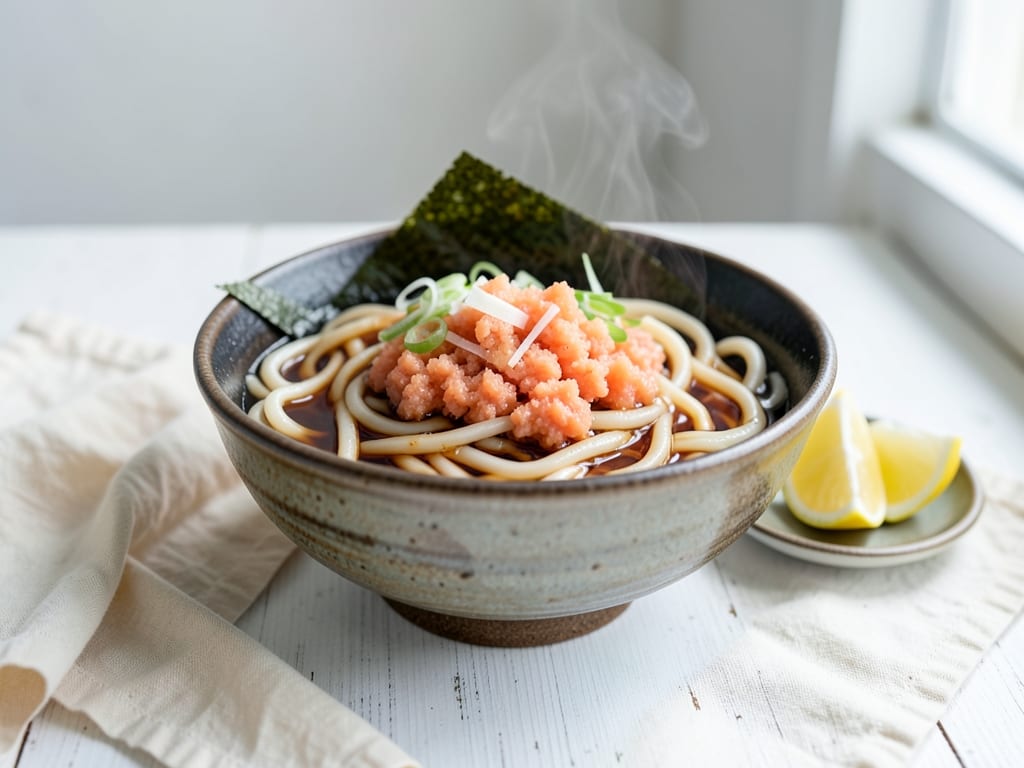
Find more like this
- Meal
- Dinner
- Cuisine
- Korean
- Diet
- Dairy-FreeHalal
- Method
- Stovetop