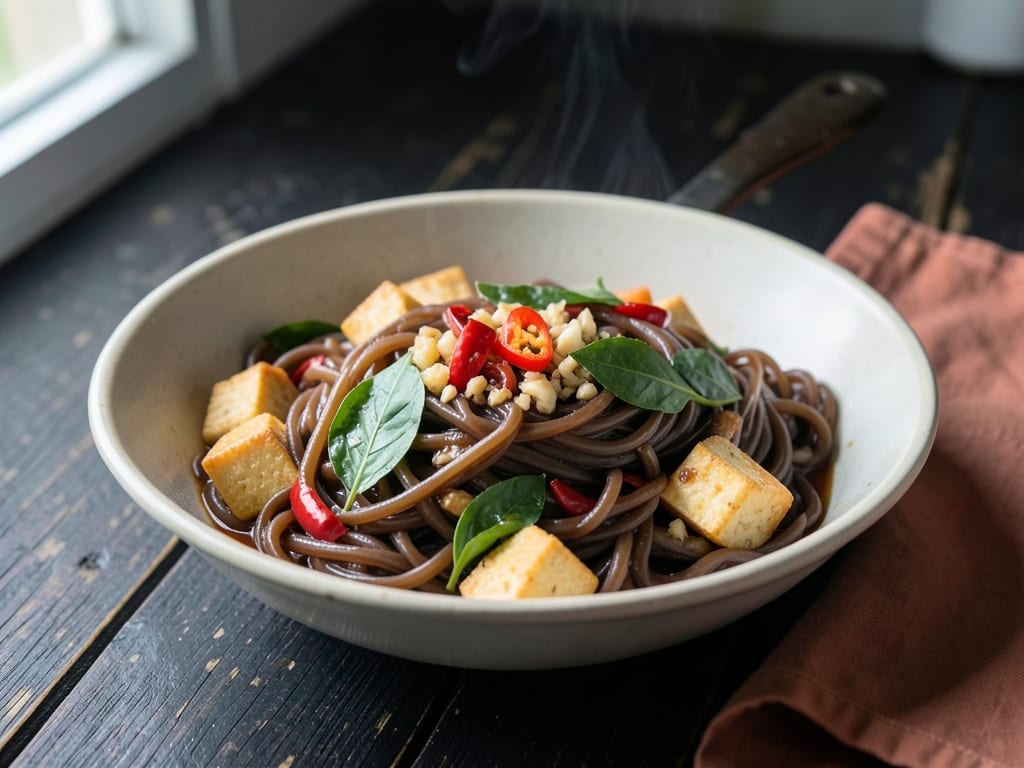
Pad Kee Mao with Tofu (Thai Drunken Noodles)
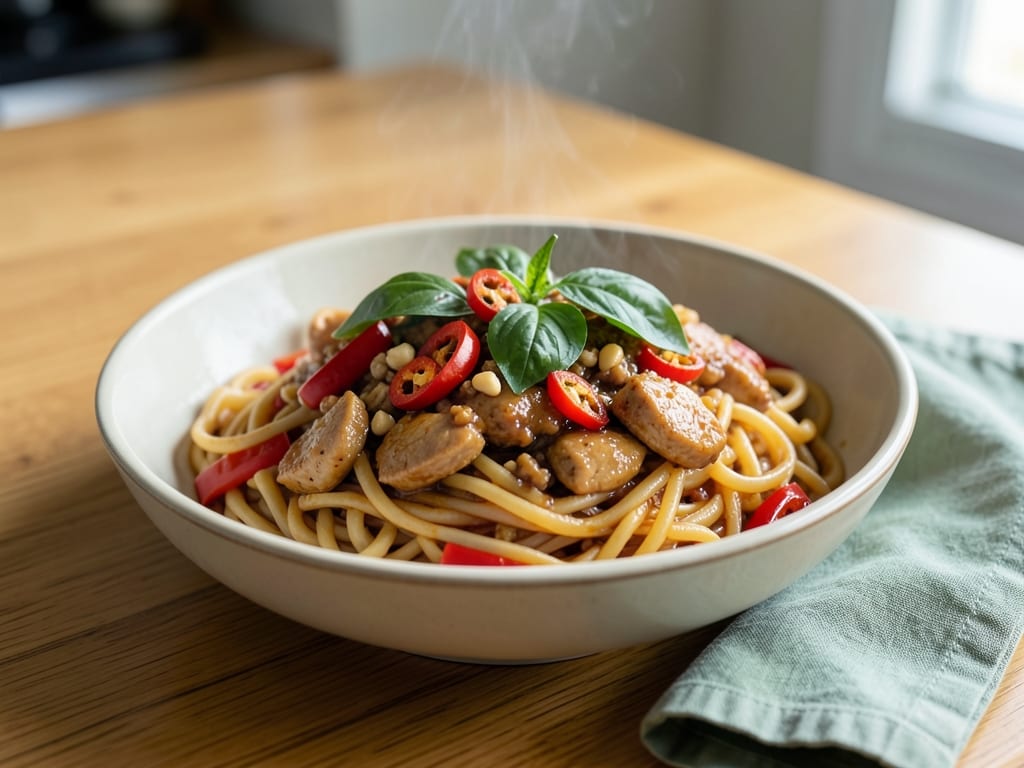
Chewy wide rice noodles tossed in a hot wok with crisp golden tofu, fiery bird's eye chilies, plenty of garlic and peppery holy basil, all coated in a glossy savory-sweet sauce. Ready in about 35 minutes.
- Prep
- 20 min
- Cook
- 15 min
- Wait
- 15 min
- Total
- 50 min
- Makes
- 3 generous servings (about 6 cups / 1.4 L total)
Steps
Before you start
- Press the tofu for 15 minutes while the noodles soften, so it fries up crisp instead of steaming.
- Fresh wide rice noodles (sen yai) are best; if using dried, soak them as directed in step 1 and drain very well.
- Stir-frying is fast. Have every ingredient chopped, measured and next to the stove before you turn on the heat.
- Bird's eye chilies are very hot. Start with 3 for medium heat, 5-6 for traditional heat, and wash your hands after handling them.
Soften the noodles
- Place the dried noodles in a large bowl and cover with very hot tap water (about 140°F / 60°C, not boiling).
- Soak 12-15 minutes, stirring once or twice, until the noodles are pliable and bend without snapping but still have a firm, slightly raw center.
- Drain well and toss with 1 teaspoon of the oil from the divided amount to prevent sticking.
- Do this while the tofu presses.
+ Show details− Hide details
Ready when: Noodles bend easily but still feel firm in the center; they finish cooking in the wok
Tip: Over-soaking makes noodles mushy and they will tear in the wok. Underdone is better than overdone.
Press and coat tofu
- Wrap the tofu in a clean towel, set a heavy pan or cans on top, and press for 15 minutes.
- Cut into ¾-inch (2 cm) cubes, pat dry again, then toss gently with the cornstarch in a bowl until all sides are lightly dusted.
+ Show details− Hide details
Ready when: Cubes feel dry on the surface and are evenly coated in a thin white dusting
Tip: Dry tofu is the secret to a crisp crust.
Prep sauce and aromatics
- In a small bowl, stir together the light soy sauce, dark sweet soy sauce, mushroom oyster sauce, sugar and water until the sugar dissolves.
- Crush the garlic and chilies together in a mortar into a coarse, chunky paste (or chop finely with a knife).
- Set the paste, shallot, bell pepper, gai lan, baby corn and basil in separate piles next to the stove.
+ Show details− Hide details
Ready when: Sugar fully dissolved and sauce is uniformly dark brown
Tip: Wash your hands with soap after handling the chilies, and avoid touching your eyes.
Fry the tofu
- Heat a 14-inch (35 cm) wok or large skillet over high heat until it just begins to smoke, about 2 minutes.
- Add 2 tablespoons (30 ml) of the oil and swirl to coat.
- Add the tofu in a single layer and let it sit undisturbed for 1½ minutes, then turn and fry, flipping every minute or so, for 5-6 minutes total.
- Transfer to a plate.
+ Show details− Hide details
Ready when: Tofu is golden brown and crisp on at least 3 sides and releases easily from the wok
Tip: If the tofu sticks, wait another 20-30 seconds; it releases once the crust forms. Work in two batches if your wok is smaller than 14 inches.
Bloom garlic and chili
- Return the wok to high heat, wiping out any burnt bits if needed.
- Add the remaining 2 tablespoons (30 ml) oil minus the 1 teaspoon already used on the noodles.
- Add the garlic-chili paste and shallot and stir-fry for 20-30 seconds.
+ Show details− Hide details
Ready when: Strongly fragrant, garlic just turning pale gold at the edges
Tip: Garlic burns in seconds and turns bitter. If it darkens fast, lift the wok off the heat briefly.
Cook the vegetables
- Add the gai lan stems, bell pepper and baby corn.
- Stir-fry constantly for 1½ minutes, then add the gai lan leaves and 2 tablespoons of water from the sauce bowl's measured water if the wok looks dry.
- Cook 30 seconds more until the leaves just wilt.
+ Show details− Hide details
Ready when: Vegetables are bright in color, leaves wilted, and stems crisp-tender
Add noodles and sauce
- Add the drained noodles and pour the sauce over them.
- Use a wok spatula to gently lift and fold the noodles from the bottom for 2-3 minutes, pressing them lightly against the hot wok so they pick up char, until the sauce is absorbed and the noodles are tender and chewy.
+ Show details− Hide details
Ready when: Noodles are glossy, evenly dark brown, soft and chewy with no firm center, and no puddle of sauce remains
Tip: Fold rather than stir vigorously. If noodles are still hard, splash in 1-2 tablespoons water and cook 30 seconds more.
Finish with basil
- Return the tofu to the wok and add the holy basil.
- Toss for 20-30 seconds, just until the basil wilts and smells peppery.
- Taste and add a splash of soy sauce if needed.
- Serve immediately on warm plates.
+ Show details− Hide details
Ready when: Basil is wilted but still bright green and the aroma is strong
Tip: Add basil last; long cooking turns it dark and dulls its flavor.
Good to know
Tips
- Keep the heat high and don't overcrowd the wok; cook in two batches if using a skillet smaller than 12 inches.
- Dark sweet soy sauce gives the signature color and mild sweetness. Without it, add 1 teaspoon extra sugar plus 1 teaspoon more light soy.
- Use a mortar to bruise rather than finely mince the garlic and chilies; the chunky texture is traditional and releases more flavor.
- Cooked noodles stick together as they cool, so keep stir-frying until serving.
Make ahead
"Press and cube the tofu, slice the vegetables and mix the sauce up to 1 day ahead; store separately in the refrigerator. Soak the noodles just before cooking."
Storage & reheating
"Best eaten immediately. Refrigerate leftovers in an airtight container up to 3 days. Do not freeze, as the noodles turn brittle. Reheat in a hot skillet with 1-2 tablespoons water for 2-3 minutes, tossing until steaming, or microwave covered 1½-2 minutes."
Substitutions
- holy basil leaves (or Thai basil) → Thai basil (or Italian basil in a pinch). Thai basil has a sweeter anise flavor; the dish is still delicious, just less peppery.
- Chinese broccoli (gai lan) → broccolini or broccoli florets. Cut into small pieces so they cook in the same time.
- dried wide rice noodles (about ½-inch / 1 cm wide) → fresh wide rice noodles (sen yai), 14 oz / 400 g. Separate the sheets by hand or microwave briefly to loosen; skip the soak and add straight to the wok.
- vegetarian mushroom oyster sauce → regular oyster sauce. Not vegetarian, but works equally well in the same amount.