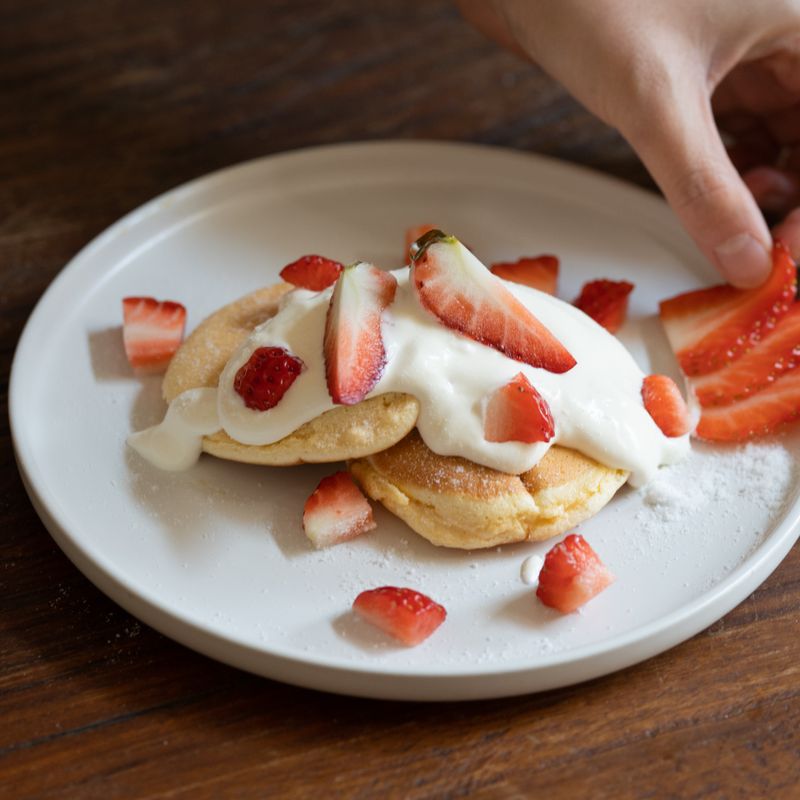
Whole Grain Spelt Strawberry Shortcake Rounds
Individual spelt flour shortcake rounds paired with fresh strawberries and whipped cream. Nutty whole grain cakes are sweetened with honey, made tender with coconut oil, and finished with a touch of vanilla. Each round is split and filled with macerated strawberries and cream for an elegant, wholesome dessert.
- Prep
- 20 min
- Cook
- 18 min
- Wait
- 45 min
- Total
- 1 hr 23 min
- Makes
- 6 shortcake rounds
Steps
Before you start
- Preheat oven to 375°F (190°C) with a rack in the middle. Line a baking sheet with parchment paper.
- Have all dry ingredients measured ahead so the batter comes together quickly.
- Macerate strawberries while cakes cool to soften them and release their juices.
- Have heavy cream cold before whipping.
Mix dry ingredients
- In a medium bowl, whisk together the spelt flour, baking powder, and salt.
- Set aside.
+ Show details− Hide details
Ready when: flour mixture is evenly combined with no lumps
Tip: Spelt flour is more delicate than wheat flour, so don't overmix the batter later—this will toughen the cakes.
Combine wet ingredients
- In a large bowl, whisk together the melted coconut oil, honey, eggs, and vanilla extract until smooth and well combined, about 1 minute.
- The mixture should be pale and slightly thick.
+ Show details− Hide details
Ready when: no streaks of egg white visible and honey is fully incorporated
Tip: Don't use hot coconut oil or it will cook the eggs; let it cool for 2–3 minutes after melting.
Fold dry into wet
- Pour the dry ingredients into the wet mixture and fold gently with a spatula until just combined.
- The batter will be thick and slightly lumpy—do not overmix.
- Stop folding as soon as you don't see streaks of flour.
+ Show details− Hide details
Ready when: flour is just barely incorporated with a few small lumps remaining
Tip: Overworking spelt batter develops gluten and produces tough, dense cakes. Fold once or twice more and stop.
Portion batter onto sheet
- Using a 2-tablespoon (30 ml) ice cream scoop or spoon, drop 6 mounds of batter onto the prepared baking sheet, spacing them about 3 inches apart.
- Use the back of a damp spoon to gently flatten each mound to about ½ inch thick and 2½ inches wide, keeping them as even as possible.
+ Show details− Hide details
Ready when: 6 cakes are evenly spaced and roughly the same thickness
Tip: Keep an ice water-soaked paper towel nearby to dampen your spoon; it prevents sticking.
Bake roundsOven 375°F / 190°C
- Bake at 375°F (190°C) for 16–18 minutes, until the cakes are golden brown on top and spring back lightly when touched on the surface.
- The centers should feel set but still tender.
- Do not overbake or they will be dry.
+ Show details− Hide details
Ready when: tops are light golden, cakes spring back when lightly touched, and a cake tester inserted in the center comes out clean or with a few moist crumbs
Tip: Spelt bakes faster than wheat flour, so watch carefully after 14 minutes. Underbaked cakes will be gummy; overbaked ones will be hard.
Cool cakes
- Transfer the baking sheet to a wire rack and let the cakes cool for 10–15 minutes until they are cool enough to handle but still warm to the touch.
- Do not let them cool completely on the sheet, or they may stick.
+ Show details− Hide details
Ready when: cakes are warm but can be picked up without burning fingers
Tip: Warm cakes are easier to peel off parchment without breaking. Once completely cool, they are more fragile.
Macerate strawberries
- While the cakes cool, place the halved strawberries in a bowl with the honey and lemon zest.
- Gently toss to coat and let sit for 20–30 minutes, stirring occasionally.
- The berries will release their juices and soften slightly, creating a natural syrup.
+ Show details− Hide details
Ready when: strawberries are juicy and surrounded by liquid syrup
Tip: If berries are very ripe, they will release more liquid—this is good for the shortcakes. Taste a berry and adjust honey if needed.
Whip cream
- In a chilled bowl, whip the cold heavy cream with the sifted confectioners' sugar and vanilla extract until stiff peaks form, about 2–3 minutes with an electric mixer on medium-high speed.
- Do not overbeat or the cream will separate into butter and whey.
+ Show details− Hide details
Ready when: cream holds stiff peaks when beaters are lifted
Tip: Use a cold bowl and cold cream; warm cream will not whip properly. If you overbeat, whip in a tablespoon of cold cream to recover it.
Split and assemble cakes
- Using a serrated knife or cake tester, gently split each cake horizontally into two halves, being careful not to crumble them.
- Place the bottom half of each cake on a serving plate.
- Spoon a dollop of whipped cream onto the bottom half, then top with a generous portion of macerated strawberries and their syrup.
- Place the cake top on the berries, then add a final dollop of whipped cream and a few strawberry halves on the upper surface.
+ Show details− Hide details
Ready when: each shortcake is fully assembled with cream and berries visible between layers and on top
Tip: Split the cakes just before serving to keep them from drying out. Use a gentle sawing motion with the serrated knife to avoid pressing down and crushing them.
Good to know
Tips
- Spelt flour tastes nutty and earthy, which pairs beautifully with fresh strawberries. If you've never baked with spelt before, know that it absorbs less water than wheat flour and bakes faster, so keep watch.
- The cakes are meant to be tender and slightly crumbly—this is characteristic of spelt shortcakes and ideal for holding the creamy, juicy filling. They are not as sturdy as a flour cake.
- For a dairy-free version, use coconut cream (the thick part from a can of full-fat coconut milk) whipped with a touch of maple syrup instead of the heavy cream and confectioners' sugar.
- Maceration is key: the honey and lemon zest soften the berries and create a natural syrup that seeps into the cake layers, keeping them moist without being soggy if eaten fresh.
Make ahead
The unfrosted cakes can be baked up to 1 day ahead, wrapped in parchment and stored in an airtight container at room temperature. The strawberries can be macerated up to 4 hours ahead and refrigerated. Whip the cream just before serving. Assemble the shortcakes within 30 minutes of serving so they don't absorb too much moisture and become soggy.
Storage & reheating
Unfrosted cakes keep at room temperature in an airtight container for up to 2 days. Do not refrigerate or freeze unfrosted cakes, as the texture will suffer. Fully assembled shortcakes should be eaten within 1 hour of assembly to prevent sogginess. Leftover components can be stored separately: cakes in an airtight container at room temp for 2 days, strawberries in the fridge for up to 2 days in their syrup, and whipped cream will not keep (make fresh).
Substitutions
- white spelt flour → whole wheat pastry flour or all-purpose flour. All-purpose flour will produce a lighter, less nutty cake. Use the same weight (240 g). Whole wheat pastry flour is closer in flavor and texture but slightly more dense.
- unrefined coconut oil → unsalted butter, melted, or mild vegetable oil. Butter adds richness and a slightly different flavor. Vegetable oil produces a more tender crumb. Use the same volume (⅓ cup / 80 ml).
- raw honey → maple syrup or agave nectar in equal measure. Maple syrup adds an earthy note; agave is more neutral. Both have slightly different sweetness levels, so taste and adjust as needed.
- fresh strawberries → raspberries, blackberries, or a mix of berries. Softer berries like raspberries will macerate more quickly and release more juice. Adjust the macerate time if using a different berry.
More cakes
See all →

Find more like this
- Meal
- Dessert
- Diet
- VegetarianHalal
- Method
- Oven