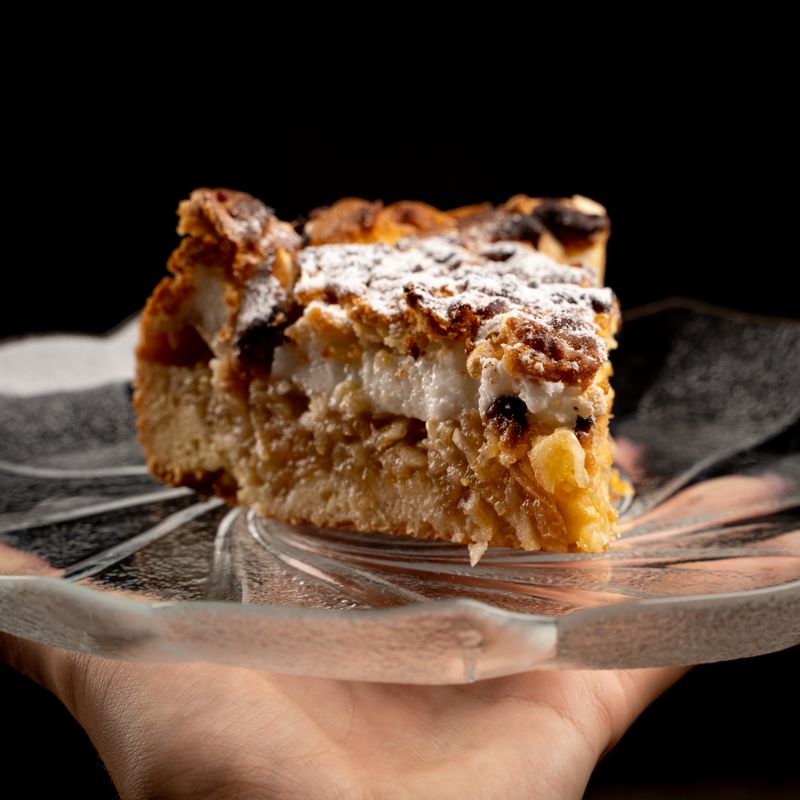
Caramel Apple Skillet Cake
A tender, buttery cake baked in a cast-iron skillet over a layer of caramelized apples and brown sugar. The apples cook down into a sweet, jammy topping that mingles with the crumb. Serve warm with whipped cream or vanilla ice cream for the ultimate comfort dessert.
- Prep
- 20 min
- Cook
- 40 min
- Wait
- 15 min
- Total
- 1 hr 15 min
- Makes
- 1 skillet cake (8 slices)
Steps
Before you start
- Preheat oven to 350°F (175°C)
- Slice apples and toss with lemon juice immediately to prevent browning
- Use a 10-inch (25 cm) cast-iron skillet; if using a different size, adjust apple and topping amounts proportionally
- Have all ingredients at room temperature for even mixing
Prepare the skillet baseOven 350°F / 175°C
- Place the 10-inch cast-iron skillet in the oven while it preheats to 350°F (175°C).
- Once hot (about 2 minutes), carefully remove the skillet and add 4 tablespoons (57 g) of butter and ¾ cup (165 g) packed brown sugar.
- Return to the oven and let the butter melt and sugar dissolve for 1 minute, then carefully remove and tilt the skillet to coat the bottom evenly.
- The mixture should be a thick paste.
+ Show details− Hide details
Ready when: Butter is melted and sugar is evenly distributed across the hot skillet bottom
Tip: Use an oven mitt—the skillet is very hot. Do not stir; just tilt to even out.
Layer the apples
- Arrange the sliced apples in concentric circles or overlapping rows over the caramel mixture, starting from the center.
- Sprinkle with 1 tablespoon (15 ml) of lemon juice and ¼ teaspoon (1.5 g) fine sea salt.
- Do not stir or compress the apples; they will cook down naturally.
- Set the skillet aside at room temperature while you prepare the batter.
+ Show details− Hide details
Ready when: Apples are neatly arranged in a single layer and evenly coated with lemon and salt
Tip: Slice all apples to a uniform thickness so they cook evenly.
Mix dry ingredients
- In a medium bowl, whisk together 1.5 cups (188 g) all-purpose flour, 1.5 teaspoons (7.5 g) baking powder, and ¼ teaspoon (1.5 g) fine sea salt.
- Set aside.
+ Show details− Hide details
Ready when: Flour mixture is uniformly combined with no lumps of baking powder
Tip: Whisk to aerate the flour and evenly distribute the leavening agent.
Cream butter and sugar
- In a large bowl, beat ½ cup (113 g) softened butter and ¾ cup (150 g) granulated sugar together using a whisk or wooden spoon for 2–3 minutes.
- The mixture should be pale, light, and fluffy.
- You can also use an electric mixer on medium speed for 1–2 minutes.
+ Show details− Hide details
Ready when: Mixture is noticeably lighter in color and has increased slightly in volume
Tip: Do not skip this step; creaming incorporates air and creates a tender crumb.
Add egg and vanilla
- Beat in 1 large egg and 1 teaspoon (5 ml) vanilla extract.
- Mix until the egg is fully incorporated and the batter looks smooth and cohesive, about 1 minute.
+ Show details− Hide details
Ready when: No streaks of egg white remain and batter is uniform
Tip: If the batter looks curdled (grainy), it will still bake fine; this is normal when using cold or cool eggs.
Combine wet and dry
- Add half the dry ingredient mixture to the wet mixture and stir gently with a wooden spoon or spatula until almost combined, about 10–15 seconds.
- Add ½ cup (120 ml) buttermilk and stir another 10–15 seconds.
- Add the remaining dry ingredients and fold together until just combined.
- Do not overmix; a few streaks of flour are fine.
- The batter will be thick and slightly lumpy.
+ Show details− Hide details
Ready when: Dry ingredients are barely visible and batter is smooth with a thick, drop-cookie consistency
Tip: Overmixing develops gluten and makes the cake tough. Stop as soon as streaks of flour disappear.
Transfer batter to skillet
- Carefully pour or spoon the batter over the apple layer in the cast-iron skillet.
- Use a spatula to gently spread it into an even layer, being careful not to displace the apples beneath.
- The batter should cover the apples completely but doesn't need to reach all the way to the edge.
+ Show details− Hide details
Ready when: Batter is spread in an even layer and apples are no longer visible
Tip: Work gently; if apples shift, do not fret—they will settle as the cake bakes.
Bake the cakeOven 350°F / 175°C
- Place the skillet in the preheated 350°F (175°C) oven and bake for 35–40 minutes.
- The cake is done when a toothpick inserted into the thickest part of the crumb (avoiding the apples) comes out with just a few moist crumbs, and the top is golden brown.
- The edges should feel firm when lightly pressed.
+ Show details− Hide details
Ready when: Top is golden brown, edges are set, and a toothpick in the crumb comes out with a few moist crumbs
Tip: If the top is browning too quickly, tent loosely with aluminum foil for the final 10 minutes.
Cool and invert
- Remove the skillet from the oven and let it cool for 10–15 minutes at room temperature.
- This resting time allows the caramel to set slightly so it won't run off when you invert.
- Run a thin knife or offset spatula around the edges to loosen the cake from the skillet.
- Place a serving plate (at least 10 inches/25 cm) over the skillet and, using both hands and an oven mitt, carefully and quickly flip the skillet and plate together.
- The cake should release onto the plate with the caramelized apples on top.
- If any apples stick to the skillet, gently loosen them with a spatula and press them back onto the cake.
+ Show details− Hide details
Ready when: Cake has released from the skillet and apples are adhered to the top
Tip: Do not skip the resting period; hot caramel will slide off. Be confident and quick with the flip—hesitation can cause the cake to break apart.
Serve
- Serve the cake warm or at room temperature.
- Cut into 8 wedges and top each portion with a dollop of whipped cream or a scoop of vanilla ice cream.
- The cake is best enjoyed the day it is made but keeps well covered.
+ Show details− Hide details
Tip: Warm the cake in a 300°F (150°C) oven for 5–8 minutes if serving the next day to refresh it.
Good to know
Tips
- Choose a mix of tart and sweet apples (Granny Smith with Honeycrisp, for example) to balance the rich caramel. Avoid mealy varieties like Red Delicious.
- The caramel layer will not be perfectly thick or uniform—that rustic quality is part of the charm. Some areas will be deeper and more caramelized than others, which is desirable.
- If you don't have buttermilk, you can make a substitute: stir 1 tablespoon (15 ml) of lemon juice or white vinegar into ½ cup (120 ml) of whole milk and let sit for 5 minutes until curdled.
- Cast iron holds and radiates heat evenly, creating a beautifully browned, crispy exterior while the interior stays tender. Do not use a regular cake pan; the results will differ significantly.
Storage & reheating
Store covered with aluminum foil or plastic wrap at room temperature for up to 2 days. Do not refrigerate, as the caramel hardens. To reheat, loosely tent the skillet or serving plate with foil and warm in a 300°F (150°C) oven for 5–8 minutes. The cake can be frozen, covered tightly in plastic wrap, for up to 1 month; thaw overnight at room temperature and reheat as directed.
Substitutions
- medium apples (Granny Smith, Honeycrisp, or a mix) → pears or a mix of apples and pears. Use firm pears (Bosc or Anjou) peeled and sliced to ¼ inch. Reduce lemon juice to ½ tablespoon (7.5 ml) as pears are less acidic. Pears will soften more than apples, so watch the bake time and check at 32 minutes.
- buttermilk, at room temperature → plain Greek yogurt thinned with 2 tablespoons milk or water. Mix together 6 tablespoons (85 g) Greek yogurt with 2 tablespoons (30 ml) milk to get 1/2 cup (120 ml) liquid. This gives a tangier, slightly denser crumb.
- granulated sugar → light brown sugar or coconut sugar. Use the same weight or volume. Brown sugar will darken the batter slightly and add deeper molasses notes. Coconut sugar may increase caramel depth.
- vanilla extract → almond extract or ½ teaspoon bourbon or rum. Use half the amount for almond extract (½ teaspoon / 2.5 ml) to avoid overpowering the apples. Bourbon or rum adds a subtle warmth without changing the texture.
More cakes
See all →

Find more like this
- Meal
- Dessert
- Main ingredient
- Apples
- Diet
- VegetarianHalal
- Quick & Easy
- Easy